Showing posts with label revolution. Show all posts

Tuesday, December 4, 2012

Protests Rattle Hurghada

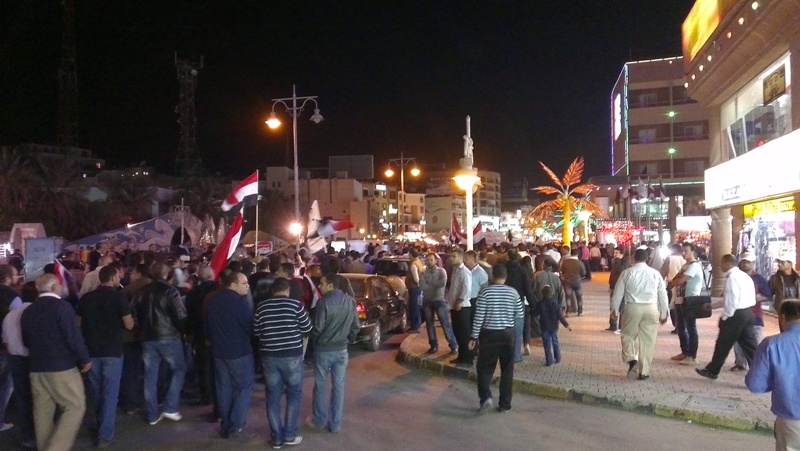
In what has not been seen since the Jan. 28th Revolution, large protests have been held around Hurghada, both pro and anti-Morsi.

While the pro-Morsi protesters took up camp in downtown Dahar of Hurghada, the anti-Morsi protesters rallied around Sheraton Street, one of the main tourist areas of Hurghada. They started in a small square in front of the Bella Vista Hotel, and spent about an hour hyping the crowd up. By this time the protest was only a few hundred strong.

After about an hour, the protesters moved down the Sheraton street. It was truly incredible to watch. To protect the protesters from the traffic and any unwanted individuals entering the flurry, the back end was sealed by a huge banner and the sides were initially sealed off by people carrying rope. The protest soon swelled however, and a human chain was created as an add-on to the rope. The protest stretched far down Sheraton as people moved down the street, diverting traffic.

Despite there being some frustrated drivers, most who passed through honked in support of the protesters walking through the street. While the protests here don't compare at all to those witnessed in Cairo, we have not seen protests like this since one or two days during the January Revolution. It's an indication of just how serious the situation at the moment really is.

Alongside chanting "The people demand the fall of the regime," protesters had a few colourful chants. From comparing Morsi to Mubarak, and calling them both liars, "Morsi is a failure" was also chanted. Find below photos from Hurghada's anti-Morsi rally today, along with some videos. Men and women, veiled and unveiled, and even children partook in Hurghada's rally tonight.

A young boy riles up the crowd


**All photos copyright Susan Richards-Benson. Please contact me for high-res photos**

Youtube Videos:


Wednesday, November 23, 2011

Ongoing unrest in Egypt

I have intentionally stayed quiet on this topic for a few days now for a few reasons. One being that I'm not in Cairo this time around, so I only have what I'm seeing on the media to go by and the last Revolution at least taught us that the media is only showing about 10 percent of what's really going on.

One thing I would like to highlight is that although through the media it looks as though the entire fabric of Egypt is collapsing again, this is not the case. In Hurghada we are very much isolated from what is going on, and were anyone to ask me "is it safe to come to the Red Sea at the moment," my answer would immediately be yes. We are already starting to see the repercussions of the unrest in Cairo, with the Egyptian pound weakening and the markets already closing early on Wednesday. Of course the primary objective at the moment is to restore peace and stability to the country, and my heart goes out to those in Tahrir fighting for their freedom. But I cannot let myself get caught up in the fervor and make it out that the entire country is on the verge of breaking down. As K said to me yesterday, were it not for the news and the internet we really wouldn't have any idea of what was going on in the rest of the country from here in Hurghada.

I said this yesterday, and I will repeat it again here. As we are all watching the scenes in Cairo and throughout the rest of Egypt unfold, I would like to take this time to remind everyone that aggression and hostility will not help anyone. The continuing tensions are undoubtedly causing cracks in the surface. We must remember to be patient when listening to others, when dealing with others in the streets. We must remember the fundamental cores of democracy that the people in Tahrir are fighting for. The right to freedom of expression, the right to live securely. If we can all remember these little facets of what the original revolution was meant to be about, together we can hope to keep the fabric of Egyptian society strong.


My thoughts are with my friends in Tahrir, and with those I hold dear in Cairo. Please let us at least remember some of the lessons we were taught in the last revolution: spreading discord and rumours will only come to bite us in the long run. Check before you're posting anything, and be patient with those around you. Remember that as expats, no matter how much we feel that Egypt is our home, this is an Egyptian fight. The best role that we can play at the moment is to stand back, show our support, help with supplies when necessary, and avoid falling into the trap of believing everything that we read. 

Sunday, November 6, 2011

Egypt's media needs a revolution

Brilliant article providing insight into how media in Egypt is run. Posted by The Guardian's Austin Mackell, read on.

As Egypt's deeply flawed parliamentary elections approach and the revolution struggles to maintain momentum, the battle over the media – and TV in particular – is of great importance. In a country with an illiteracy rate of 40%, television is the main and most trusted source of news. This is not lost on Egypt's activists, who are busy looking for ways to reach those outside the informed and critical Twitter/Facebook circles that have been the central means of spreading dissent so far.
Alaa Abd El Fatah, the prominent blogger who is currently imprisoned, was among a group of activists hoping to set up a nonprofit broadcaster in Egypt. Such a channel would still be vulnerable to direct military intervention (troops have entered TV studios on at least three occasions, and in the case of al-Jazeera Mubasher they seized equipment and forced the channel off air). It would, however, prevent the military rulers and other establishment figures leaning on a single owner or group of owners to control the channel's coverage.
That practice – in some ways more insidious than outright censorship – is said to be rife. The activists are not alone in making this accusation; prominent journalist Yosri Foda recently cancelled his show Akher Kallam("The Last Word") saying that if he couldn't tell the truth, he would say nothing at all. Unfortunately, such journalistic integrity is far from universal in the Egyptian media. More common is what Foda described as "cheap and propaganda-style journalism". The most extreme form of this is to be found in the government media which have made themselves accomplices in state terror.
It is hard to imagine a more perfect example of media malpractice than the events of 9 October. Unarmed protesters were being shot and crushed to death under army vehicles, literally within spitting distance from the famousMaspero building, where state media is headquartered.
Meanwhile, inside, state TV anchor Rasha Magdy was reporting the opposite: armed "Christians" had attacked soldiers, killing three, she said. She went on to call for "honourable citizens" to come to the streets and defend the army – directly inciting sectarian violence.
State TV's malpractices, including showing tranquil shots of the Nile during the January uprising while massive protests filled Tahrir Square just a few blocks away, and coverage of the 6 October holiday celebrating Egypt's "victory" in the 1973 war with Israel can border on the absurd – though in reality they are no laughing matter.
A former state TV employee told me recently how explicit commands would filter down from management to report a story a certain way, or to ignore it, or to wait for an official statement – the reading of which would be as far as coverage on that issue went. "I felt like a liar for a long time before I decided to quit," she said, adding: "We didn't actually cover Tunisia until Ben Ali fled".
Despite a protest and sit-in by some state TV employees in the months immediately after Mubarak's fall, calling for wage increases and a purge of the higher echelons, this culture of obedience has survived but with one distinct change. Before the instructions had come primarily from the ministry of information; now, they come almost exclusively from the military.
Just as worrying as these workplace practices however, was the manner in which my acquaintance got her job in the first place – through a connection she describes as her "godfather" in the organisation. This is typical of the culture inside Maspero, where networks of nepotism, rather than professional merit are what determine employment and promotion.
These networks of client-patron relations – reminiscent of ancient Rome or the modern-day mafia – are not limited to state TV, but infect every element of Egyptian bureaucracy, business and society and are the wire that holds the old order in place. Before this revolution can be complete they will all need to be challenged. The state broadcaster is a perfect place to start.

Saturday, September 10, 2011

When the many suffer the consequences of the few

Unless you have completely avoided any form of media outlet over the past 24 hours, you have probably heard what is happening in Cairo. Specifically, the dozens of protesters that stormed the Israeli Embassy (eventually swelling to their thousands), causing the evacuation of the Israeli ambassador and a handful of diplomats, and opening up a can of political worms that Egypt just might not be able to wiggle its way out of.

As per usual, there are many accounts for the causes behind what happened. They include: remnants of the former regime paying thugs to stir up violence and aggression in an already tense crowd (re-playing the popular sentiment during the revolution); frustrated protesters who, for the past few weeks have been demonstrating outside of the Israeli Embassy as a result of the attacks in Eilat, finally lost their patience and mob mentality took over; and finally, that forces outside of Egypt are stoking the Middle East fires in a political powerplay to throw the region into further chaos and potentially war. All of these theories include stories to back them up; all of them are lacking in that they do not address the underlying reason for why these attacks were allowed to happen in the first place.

AP News reports that "Egyptian police made no attempt to intervene during the day as crowds of hundreds tore down an embassy security wall with sledgehammers and their bare hands or after nightfall when about 30 protesters stormed into the Nile-side high-rise building where the embassy is located."

Further reports indicate that at least 3 Israelis were trapped inside the Embassy while protesters were storming the building, causing Egyptian special forces to rush in to save them. CBC News reports that the protesters beat one of the Israeli's, but no corroborative reports could be found.

Israel has appointed its consul for state affairs to oversee the Embassy while Israel contemplates their next move. Israeli Defence Minister Ehud Barak has allegedly been speaking with Leon Panetta, U.S. Defence Secretary, on how they will address the growing tensions in the Middle East. U.S. President Barack Obama expressed "great concern" with the situation unfolding in Cairo, assuring the Israeli Prime Minister Benjamin Netanyahu that the U.S. was acting "at all levels" to find a solution to the situation.

Ironically enough, peppered in with the media reports of Egyptians attacking the Israeli Embassy, I was pointed towards this report, from Al-Masri Al-Yawm. The report claims that Israel filed charges against a 24 year old man, David Macmill, who was arrested for stoning the Egyptian Consulate near Eilat, the location notorious for the recent incident involving Israel shooting at Egyptian police in response to an attack on a bus carrying Israeli tourists.

The charges levied against Macmill include "a maximum of four years in jail on charges of "harming the flag or symbol of a friendly country" and "attempting to cause damage with malice", according to the indictment served at Beersheba Magistrate's Court."

Can anyone else spot the irony here? The paradox of the two situations?

Egyptian protesters were virtually unhindered in their attempts to break into the Israeli Embassy. Currently politicians are sitting back discussing what we hope will be a diplomatic solution to the problem. Police seem unable to regain control over their country. Does this indicate to the rest of the world that Egypt essentially has no government at the moment?

One man, acting alone, was arrested for throwing stones at the Egyptian Consulate. One man.

Do you think that these two Egyptian protesters, proudly displaying their seizure of documents from inside the Israeli Embassy will ever see the inside of a court room?

Source. AP image. 

At this point, only time will tell. The continued aggression against Israel's Embassy in Egypt will not be left unheeded much longer. What happens then is a guess for anyone to make. Will Egypt be slapped with international sanctions? Will foreign forces enter the country under the auspices of returning the country to a state of order? Will these protests continue unhindered until it really is too late and there is no turning back from a war in the Middle East as the Telegraph would have you believe? Because let's face it; the use of any weapons of mass destruction in this volatile region will spell disastrous affects for millions of people, forced to accept the consequences of the actions of a few testosterone and aggression fueled individuals.

Or will the Egyptian youth be able to regain their revolution, with their ideals, with the hand they are being forced to play.

It's a tense time in Egypt these days.

For more reading on this situation as it unfolds, check the following:

Egyptians break into Israeli Embassy in Cairo

Egypt on alert after Israel embassy stormed in Cairo

Full scale Middle-East war is 'imminent', warns Israeli general

Over 450 injured in Egypt clashes at Israeli Embassy

Israeli PM condemns embassy attack in Egypt

Israel condemns attack on Cairo Embassy 

Monday, September 5, 2011

The Mubarak trial continues

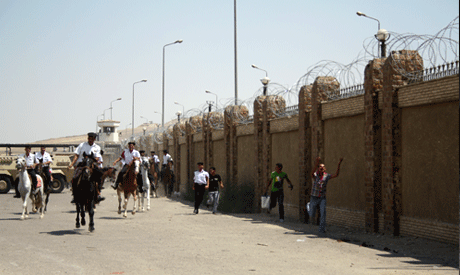
The trial of former president Hosni Mubarak continued today, with reports of clashes both outside the courthouse, and inside the courtroom. Al-Masri Al-Yawm updated at 4 p.m. that the defendant's lawyers and members of the martyr's families began throwing their shoes at each other. With cameras being banned inside the courtroom, it doesn't take a stretch of the imagination to think of what shenanigans are unfolding within.

Here is an update on the trial from Al-Ahram, on the clashes that are slowly becoming synonymous with the Mubarak's trial.

Historic Mubarak trial resumes amidst fierce clashes outside and inside courtroom 


Third session of the trial of Egypt's former dictator begins, untelevised, as his supporters throw stones at families of martyrs outside of courtroom


Photo from Al-Ahram; credit Mai Shaheen


The third session of the trial of Egypt's ousted dictator Hosni Mubarak has begun minutes ago.

This is the first session of the historic trial that would not be televised as presiding Judge Ahmed Refaat had decided at the end of last round to ban TV broadcasting.

Clashes errupted inside courtroom between the defendants' and victims' lawyers, resulting in six injuries.

A confirmation about the clashes came from a lawyer representing the families of the victims, Gamal Eid of the Arabic Network for Human Rights Information. Eid, who is Tweeting from inside the courtroom, added that the clashes disrupted the session, forcing the presiding judge, Ahmed Refaat , to recess the session after lawyers yelled at him.

News reporters confirmed that all defendants - Mubarak, his two sons, his former minister of interior and six of his top aides - have all appeared in Court.

Mubrak was wheeled in on a stretcher as he did in the previous two sessions. However, his two sons, Alaa and Gamal, entered the courtroom in handcuffs for the very first time during the trial.

Earlier this morning, scuffles have broken out between protesters and police officers outside courtroom, as the 3-judge panel prepares to hear from police witnesses who were in the headquarters control room during the crackdown on pro-democracy demonstrators during the January uprising against the former dictator.

Our Ahram Online reporter on the scene says that clashes began when some families of the martyrs were infuriated that police prevented them from entering the court room while allowing relatives of accused police officers to do so.

Police pushed back martyrs families and their supporters and things quieted down for a few moments.

However, our Ahram Online reporter adds, tens of Mubarak's supporters began throwing stones at families of martyrs and journalists.

At this point, all hell broke loose.

Families of the martyrs and their allies, who number around 100, picked up stones and started to throw back at Mubarak supporters.

Security forces and Mubarak supporters responded and scuffles escalated.

In the melee that ensued, at least 3 protesters and one police officer were injured.

Eye witnesses say more police were deployed this time compared to the last two sessions of the trial.

The third session of the trial of Mubarak, his two sons and his former minister of interior will feature for the first time testimonies of witnesses on charges that Mubarak used snipers to kill protesters during the January uprising against his 30 year rule.

Mubarak is standing trial with his two sons, Alaa and Gamal, as well as Habib al-Adli, a former interior minister, and six senior police officers on charges of corruption and killing peaceful protesters .
Lawyers have been looking forward to this session that will include the testimony of four significant witnesses. Among these is a very important general, Hussein Moussa, who is the former head of operations in the Central Security Forces who were on the frontline during the crackdown.

According to lawyer Gamal Eid, head of the Arabic Network for Human Rights Information,, Moussa is especially important as he was “formally accused of erasing all information and recorded phone calls from the official records”.

Ten Kuwaiti lawyers were expected to join the defence team for Mubarak on Monday, but no one has shown up in court yet.

Some of the lawyers said their role comes as a gesture of gratitude to Mubarak for his support for a US-led coalition that expelled Iraq from Kuwait in 1991.

Thursday, July 28, 2011

Diary of a Traveller, part 1

I'm currently sat in Cairo International Airport waiting for my flight to Amsterdam. Usually when I'm flying out of Cairo, I'll take the bus from Hurghada and then make my way to the airport. After my last trip on the bus, which was disastrous to say the least, I vowed that I would never again be sat on that bus.

This morning, I flew from Hurghada. The flight is so short, you literally take off, finish your beverage, and are told to re-fasten your seatbelts. AWESOME. I love short flights, especially when the alternative is a 5 hour (minimum) ride in a bumpy, smelly, sweaty, often times roller coaster take your life in your hands bus ride.

Flying over Hurghada allowed me to take some fantastic pictures. It reminds me every day of how lucky I am to be able to wake up living here, despite its ups and downs. When you live by this, you have to count your blessings.


Birds eye view of Hurghada's coastline

Travelling to me has always been an adventure. I am constantly reminded of the incredibly true sentiments expressed in the film "Fight Club," of the single serving friends. The single serving drinks. The single serving meals. I'm currently enjoying my single serving pizza slice, with my single serving coffee. I have met many single serving friends travelling; sitting in the airport I wonder where in the world they are today.

I think one thing that "Fight Club" film failed to portray in their narrative on airports and travel was the advantage of such 'single serving' experiences. I love the emotional atmosphere in an airport. Name me one other place in the world that you can relish in people watching in such extreme states. Joy at being reunited with a family; fatigue following many long hours of flight only to head into yet another business meeting; tears for those departing their loved ones; and the oh so familiar human sprint for people rushing to their gates before it closes, having almost missed their flights. Or one of my personal favourites: People with carry on luggage that is evidently far too large, yet are convinced with their continued thrusting, jostling, pushing and squeezing that they will morph their bag into a shape that will miraculously fit the overhead bins.

Two things to always remember when travelling - aside the obvious passport and ticket :p - a good book and some good music. I have flown many times in the past few years without the addition of a laptop that runs on batteries, let alone one with wifi access. Today, I am spoiled :D.

My trusty literature companion today is fitting in many ways.


So far so good, I'm enjoying the erratic writing style, and the familiarity that the author creates with the reader.

Today also marks the first time that I have come through the airport since the Jan 25th Revolution. One thing that struck me were the inspirational posters that are hung up throughout the airport. There were three hanging over baggage claim in the Domestic arrivals. I have yet to see any in the International Terminal. If I do I will be sure to snap some shots. 

Also surprising is the lack of Army or Security in general in the airports. I flew from Hurghada without having my passport checked once; thankfully I really am who I say I am, but that makes me nervous for the security situation in this country. I could have literally been anyone using my ticket! Also here in Cairo Airport is a lack of security. One thing not lacking though are the flocks of people evidently heading to Saudi Arabia for a mini-hajj pilgrimage before the beginning of Ramadan. Women dressed in long flowing white robes and hijabs are everywhere; fortunately I do not yet have to brave the crowd as I have a bit of a layover.


Oh, and for those who are wondering about the system of corruption in Egypt: The very long queues make for prime pickings for those looking for a weary traveller to extort. I was approached by someone who enthusiastically took my bags, assuring me he "knew the line to get in to." He takes me to the second baggage control point, and tells me "the policeman there will take baksheesh (tips) for you to have no line." Erm...how much baksheesh? "Well, he's boliceman (spelling intended), so nice baksheesh." I politely took my bags back, and went to sit in the cafe. Nice to see some things never change though :)

PS - word to the wise for Cairo airport employees. The free bus shuttle service from one terminal to the next is great. But please instruct your bus drivers to announce where they are stopping. I almost got off in the wrong place THREE times, having been assured that the bus goes directly to Terminal 1. I suppose in some ways I did have to be reminded I was in Cairo, and lucky not to have taken the bus. Rather than the 5 hours in a dank and smelly bus, I had 10 minutes in the crowded, leap while still moving, airport shuttle bus.

Now off to continue the rest of my adventures. In the meantime, feast your eyes on some of these beautiful pictures.

Red Sea morning!

Who said Cairo was in the desert? LIES! ;)


Fertile Nile Valley

Another sign in the airport :)

Wednesday, May 4, 2011

What can Britons learn from the Egyptian Revolution?


Budget cuts in Britain are a hot topic of discussion in light of the past few years of economic distress in many Western nations. Countries are doing everything they can to cut back on government spending and programs in an attempt to revive a fledging global economy. New powerhouses are coming onto the scene, with countries such as China flexing their economic weight in the world, and seizing this opportunity to spread their arms of investment far and wide.

I was listening to the BBC Radio 2 a while back, and their main focus of discussion were the proposed cut back to the country’s police force. It is estimated that over 25,000 officers will be pulled off the streets in the next four years.  Source

Of course this has tongues wagging for many people in the United Kingdom. What will this mean for their personal safety? What will this mean for the security of the country as a whole?

To compensate for the expected police drawdown, citizens in the U.K. are beefing up their own security. One of the radio listeners phoned in to explain his extensive CCTV system that he has had installed. He claimed that it was in part responsible for discouraging local youth in his neighbourhood from vandalizing on his property, and overall kept him feeling safer. The only setback? The cost of implementing this connected network of CCTV can total in the thousands of pounds for reliable protection. Source.

CCTV cameras are already up and running in London, so to see just how effective the installation of CCTVs would be in your home, let’s take a look at the crime statistics in London for the past few years. Ideally, you’d notice a decrease in the level of crime occurring if the CCTV network was deterring criminals from carrying out their crimes. According to some studies, CCTV has effectively helped to reduce crimes of burglary and theft by upwards of 50 %, but has done little to the rate of violent crimes. Source.

So here’s my question, is it really necessary to spend thousands of your hard earned money to install cameras and other security systems around your house? My immediate answer would be yes, but having seen something else with my own eyes, I will argue that “no, it is not.”

During the Egyptian revolution, police presence was entirely withdrawn from the streets. Criminals took this opportunity to run rampant throughout the city, looting stores and breaking into apartment buildings.

Army tank on the main road running along Maadi's outskirts
I was in Maadi, a suburb in Cairo. Maadi is an intricate layout of closed and small streets that from a bird’s eye view appear to follow the design of the English flag (Not coincidentally might I add). Maadi is unique in that there are only three main entrances into the suburb from Cairo itself. Army personnel set up check points and road blocks at these main entrances. But once inside, there was limited Army presence outside of the police stations in Maadi. Essentially, it should have become a lawless jungle.

What happened instead was an inspiring look at the power of neighbours banding together to protect their neighbourhood. Men and sons from individual buildings, apartments, and villas in Maadi went down to the street, forming impromptu "neighbourhood watch groups" to protect their assets. 

Rumours surfaced that criminals were driving around in pick-up trucks, firing randomly throughout neighbourhoods in Maadi (and throughout the rest of Cairo). The neighbourhood watch groups responded by setting up road blocks throughout the densely intertwined streets in the suburb. As the Army was not as obvious a presence as in many other areas of Cairo, Maadi became a city unto itself. 

Because it is a fairly small suburb, most people recognise each other in Maadi. This made it easier for the road blocks, recognising a familiar face, and you would be allowed through. The road blocks themselves were inspired; some grabbed police "huts" to block the road, I even saw a bathtub roadblock. 

Yes. That is actually a bath.

Over-turned police hut becomes an impromptu road block


Alongside the roadblocks, local residents took to wearing Seoudi market bags tied around their arms as indicators that they were from Maadi. An ingenious method of distinguishing "Maadi-ites;" Seoudi market is a notorious supermarket in Maadi, and their white and green bags very easily recognisable. 

Seoudi bag in the front of the car to distinguish
us as Maadi residents
When Karim and I were driving through Maadi, we would have to place this Seoudi bag by the windshield, so that going through checkpoints we'd be immediately spotted as locals. When Karim was out patrolling, he also wore these bags tied around his arm. Alongside their impromptu weapons (sticks, kitchen knives, and anything else that could become a potential weapon), men in Maadi headed out to stand guard under their homes, and man the road-blocks that were found on virtually every street corner. It was an incredible, and very amusing, spectacle to behold. 

So what is the point behind this? What can Britons learn from the Egyptian experience? 

Simply, get to know your neighbours, get to know your neighbourhood. Your neighbourhood is only as safe as you allow it to be. Even without any police presence whatsoever, it is possible to look out for one another. All it requires is going back to the fundamental belief that inside, we are all the same, and we all want to see our homes, families, and possessions stay safe. 


Tuesday, April 19, 2011

Rising harassment in Egypt

I read an article in Al-Masri al-Yawm today that discusses the increased incidents of harassment during the Egyptian Revolution. In the article it documents incidents of alleged harassment, ranging from inappropriate touching, to cat calls, to indecent exposure. Let it be said, that I do not think 'cat calls' should count as harassment, as if that's the case imagine what percentage of men in the West have harassed women. 

The indecent exposure and groping however, is just sad. People taking advantage of a situation that they should not be able to take advantage of. 

For women living in Cairo, or Egypt in general, the Web site mentioned below is one to bookmark. It frequently posts updates from women throughout the city on harassment, including taxi drivers who have inappropriately approached women, etc. 

In addition, ladies out on the streets take your safety into consideration at ALL times. A few simple rules can help reduce your chances of experiencing harassment on the streets. These include: 

  1. Do not make eye contact with men in the streets. This is seen (particularly when it's coming from a Western woman) as an invitation by many men here. 
  2. Pepper spray is not found in Egypt. However it is easy to make. All you need is 2 tbsp of hot red pepper or habanera pepper, 1 cup of vinegar OR rubbing alcohol, and a drop of Baby oil. Mix together all three (the pepper must be ground into a fine powder), and empty into a spray bottle. When sprayed into an attacker's eyes, the spray will temporarily blind him giving you the opportunity to get away. 
  3. Carry your keys in your fist, with the jagged edges pointing out between your fingers. This way, if anyone tries to approach you, one swift hit with your fist will hurt them immensely, if not cut their face. 
  4. No matter what the cat calls, do NOT engage these men. Doing so will only aggravate them further, and may end up putting you in a potentially dangerous situation. 
  5. Always walk with your purse facing away from the road. This will help protect you from purse snatching and/or groping in an attempt to snatch your bag. 
  6. NEVER ride in the front of taxis. I have heard far too many stories of taxi drivers copping a feel from an unsuspecting girl who sat in the front seat. 
  7. If you are inappropriate touched, report it to the police. Although many people believe that the police will do nothing, one of the reasons that sexual harassment in Egypt goes unpunished is because women will not report it. In Middle Eastern cultures, rape and sexual harassment is generally seen as being brought on by the woman herself. As such, the shame women feel often prevents them from ever pursuing any justice. If you do not want to report it to the police, at least post on the website HarassMap.org
  8. Remember that you are in a Muslim country. Dress appropriately. This means no cleavage, no daisy duke shorts, no skimpy outfits, etc. Dress the part, and you'll find your experiences in Egypt are much less stressful. 

These few simple tips can make a world of difference in avoiding harassment in the streets in Cairo. Even here in Hurghada harassment is up, despite the return of tourists to the town. Men here are simply capable of getting away with more, and accordingly push the boundaries further. Remember that you have the power to help prevent harassment. 

And without further ado, here is the article from Al-Masri al-Yawm. 


Photographed by other


Statistics gathered by an organization dedicated to decreasing sexual harassment in Egypt showed an increase in harassment during the revolution.

Egypt experienced a weak security presence during the 25 January revolution, which has since gradually reversed.

HarassMap is an organization and website created by female activists to shed light on dangers of harassment. The website, HarassMap.org, compiles complaints from women and girls via SMS or the internet, creating an online map of harassment cases.

The map showed Cairo had the biggest number of cases, followed by Alexandria and Upper Egypt.

In downtown Cairo, Maadi and along the corniche, the map compiled 39 incidents of harassment by touching.

Other cases included 20 cat calls, 22 incidents of ogling and nine cases of indecent exposure, in addition to other incidents.

Thursday, April 14, 2011

Please don't forget the horses!


Let me post again another follow-up to the feeding posts I've been doing for ESMA. This one however, is so much more important than previous postings in light of the announcement made yesterday by The Brooke animal sanctuary.

According to The Brooke's statement, "The Egyptian Ministry of Tourism has announced tourists are returning to Egypt and the industry is slowly recovering. Animal owners are therefore able to start earning an income again and the overall situation for animals has stabilised...The Brooke has assessed the situation carefully, and together with The Donkey Sanctuary and Egyptian Society for Animal Friends (ESAF) – two organisations we have been working closely with, we have agreed the current emergency programme will come to an end on 21 April."

Firstly, I would like to be directed as to where exactly the Ministry of Tourism announced that travel in Cairo was back to normal? I have only seem them promoting tourism and reporting an increase in tourism in the Red Sea areas, and the Sinai. In fact, the most recent comments that I have heard is that flights into Cairo International Airport have returned to 70 % of their pre-revolution level, whereas "Activity is expected to gradually return to normal starting in June, when expatriate Egyptians typically return for summer vacations and when Muslims often travel for pilgrimage." [Source] So according to The Brooke, tourists are returning to Cairo in such a number that the aid for the horses is no longer necessary. Yet I seem unable to find ANY source to verify this claim. I would ask that they send me their sources directly, because they are obviously so obscure that nobody else can find them. 

Having spoken to people in Cairo directly, who just this past weekend went out to a horse feed, I can attest that the struggle is far from over. The idea of this blog is not to discredit one animal rights organization or another, simply to point out that the dire situation with the horses has a long way to go before it can return to satisfactory, and more importantly, sustainable levels. 

ESMA feed, Saturday 9th April 

The Egyptian Society for Mercy to Animals have tirelessly been sending out teams of volunteers each and every weekend to distribute feed to the animals in the worst condition. Volunteers from ESMA note that "there are still hundreds of animals starving, and not enough tourists to provide business." While furthering education campaigns to help the horse owners understand the responsibility of horse ownership is of course vital, in the meantime how many of these animals have to die before these education campaigns take effect. 


There remain so many cases that are in desperate need of help

ESMA has established a routine for the weekly feed. Run out of a large garden, the horses in the worst condition are supervised while they receive their food. It is an unfortunate truth that were ESMA simply to hand out the feed to the stable owners, many of the horses would never see it. 

The horses are supervised as they receive their feed


ESMA volunteers carefully record and track each horse that is given feed to ensure that they are not fed twice. Not only do they receive feed, they are also given a check over by ESMA's dedicated team of vets, who spend all day in the sun helping out the horses. 

ESMA volunteers mark horses that have received their feed

Horses with open wounds on their back receive emergency care
Many of the horses that are seen by ESMA have open wounds or sores. When the owners were asked why the situation got so bad, their response is shocking and disturbing. The government vets, that are meant to provide services free and medical supplies at a discounted price, will overcharge their patrons. This results in most of the owners simply being unable to afford to get their horses treatment. It's a vicious cycle. 

This is a plea to remember that the situation is not over. Don't forget about these horses that are suffering and dying every day around the pyramids. The tourism industry in Cairo has not returned to a level that provides enough income for these stable owners. Please, if you can, donate to ESMA, mark it down as a donation for the horses, and do your part in helping these animals see a brighter future. For additional information on how to donate, click here. You will also find here a more detailed post on what it is that is being done to help put an end to this mass starvation of animals.

If you haven't yet, check out this post to find how just a few seconds of your time could end up making a world of difference for the neglected and abused animals in Egypt!

Saturday, April 9, 2011

Violence in Tahrir again

Well..the honeymoon is officially over. Large protests have again erupted in Tahrir square, demanding that former president Mubarak be made stand trial, the removal of Tantawi, and clearing out any of the old regime.

Photos and video have been released that show army officers joining with the protesters. According to Al-Ahram online, several sources have "claimed the officers who appeared in the videos were retirees living abroad who were seeking vengeance on Egypt’s military institutions." The Supreme Council of the Armed Forces, in their second official statement today said that there were civilians "claiming" to be military officers.

Regardless, the violence that erupted in Tahrir this morning around dawn has left at least 2 dead according to news sources, although the Egyptian Health Ministry claims only 1 dead. Many more are injured, as protesters in Tahrir were again subjected to brutal use of batons, tear gas, and bullets.

Yesterday saw one of the largest protests in recent weeks, which I think for many living here was rather surprising. Coined the "Cleansing Friday," it saw reported figures numbering in the tens of thousands flocking to Tahrir square. I would have imagined that the week following the recent vote on constitutional amendments would have prompted large protests, but it didn't. Instead many who I spoke to said that it was the "natural progression of democracy and they would not return to the streets to protest the results." So what's changed? Why are they back in the streets now?

The minimal changes that have taken place since the fall of the past regime are the underlying reason. Tantawi has long been seen as Mubarak's lapdog, even nicknamed "Mubarak's Poodle," so to demand his resignation as the natural progression of the Revolution is normal.

What will happen next is unsure. What is certain, is that many have returned to Tahrir in response to the violence exhibited this morning by Army forces. A few of my friends who were in Tahrir from the beginning have again returned, and are prepared to camp out if necessary.

Here is a good story posted by The Guardian including the viewpoints of Egyptians who were in Tahrir today.

Wednesday, April 6, 2011

So what's keeping the youth protesting?

I was sent this article by a friend of mine, which basically provides an overview on what it is that the Egyptian youth are still looking for in the post-revolutionary period. It's a series of 26 questions that they feel have yet to be addressed by the Army, which is undermining the impact of the revolution. I, however, do not agree with all the points raised herein, and will put my comments in Italics between the questions.

Let me first say, in my opinion people have come to believe that Egypt can, and should, change overnight. This is an entirely unrealistic approach, who expects from 30 years of dictatorial rule that a country will instantaneously become a democracy overnight and thereby eliminate all of the factors that kept the people suppressed for the past three decades. To successfully rebuild a country requires time, and trust. Trust is the huge factor that is absent in Egypt at the moment. While the recent elections would make it appear that an overwhelming majority of Egyptians are prepared to amend the constitution, rather than scrap it entirely, trust in the ruling regime is waning rapidly. When the Army first came onto the streets, people felt that things would improve, that the Army would readily support the will and wishes of the people. Yet as time goes by, it becomes more and more clear that many of the youth are realising that although Mubarak has gone, his regime and the elements that kept him in power for so long are still around. As such, the trust in the Army is waning. I believe that it will take an entire generational span to effectively change this country around; with the revolutionary youth implanting their beliefs in the upcoming generation, only then will we begin to see the prospect of a real civil shift within Egyptian society.

So here is the article, from The Daily News Egypt.

CAIRO: In an ironic numerical coincidence, 67 days after the January 25 outbreak of the popular revolt that toppled Egypt’s 30-year regime and its dictator ex-president Hosni Mubarak, Egyptians have returned to Tahrir Square to “save the revolution,”

For some, the connection between 67 days and the Naksa is all too poignant. In the 1967 Naksa (setback) Egypt lost a six-day war against Israel which cost it the entire Sinai Peninsula and during which Israel annexed the Gaza Strip, the West Bank, East Jerusalem and the Golan Heights.

Many who went to Tahrir on Friday were feeling, perhaps with little reasonable justification, that a similar setback is “stealing the revolution,” a phrase frequently used to describe a potential disaster scenario where after the dust settles and the euphoria of getting rid of Mubarak subsides, everything will go back to the way it was before, the only difference being in the names and faces.

While I personally do not believe that Egypt will ever return to the horror of its black pre-Jan. 25 reality, many Egyptians do, and here are 26 questions they’re asking:

1. Why aren’t Mubarak and his family in court until now? If sources are correct, Mubarak has already fled the country. Given his long-standing friendly ties with many Western nations and his deteriorating health, it is unlikely that Mubarak will ever see the inside of a court-room. A troubling fact indeed. 
2. Why is ex-interior minister Habib El-Adly still not being tried for his involvement in the killing of peaceful protesters in the early days of the revolution?
3. Why did the Prosecutor General wait over a month and a half before imposing a travel ban on the icons of the past regime, 21-year House Speaker Fathi Sorrour, National Democratic Party (NDP) and Shoura Council Speaker Safwat El-Sherif, ex-chief of presidential staff Zakaria Azmy and former housing minister Mohamed Ibrahim Soliman? Sadly, not surprising seeing as how ousting Mubarak did little to shift the power-house that allowed him to remain in power for so long.
4. Why has the National Democratic Party not been dissolved? A better question would be, why is the NDP being allowed to head up the constitutional amendments and plans for the upcoming elections in November?
5. Why are former NDP leaders still allowed to participate in the political transition to democracy, despite the clear conflict of interest? My comment remains the same as with question 3.
6. Why is the state of emergency still in place? Because Egypt remains in a state of emergency? Security in the country is dwindling on a daily basis with the crime rate skyrocketing. Would it really be prudent to remove this legislation now? In time, of course it should be lifted. When stability returns to the country. 
7. Why have governors and heads of local councils appointed by the previous regime not been replaced?
8. Why have leading figures in the Egyptian Radio and Television Union not been removed from their positions despite inciting violence against protesters and spreading disinformation during the uprising? This is sadly evidence that the old regime maintains a stronghold on power. From my own sources within the Middle East News Agency (MENA), I know that they struggled to overthrow their "corrupt" editor in chief, without success. 
9. Why is there a media blackout on the severe human rights violations committed by members of the military police against Tahrir protesters on March 9? Similarly, why are the attacks on women protesters in Tahrir square on International Women's Day not being investigated?!
10. Why is there a similar media blackout on violations by the army including the use of cattle prods, to disperse Cairo University students demanding the removal of the dean on the Faculty of Mass Communication?
11. Why has the army maintained a monopoly over all decisions, while staging an unnecessary referendum which cost the state coffers LE 200 million when, in effect, all its decisions have been unilateral?
12. Why doesn’t the constitutional decree recently announced by the army shrink the powers of the president?
13. Why is the army insisting on fast legislative elections, even though all indicators signify that they can only lead to an overwhelming majority for Islamists and ex-NDP members? Hmm...is it even remotely possible that the army does not actually WANT real democratic change in Egypt? 
14. Why is the army being secretive in its drafting of vital laws that will see the country through the transition, such as the much debated law regulating the establishment of political parties?
15. Why did the Illicit Gains Authority only just approach the EU to demand the freezing of assets by leading members of the former regime?
16. Why has the government not set a minimum wage until now? This, I believe, is an irrational goal to believe should have been fulfilled by now. The Egyptian economy is still struggling to recover, until stability returns to the financial markets, where is the extra cash to cover the new minimum wage meant to come from? 
17. Why is Cabinet attempting to intimidate workers by proposing a ban on workers’ strikes in a blatant violation of International Labor Organization standards?
18. How can we trust investigators and prosecutors that were all part of the previous state machinations?
19. Why hasn’t the ruling army council set up a special tribunal of known judges and prosecutors untainted by connections with the previous regime to probe the corruptions cases?
20. Why is the army council side-lining the young activists who sparked the revolution?
21. Why has there been no official investigation into the attack on presidential hopeful Mohamed ElBaradei on referendum day?
22. What is the fate of the hundreds of thousands of Egyptians trapped in Libya?
23. Why haven’t all political detainees been released? Yes, some detainees should be released, particularly those who were incarcerated purely for expressing their ideals that differed from those of the state. But all detainees? All at once? 
24. What is the mandate of new Interior Ministry arm — National Security —that has replaced the notorious State Security apparatus?
25. What is the Interior Ministry doing with the State Security files?
26. What is the government doing about the rising domination of the Salafi discourse threatening a bigger role of religion in politics?

Many of these questions betray a deeply engrained lack of trust between the people and authorities, which is slowly poising [poisoning] some peoples’ image of the army as a just arbitrator and protector.

However, when it comes to the constitutional decree announced Wednesday, I share the view of Amr Hamzawy, researcher at the Carnegie Endowment for International Peace, in a column in Al-Shorouk Friday, that despite a few critiques, hats off to the army for not abusing its current position by giving itself more powers in the interim phase and promising to pass on all legislative authorities to the PA as soon as it is elected.

All other changes like shrinking the president’s sweeping powers, for instance, or canceling the Shoura Council, will be in the hands of the constituent assembly charged with drafting a new constitution.

Since we have chosen the path of democracy, we must accept that democracy takes time, but that only vigilance, self-education, political awareness, persistence and transparency will guarantee that we’re on the right track.

For now we must also accept that chaos too is part of the transition and that the only way to avert descending into absolute chaos is to move the tug-of-war between the will of the people and the power of the state from the street to the dialogue table. We don’t want the million man protests to lose their impact, who knows when we’ll seriously need them again.

Rania Al Malky is the Chief Editor of Daily News Egypt.

Sunday, April 3, 2011

The Pharaoh has left the Country

According to preliminary reports on al-Jazeera, ousted President Mubarak has fled the country.


Mubarak had been staying in Sharm El-Sheikh under house arrest since he stepped down from office on February 11.Sources tell Al Jazeera that Hosni Mubarak, the former Egyptian president, has left the resort town of Sharm El-Sheikh on a flight headed to Germany, possibly for medical treatment.
However, Al Jazeera's Zeina Khodr, reporting from Cairo, said that military sources deny the story and the Egyptians are holding the military to the promise of keeping Mubarak in the country to stand trial for alleged crimes under his presidency.
Media reports earlier this month indicated that Mubarak, who is said to be suffering from cancer, was receiving medical treatment in Saudi Arabia.
And in February, German newspaper Der Spiegel reported that Mubarak's trip to Germany would be part of a long-term plan hatched by the US as an exit strategy for Mubarak.
The United States government's scenario for an end to the political chaos in Egypt appears to be this: President Hosni Mubarak travels to Germany for a "prolonged health check" that would offer the 82-year-old a dignified departure.
Mubarak was outsted by a populist revolution after 30 years of rule.

Source.

Monday, March 28, 2011

ESMA Feeding Update

I've been really busy this past week, hence the hiatus! Have much to blog about.

ESMA has continued with the campaign to feed the horses, heading to Nazlat al-Samaan around the pyramids every week to hand out feed rations for one week. 

The most recent feeding from this past weekend saw ESMA volunteers hand out feed for 504 horses, alongside feeding some of the skinniest animals. Each feeding session sees more and more horses appear that have not been to the ESMA feeds before. Donations are crucial; ESMA is doing all they can to stay afloat but already have many cats and dogs in their shelters to take care of! Watch for a blog posting in the next few days on ESMA's adoption campaigns and what you can do to help. 

Some animals had never been to the ESMA feeds before

With more animals showing up that have previously never been seen at these feeds, two things become increasingly evident. Firstly, word of the feeding campaigns and the hard work ESMA volunteers are putting into everything have spread far and wide. Secondly, there is much yet to work on and many mouths to feed. Mona Khalil, co-founder of ESMA, estimates that it could take another six months of work to see any real change take effect in the pyramids area. Tourist are still scarce; although there are some locals who have returned to riding around the pyramids, the numbers are no where near enough to sustain the stable owners and their animals. 

Some of these thin animals showed up to the feeds with saddles on their backs. Without even enough strength to hold their heads up, these poor horses are expected to cart around their owners. Once the feeding campaigns have slowed down, ESMA faces the daunting challenge to increase education for stable owners. Only through education will these owners understand how to treat their animals, and that by treating them properly they will live longer and more industrious lives. 


ESMA is still in need of volunteers to help with the feeding programs. For more information, check out their facebook page here. Don't forget if you haven't already done so...Cat Bless You has pledged 25,000 $ to ESMA if they are able to reach 25,000 fans on their facebook. Check here to see what you can do!