Showing posts with label Jan 25. Show all posts

Saturday, April 9, 2011

Violence in Tahrir again

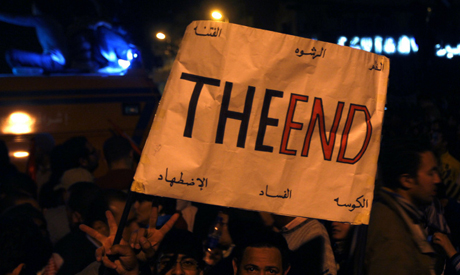
Well..the honeymoon is officially over. Large protests have again erupted in Tahrir square, demanding that former president Mubarak be made stand trial, the removal of Tantawi, and clearing out any of the old regime.

Photos and video have been released that show army officers joining with the protesters. According to Al-Ahram online, several sources have "claimed the officers who appeared in the videos were retirees living abroad who were seeking vengeance on Egypt’s military institutions." The Supreme Council of the Armed Forces, in their second official statement today said that there were civilians "claiming" to be military officers.

Regardless, the violence that erupted in Tahrir this morning around dawn has left at least 2 dead according to news sources, although the Egyptian Health Ministry claims only 1 dead. Many more are injured, as protesters in Tahrir were again subjected to brutal use of batons, tear gas, and bullets.

Yesterday saw one of the largest protests in recent weeks, which I think for many living here was rather surprising. Coined the "Cleansing Friday," it saw reported figures numbering in the tens of thousands flocking to Tahrir square. I would have imagined that the week following the recent vote on constitutional amendments would have prompted large protests, but it didn't. Instead many who I spoke to said that it was the "natural progression of democracy and they would not return to the streets to protest the results." So what's changed? Why are they back in the streets now?

The minimal changes that have taken place since the fall of the past regime are the underlying reason. Tantawi has long been seen as Mubarak's lapdog, even nicknamed "Mubarak's Poodle," so to demand his resignation as the natural progression of the Revolution is normal.

What will happen next is unsure. What is certain, is that many have returned to Tahrir in response to the violence exhibited this morning by Army forces. A few of my friends who were in Tahrir from the beginning have again returned, and are prepared to camp out if necessary.

Here is a good story posted by The Guardian including the viewpoints of Egyptians who were in Tahrir today.

Thursday, March 31, 2011

Repost: The Revolution's Honeymoon is Over


With the apparent momentum of the January 25th Revolution slowing down, April 6 youth again rally calls to march on Tahrir tomorrow, April 1st, to remind the army that their intial demands still stand. Many youth of the revolution feel that their demands have been brushed aside; corrupt members of the old regime remain key figure heads in the government. Some even claim that a "counter revolution" has been spawned within the government ranks itself in an attempt to undermine the goals achieved. 

Below is a feature analysis from al-Ahram online on the march tomorrow, what it is meant to entail, and how the youth have come to this point again.

The revolution's honeymoon is over
With the revolution losing its momentum and other forces gaining the upperhand, activists open up new avenues with which to push through their demands
Yasmine Fathi , Thursday 31 Mar 2011


“Do not give up, Do not get bored, Do not stop,” screamed the title of a motivational video on the Facebook page of the April 6 Youth Movement.

The movement, which emerged as one of the main players in the Egyptian revolution, accompanied the video with an invitation to the “Save the Revolution Friday” million man march on 1 April. The purpose of the event, they say, is to press on with the rest of the revolution’s demands, rid Egypt of the “institution of corruption” with all its figures and symbols and to challenge the counter-revolution initiated by the old regime which, they say, is playing behind the scenes to end the Egyptian revolution.
“The Egyptian people will not accept the laundering of the old regime and presenting it back to them in a new form,” wrote the group in the invitation, explaining that they insist on the complete removal of the remnants of Mubarak’s regime from every institution in the country.

No one can deny that the Egyptian revolution inspired the world. To peacefully topple a dictator like Mubarak who ruled the country with an iron fist for 30 years in just 18 days was seen as a miraculous achievement, one that stunned the whole world.

And the Egyptians basked in the praise, reminding themselves that they did the impossible. “We were even faster than the Tunisians who needed a whole month to topple their regime,” they said as they nudged each other. But it seems that while the revolution was successful at first, it has begun to burn out.

Following the fall of Mubarak, the prosecutor-general announced that Egypt’s former untouchables including Ahmed Ezz, a close confidant of Gamal Mubarak who monopolized the steel industry for years and the detested Minister of Interior Habib El-Adly, would face trial. Assets of former ministers and corrupt businessmen were frozen, the Parliament and Upper House were dissolved as was the state security apparatus and many of its officers were put on trial.

But then the situation turned sour. Many of the revolutionary demands were not met, without any satisfactory explanations from either the Armed Forces or the “revolutionary government” of Prime Minister Essam Sharaf.

Mubarak has not been put on trial. The National Democratic Party (NDP) is still alive and kicking despite the revolutionaries insisting that it has to be dissolved. The local councils and governors appointed by the old regime have not been replaced; editors of all the national papers, associated and hired by the old regime, remain in their positions; members of the old regime still dominate most workers’ unions and public companies; the emergency law has not been lifted and most political detainees remain in captivity.

The shame list does not end there. Members of the old regime, including those the April 6 movement dub the “axis of evil” – Safwat El-Sherif, Zakaria Azmy and Fathi Sorour – have neither been arrested, nor investigated.

Reports and eye witness accounts have emerged that the army detained, tortured and even performed virginity tests on protesters seized in Tahrir Square on 9 March. Many of the protesters were then put on trial in military courts and handed prison sentences.

Two weeks after Tahrir was cleared by the army, the government approved an anti-strike law banning protests, strikes and sit-ins that “damage the economy” and slamming a one year sentence and fines of up to half a million pounds on protesters. This was followed by a new political parties law, which stipulated that any new political party must have at least 5000 members across ten governorates to be registered, which means that many political parties, still under construction will not be able to recruit enough members in time for the parliamentary elections in September. This, say analysts, means that the next parliament will be dominated by those who are ready, namely the NDP and Muslim Brotherhood, who not only have the numbers but also the presence in the streets and towns of Egypt.

The starkest reminder is Tahrir Square; the symbol of the revolution is now empty save for the normal traffic after being filled with millions of protesters. All this has made people ask, has the Egyptian revolution lost steam? Did it speed like a train only to now be stuck in the same stop, unable to move?
“I don’t understand,” fumes Ahmed Bahaa El-Din Shaaban, an activist and one of the founders of the Kefaya movement “During the Sadat and Mubarak eras, political parties needed only 1000 members and now in the revolution they need 5000? In the Mubarak era you could protest and now in the revolution there is an anti-protest law? Does this make sense? The honeymoon phase is over and obviously if we want to save the revolution, we have to work hard because something sinister is going on.”

A counter- revolution, says Aida Seif El-Dawla, a human rights campaigner and political activist, is what's going on. “All this is evidence that there is a very strong counter-revolution at work here,” she says. “The old regime wants the revolution to end here, because any more changes will harm them greatly. But the revolution has not ended, not at all.”

But, she adds, the revolution is under threat, which is why many activists have put together “Popular Committees to Protect the Revolution” across the nation. Each committee is comprised of the residents from a neighbourhood and works on raising political awareness of the revolution and its goals to galvanise grassroots support. There are currently 40 committees working throughout Egypt and, says Seif El-Dawla, they are organizing a general conference for 22 April to discuss how to maintain the momentum of change.

Ahmed Ezzat, a young lawyer who coordinates 25 of those committees, says that the committee has also begun releasing a newspaper called Revolutionary Egypt, with a print run of 50,000 copies per week.

“This publication helps us raise awareness of the fact that the revolution is far from over and explain to people how the counter-revolution functions and how they are misled by the state media every day,” says Ezzat.

But it’s not just awareness that they want, says Ezzat, but also the support of the people. The idea to create this committee came to him while he was still in Tahrir Square during the revolution.

“I met people from different suburbs, cities and workers unions and thought that we need to recruit these people so that when they go back home, they can spread the message of the revolution to their families, neighbours and friends,” explains Ezzat.

In fact, it is these people who will keep the revolution alive and kicking, he says.

“Some people say that the problem with this revolution is that it doesn’t have a leader,” says Ezzat. “But for me the problem is that it doesn’t have a body, it needs support and people, lots of people to keep the pressure on.”

But, says Ezzat, it’s hard enough when the state media is telling the people to back off.

“They keep telling people that we should be patient and give the Armed Forces time and they play the stability tune,” says Ezzat. “But no, if we give them a chance, they will use it to regroup and repress us again. Besides why do they need time to put Mubarak on trial, aren’t all the corruption files there? How about the emergency law, why do they need time to lift it?”

The writer and historian Saad Zahran says that one of the problems with the Egyptian revolution is that it is not “owned by anyone.” It was not triggered by a political party, a secret organization, or pushed forward towards a specific political ideology. It was, as most Egyptians will proudly tell you, a mass uprising that did not leave out any political factions.

“This was glorified and hailed by the media,” explains Zahran. “The best thing about our revolution is that it doesn’t belong to anyone, that’s what the media sang for days. But this is not a good thing. It means that nobody prepared for it and there is no unified vision; it means that everyone right now is confused, trying to think of ways to move the country forward, which leaves the arena empty for anyone to hijack the revolution and use it to benefit their own interests.”

Indeed, while Egyptians made a show of unity to the world during the revolution, now everyone is at loggerheads about what to do next. The 19 March referendum on constitutional amendments laid these differences out in the open.

The Muslim Brotherhood, which actively participated in the protests in January, campaigned heavily for a “Yes” vote during the referendum, while the rest of the political parties and groups were against the proposed amendments. The referendum also opened up sectarian divides; many Christians hoped for a “No” vote, in opposition to Salafists and supporters of the Brotherhood.

Political scientist Emad Gad says that the military council rejected a plan presented by the country’s intellectuals to slowly ease the country towards democracy by creating a presidential council made up of two military officials and a civilian, and appoint a constituent assembly to write a new constitution before holding parliamentary and presidential elections.

“But no they insisted on holding a referendum extremely fast which they held in an undemocratic environment,” he says. “They saw the use of religion to manipulate the public to vote yes, they witnessed the Salafists terrorizing anyone who wanted to say ‘no’ and they did nothing about it.”
All this, adds Gad, coincided with a public relations campaign, aimed at scaring the public into following the council’s plans without objecting. The release of the Islamic Jihad member Aboud El-Zomour, who was convicted for the assassination of President Anwar El-Sadat, from prison and his subsequent appearances on television, the video of Sheikh Hussein Yaqoub, a famous Salafist cleric, who described the ballot boxes as “ghazwa” (a term used during the era of Prophet Mohamed to describe a battle) and calling anyone who voted “No” a kafir (infidel), were all in sync with the plans of the military council, says Gad.

“Why did they let El-Zomour say on national TV that he wants to cut people’s hands and legs off, why did the video of Yaqoub go viral on the internet?” asks Gad.

Another suspicious issue is the sudden appearances of Salafists and reports of them attacking Christians which began spreading shortly after the revolution, a big blow to the protesters who claimed that national unity was one of the main values of January 25. Last week, it was reported that Ayman Mitri, a Coptic school teacher in Qena,had his ears cut off by Salafists who accused him of running a prostitution ring. On Monday, a text message was sent to women across the country, warning them that the next day, “Salafists will hold protests in streets and squares and have said that they will kidnap any woman who is not wearing a veil,” and went on to warn women to stay home.

“This is all so suspicious. The military council has opened the door for all the Salafists and other extremists to scare the people. To make them feel that they need their protection from those crazies and to agree to the transitional plan they have.”

Shaaban is clear on what Egyptians and their revolution are now up against. “The military council and the Brotherhood are kidnapping the revolution, stealing it from under the noses of Egyptian,” says the activist. “The council was given the duty of fulfilling the demands of the revolution after Mubarak left, but there is a conflict of interest here because they were part of the Mubarak regime.”

Though worrying, according to analysts, there is no need to fret. The supporters of the revolution may have lost some battles, but the war is far from over.

Amr El-Shoubaki, a senior analyst at the Al-Ahram Center for Political and Strategic Studies, says that the battle has simply changed its form and moved from Tahrir Square to other arenas.

“People are now forming new political parties, independent syndicates, and preparing for the parliamentary and presidential elections,” says El-Shoubaki. “I believe that the next battle will be in the social and political arena rather than on the streets.”

Egyptian workers, forbidden from creating independent unions since 1952, are now organizing unions to speak in their name to demand their rights. But, says Kamal Abbas, the general co-ordinator for the Centre for Trade Union and Workers Services (CTUWS), the workers themselves are facing their own counter-revolution.

After Mubarak stepped down, workers across Egypt held strike after strike, often curtailing the production of their factories and companies.

“But when we investigated the matter, we found that they are often striking because their company is provoking them so that they can strike,” explains Abbas. “For example, you can have an electricity company who refuses to give its workers their benefits, and then tell them to go and protest in front of the ministry of electricity, why?”

The proliferation of independent unions, even among previously unsyndicated professions such as barbers and salesmen, proves to Abbas that things are changing.

“No revolution continues in the same momentum; it usually ebbs and flows,” he says. “But in my opinion it is important for workers and Egyptians in general to organize themselves, so that they can have the tools to fight the next war. And that doesn't mean that the revolution is over but that it has morphed into something different, but with the same goals.”

Last Friday, activists and political groups called for a million man march in Cairo to protest the anti-strike law, but only a few thousand turned up in front of the Radio and TV headquarters in Maspero. As several army officers monitored the protests, one protester began chanting the popular slogan during the revolution of "the people and the army are one hand." This time, however, he was booed and people screamed "not anymore." Now on Friday, it will become clear if the Egyptian revolution is still on or not. Activists are calling for millions to join in and if they do, it will be the first official face-off between the people and the army.

Wednesday, March 2, 2011

En-route to Tahrir, Tuesday morning

I've never actually made it all the way down to Tahrir since the unrest started, but yesterday was the closest I've come to the square. I have to say, seeing this at 8-30 a.m. on a Tuesday morning will definitely either bring a smile to your face, or make you wonder "wtf have I gotten myself in to!" Haha. Fortunately, this was so small I don't know if it even warrants the term protest.

So here it is, my experience of a "mini protest" in downtown Cairo.


Monday, February 21, 2011

Israel fears New Egypt


Here's a great report from Al Jazeera English, on Israel's evolving stance towards the emerging new democracy in Egypt.

Israeli media 'fears' the new Egypt
Israel's media presents Egyptian democracy as a threat, with one commentator lamenting the end of colonialism.

Israeli media changed its tone, first arguing that Hosni Mubarak's government would not fall, and later worrying about the implications for Israel [GALLO/GETTY]


Over the past three weeks the Israeli media has been extremely interested in Egypt.

During the climatic days of the unprecedented demonstrations, television news programmes spent most of their airtime covering the protests, while the daily papers dedicated half the news and opinion pages to the unfolding events.

Rather than excitement at watching history in the making, however, the dominant attitude here, particularly on television, was of anxiety-- a sense that the developments in Egypt were inimical to Israel's interests. Egypt's revolution, in other words, was bad news.

It took a while for Israel's experts on "Arab Affairs" to get a grip on what was happening. During the early days of unrest, the recurrent refrain was that "Egypt is not Tunis".

Commentators assured the public that the security apparatuses in Egypt are loyal to the regime and that consequently there was little if any chance that President Hosni Mubarak's government would fall.

Media switch

Once it became clear that this line of analysis was erroneous, most commentators followed Prime Minister Binyamin  Netanyahu's lead and criticised President Barack Obama's Administration for not supporting Mubarak. The Foreign News editor of one channel noted that: "The fact that the White House is permitting the protests is reason for worry;" while the prominent political analyst Ben Kaspit expressed his longing for President George W. Bush.

"We remember 2003 when George Bush invaded and took over Iraq with a sense of yearning", Ben Kaspit wrote. "Libya immediately changed course and allied itself with the West. Iran suspended its military nuclear program. Arafat was harnessed. Syria shook with fear. Not that the invasion of Iraq was a wise move (not at all, Iran is the real problem, not Iraq), but in the Middle East whoever does not walk around with a big bat in his hand receives the bat on his head."

Israeli commentators are equivocal on the issue of Egyptian democracy.  One columnist explained that it takes years for democratic institutions to be established and for people to internalise the practices appropriate for democracy, while Amir Hazroni from NRG went so far as to write an ode to colonialism:

"When we try to think how and why the United States and the West lost Egypt, Tunis, Yemen and perhaps other countries in the Middle East, people forget that. The original sin began right after WWII, when a wonderful form of government that protected security and peace in the Middle East (and in other parts of the Third Word) departed from this world following pressure from the United States and Soviet Union... More than sixty years have passed since the Arab states and the countries of Africa were liberated from the 'colonial yoke,' but there still isn't an Arab university, an African scientist or a Middle Eastern consumer product that has made a mark on our world."

Fear and the brotherhood

While only a few commentators are as reactionary as Hazroni, an Orientalist perspective permeated most of the discussion about Egypt, thus helping to bolster the already existing Jewish citizenry's fear of Islam. Political Islam is constantly presented and conceived as an ominous force that is antithetical to democracy.

Thus, in the eyes of Israeli analysts, the protestors- that Facebook and Twitter generation- are deserving of empathy but also extremely naïve. There is a shared sense that their fate will end up being identical to that of the Iranian intellectuals who led the protests against the Shah.

Channel Two's expert on "Arab Affairs" explained that: "The fact that you do not see the Muslim Brotherhood does not mean they are not there," and another expert warned his viewers not to "be misled by ElBaradei's Viennese spirit, behind him is the Muslim Brotherhood."

According to these pundits, the Muslim Brotherhood made a tactical decision not to distribute Islamists banners or to take an active part in leading the protests. One commentator declared that if the Muslim Brotherhood wins, then "elections are the end of the [democratic] process, not its beginning," while an anchorman for Channel Ten asked former Minister Binyamin Ben Eliezer whether "the person who says to himself: 'How wonderful, at last the state of Egypt is a democracy,' is naïve?"

The Minister responded: "Allow me even to laugh. We wanted a democracy in Iran and in Gaza. The person who talks like this is ignoring the fact that for over a decade there has been a struggle of giants between the Sunni and Shia with tons of blood spilled. The person who talks about democracy does not live in the reality we live in."

Democratic threat

Ben-Eliezer's response is telling, not least because it is well known that Israel supported the Shah regime in Iran and has not proven itself to be a particularly staunch supporter of Palestinian democracy. Democracy in the Middle East is, after all, conceived by this and prior Israeli governments as a threat to Israel's interests.
Dan Margalit, a well-known commentator, made this point clear when he explained that Israel does not disapprove of a democracy in the largest Arab country but simply privileges Israel's peace agreement with Egypt over internal Arab affairs.

Israel, one should note, is not alone in this self-serving approach; most western countries constantly lament the absence of democracy in the Arab world, while supporting the dictators and helping them remain in office. In English this kind of approach has a very clear name - it is called hypocrisy.
Neve Gordon is the author of Israel's Occupation and can be reached through his website.
The views expressed in this article are the author's own and do not necessarily reflect Al Jazeera's editorial policy.

Friday, February 18, 2011

Lets Clean up Hurghada!

Today marks one week since Mubarak stepped down. All over the country, Egyptians are out en-masse to show their spirit and pride. In Cairo, thousands, if not millions, gathered in Tahrir square in celebration.

In Hurghada, locals gathered to help clean up the streets. In what has become a week-long campaign, day one saw volunteers from all walks of life taking to the main touristic strip, Sheraton Road. I'll post a blog detailing my experiences later, but for now, I wanted to leave you with a video of what I saw today. Absolutely amazing to watch people really come together. Finally, Hurghada came out to show that we do care about making a difference!


Look the next few days for my post with details on today's clean up job, and when the next outing will be. Come on Hurghada, let's show the world that we can all make a difference, and Egypt today is a happier and brighter Egypt than anyone has ever previously seen!!!


Saturday, February 12, 2011

The Silent Victims

I have previously posted blogs about the Egyptian Society for Mercy to Animals and the great tasks that they take on in furthering animal rights in Egypt.

ESMA again has a monumental challenge facing them as the dust settles in post-revolution Egypt.

Multiple media reports have been aired about the human victims of the period of unrest in Egypt. Their sacrifice for freedom is a valiant one, which will not be forgotten lightly.

But what about the silent victims of the revolution, those who's voices have not been heard?

This is a call for help.A call to help the animals in Egypt currently suffering. Currently starving, and dying quietly as the rest of the country begins the arduous road to rebuilding itself.

With the drop in Egypt's tourism market, many stable owners living around the pyramids area have been faced with very grave decisions to make. Many of these stable owners rely on the tourism market as their primary source of income. No tourists equals no money to put bread on the table, let alone feed in a horse's or donkey's stall.

The result? Starvation.

Animals are lying dead in the street. Eyewitness reports note that horse carcasses are littering the entrance into the pyramids area. Hundreds more are struggling to survive, owners unable to feed them, left as skin and bones.

ESMA is appealing to anyone and everyone, both inside and outside of Egypt, to contribute in an attempt to put an end to this suffering. Their dedicated team of volunteers are themselves heading into the area around the pyramids to provide as much food and medical assistance to the suffering animals. Please find below the contact information for those based in Egypt. If you are outside of Egypt and want to do what you can in helping, you may message me through this blog and I will respond to you directly.

From everyone at ESMA, and all the animals, thank you for reading, and for opening your hearts.

As most of you have already heard, following the past 3 weeks of instability, we now have a very serious situation where the camels, donkeys, and horses in several areas are dying of hunger and lack of medical treatment. ESMA is raising funds through donations to feed and treat these poor animals itself, and we need all the financial help we can get! If you have not yet donated and can help out please do so, and forward this email to as many people as possible.

David Magdy, one of ESMA's active volunteers, will be in charge of collecting any donations for this cause. He can be reached by telephone on 0127844385. 

We also need physical help and not just financial! This week we will be going down to help as many of the critical cases as we possibly can in Nazlet El Seman - Haram, the stables on the ring Road, and the Giza Pyramid area, more information to come soon. We understand that lately things have been dangerous in regards to moving around the city, and we understand if you can't make it. However, things have calmed down a lot, and we need as many volunteers as possible to help with this tremendous effort! Please RSVP with me ASAP by replying to this email, or call me on 0105799777.

Horses starving in Giza

Their carcasses litter the streets :(  

What comes next?


Interesting read on the BBC. It is worth highlighting, that the times ahead in Egypt are full of uncertainty!


Viewpoint: Too early to celebrate in Egypt?


After 18 days of historic protest, Tahrir Square has finally found reason to let off fireworks and brighten Cairo's night sky.


It seems an unnecessary cruelty to cast a shadow over the massed crowd when they have secured what is certainly the most far-reaching change in the Arab world for many decades.


But this is a revolution that has stalled every time it appeared at the cusp of takeoff, and Hosni Mubarak's departure does not yet complete the victory for Egypt's democrats.


Within hours of the moment, Egypt's finance minister appeared on television to promise that "the oligarchy" would be swept away too.


But for six decades, civilian and military elites have deeply inter-penetrated.

'Mubarak's poodle'


The army has hedged its bets in masterful fashion over the last two weeks, appearing to side with protesters but remaining passive in the face of regime-sponsored violence and accepting Mubarak's desultory promises of reform until this was no longer tenable.

Mohamed Tantawi is the head of the Higher Military Council now in control


This is because the military establishment stands to suffer enormous losses, in both financial and political terms, from genuine democratic reforms.


Moreover, if a future government seeks to chart an independent policy towards Israel or Hamas, the military will be loath to jeopardise its flow of US aid.


This could prompt a Pakistan-like situation in which elected leaders are stripped of control over foreign policy.


The man now at the apex of Egypt is Defence Minister Mohamed Tantawi. He embodies the reactionary forces still embedded at the heart of a regime that may have shed its figurehead but not its essence. Field Marshal Tantawi is known by junior officers as "Mubarak's poodle".


According to Wikileaks cables, he has resolutely "opposed both economic and political reforms that he perceives as eroding central government power" - hardly such stuff as revolutions are made on.


There is every possibility that he will simply rebuild the apparatus of autocracy by dispersing superficial powers to a fractured opposition, while restoring the army to its Cold War standing.


Some optimists have invoked the "Turkish model" for Egypt, but recall that the Turkish army has toppled four governments since 1960 and still lurks just under the surface of that country's democratic institutions.

Surely, though, American pressure will push military elites, with whom they have extensive ties, along the path of reform?

President Barack Obama noted on Friday night in typically florid style that "the arc of history has finally been bent toward justice".


Perhaps, but for most of the past two weeks Washington has been chasing that arc from a safe distance. When the regime seemed to have locked in army support, the White House went silent.


What has united observers as disparate as Iran, Hezbollah, Britain and the United States is a frantic and flimsy effort to catch up with the crowd's indomitable spirit.


Just as Iran claimed the uprising as an Islamic revolution, Mr Obama clambered to put the US on the right side of change.


There is little reason to suppose that Mr Obama's lofty demands will be backed with the force of America's weight if the administration thinks that the old guard will continue to call the shots on matters of US concern.

'Strewn with traps'


Germany's Angela Merkel reacted to Mr Mubarak's ouster by demanding that "future Egyptian governments… uphold peace in the Middle East and respect the treaties concluded with Israel".


This is not unreasonable, but it indicates the low priority placed by the international community on the democratic quality of future Egyptian governments.

The protests against Mr Mubarak have been broad-based in nature


As in both Lebanon and Palestine over the past six years, democracy promotion could wither on the results of future elections.


The ill-informed alarmism about the Muslim Brotherhood that has accompanied these protests does not bode well.


Finally, even if the military hands over power to a broad-based opposition committee and steers through far-reaching reforms, the path to democracy is strewn with traps.


As the revolutionary high subsides, the social pressures that kicked off unrest will pummel an inexperienced and fragile government.


But instability has inflicted grave damage on Egypt's economy, which was already in precarious fiscal shape.


Demands to increase food subsidies will combine with extended disruption to tourism. If the government cannot pay workers and ensure social welfare, it is likely to be anti-democratic forces that are the beneficiaries of a backlash.


There is a fine line between realism and cynicism, and Egypt's would-be democrats have supplied reasons for hope.


These include the remarkably broad-based nature of the protests, to the scenes of Christians and Muslims protecting one another from police violence during prayer.


Mass mobilisation has forged new political forces in Egypt that will make themselves felt in any democratic future.


But the heat and light of revolutionary successes can obscure the scale of the challenges that must follow.


When the fireworks have stopped, Egypt's crowds must sober up if they are to redeem their promise of post-Mubarak freedom.


Shashank Joshi is an Associate Fellow at the Royal United Services Institute (RUSI), a defence think-tank, and a doctoral student of international relations at Harvard University.

Friday, February 11, 2011

Celebrations extend to Hurghada


Video I took in Hurghada, just following the resignation of former President Hosni Mubarak. Words cannot describe the emotions in the air at the moment!

Every person on the street is smiling. Everyone is electrified with the new found power in democracy and their individual voices. Hurghada, the city that previously has shown very limited action in terms of protests, is now alive with cars beeping, people swarming the streets, and celebrations all around.

Mabrouk ya Masr!


Democracy unfolds in front of your eyes

What an incredible time to be in Egypt. We are witnessing history in the making. A 30 year long regime has finally buckled at the knees under the pressure of hundreds of thousands, even millions of voices.

Mubarak has been brought down by the people! The Egyptian people are tasting the first breath of democracy! All powers have been handed over to the Army, who knows what will happen next in the rapidly changing political climate in Egypt.

All questions aside, now is a time to revel and sit back and watch the pure power of the people.

To all my friends in Egypt, Egyptians themselves and those who feel Egyptian at heart...

MABROUK. YOU HAVE DONE IT. THROUGH THE SHEER POWER OF THE PEOPLE! 

Tuesday, February 8, 2011

Iraqis call for demonstration in Baghdad's Tahrir (Liberation) square Friday, Feb. 25th


BAGHDAD / Aswat al-Iraq: A statement has been released in Iraq on Tuesday, calling on intellectuals, unemployed people, widows and orphans to join together in a broad demonstration in central Baghdad's al-Tahrir (Liberation) Square on Friday, February 25th.

Image Copyright Aswat al-Iraq
The statement, a copy of which was received by Aswat al-Iraq news agency, called on "unemployed Iraqis, intellectuals, toilers, graduates from Iraqi and international universities who became house-keepers and millions of unemployed people, widows and orphans, to head to the streets for huge demonstrations on Friday, February 25th, in central Baghdad's al-Tahrir (Liberation) Square.

The party behind the call for the demonstration called it the "Iraqi Rage Revolution," that will be launched "for change, freedom and geunuine democracy."

The demonstrators, the statement said, shall carry bannerw and slogans, including, "Haven't we kept enough silence?," "Haven't we been patient enough?," and "don't you know that we carry on our backs about 100 billion (b) dollars annually from oil, trade and tourism revenues, and we still eat onions, if available?"

"Thousands of conscious youth have been informed about the planned demonstrations through electronic messages and Facebook," the statement highlighted. 

"These messages have called on the Army and Police forces to become protectors of the Homeland and the People," the statement added.

It called on the Army and the Police to take "similar positions, like their brethren in Tunisia and Egypt, as we are not in the epoch of mobs and dreadful weapons, but the epoch of the pen and the real word, expressing the right of the poor to live decently."

Several Egyptian cities have witnessed a series of protest demonstrations against the regime of President Hosni Mubarak over the past two weeks.
Despite the deployment of Army forces in the main streets, supporters of Mubarak's regime have clashed with the demonstrators about five days ago, killing and wounding dozens of people.

Original source here.