Showing posts with label protests. Show all posts

Tuesday, December 4, 2012

Protests Rattle Hurghada

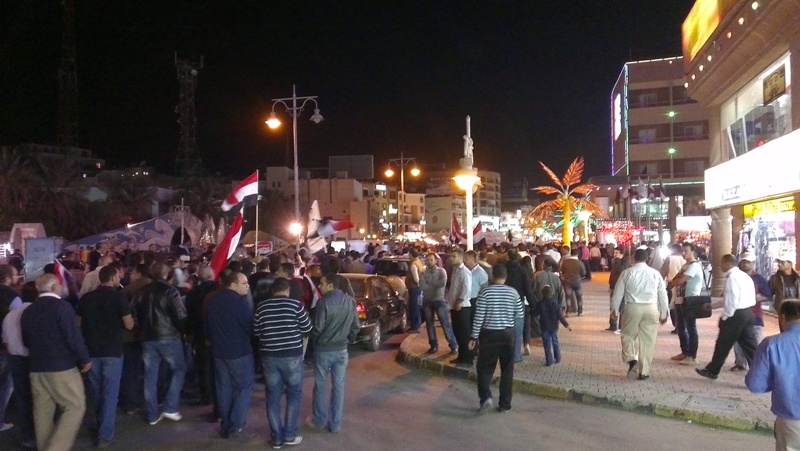
In what has not been seen since the Jan. 28th Revolution, large protests have been held around Hurghada, both pro and anti-Morsi.

While the pro-Morsi protesters took up camp in downtown Dahar of Hurghada, the anti-Morsi protesters rallied around Sheraton Street, one of the main tourist areas of Hurghada. They started in a small square in front of the Bella Vista Hotel, and spent about an hour hyping the crowd up. By this time the protest was only a few hundred strong.

After about an hour, the protesters moved down the Sheraton street. It was truly incredible to watch. To protect the protesters from the traffic and any unwanted individuals entering the flurry, the back end was sealed by a huge banner and the sides were initially sealed off by people carrying rope. The protest soon swelled however, and a human chain was created as an add-on to the rope. The protest stretched far down Sheraton as people moved down the street, diverting traffic.

Despite there being some frustrated drivers, most who passed through honked in support of the protesters walking through the street. While the protests here don't compare at all to those witnessed in Cairo, we have not seen protests like this since one or two days during the January Revolution. It's an indication of just how serious the situation at the moment really is.

Alongside chanting "The people demand the fall of the regime," protesters had a few colourful chants. From comparing Morsi to Mubarak, and calling them both liars, "Morsi is a failure" was also chanted. Find below photos from Hurghada's anti-Morsi rally today, along with some videos. Men and women, veiled and unveiled, and even children partook in Hurghada's rally tonight.

A young boy riles up the crowd


**All photos copyright Susan Richards-Benson. Please contact me for high-res photos**

Youtube Videos:


Sunday, December 4, 2011

Hurghada protests suggested boat tax

Boating and snorkelling trips are one of the hot commodities as far as tourism excursions go in the Red Sea. Hurghada is no exception. It's unlikely that you can run into anybody who has come to spend time on the sea-side resort town who will not be taking a boat trip. Diving, trips to surrounding islands, boat parties, snorkelling outings, dolphin sighting trips, the list goes on. There is no shortage in boat trips to choose from. This made recent suggestions to impose a 10 LE per person per boat tax a seemingly great way to earn some extra revenue.  

It came as a surprise to tour operators and boat owners when last week the Governor of Hurghada, newly appointed after the Revolution, announced plans to impose a 10 LE charge (just under 2 dollars) per person, per boat trip, for all companies. This included live aboards, dive trips, down to the average boat ferrying people back and forth to Giftun island. This 10 LE surcharge was in addition to the taxes and fees already paid by each company to the government, taxes that include environmental protection taxes, security taxes, marine taxes, the list goes on.

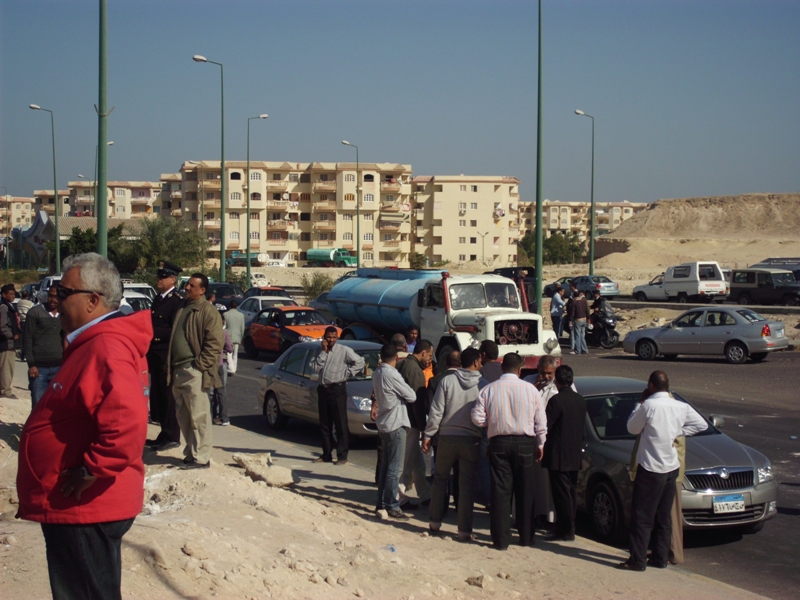
A protest was organized for today, Sunday, among tour groups, boat owners, and excursion companies. Approximately 200 protesters all gathered in front of Hurghada's Naval building, located near the Nile Hospital. Their demands were simple. At a time when tourism in Egypt is already suffering as a result of continued unrest, companies do not need additional unnecessary surcharges per client, particularly when the destination of this surcharge was not clarified.

The protesters were gathered on a well-travelled road in Hurghada, and consequently took great care to ensure they were not disrupting the normal flow of traffic. The protest was peaceful and orderly, with one 'spokesman' leading the chants with the protesters demands.

Ultimately, the end result proved successful. The governor initially promised to "look over" the proposal and see if it could be amended, but following pressure from the protesters - who promised a sit-in did the governor not comply - the governor recanted his initial statements, ensuring protesters that the tax would not be imposed.

Below are some shots from the protest, all photos copyright Karim Mubariz.

The leader of the protest, shouting out their demands 


Down on the street, protesters urged people upwards
to ensure normal flow of traffic.

Close up of the "spokesman"

Wednesday, November 23, 2011

Ongoing unrest in Egypt

I have intentionally stayed quiet on this topic for a few days now for a few reasons. One being that I'm not in Cairo this time around, so I only have what I'm seeing on the media to go by and the last Revolution at least taught us that the media is only showing about 10 percent of what's really going on.

One thing I would like to highlight is that although through the media it looks as though the entire fabric of Egypt is collapsing again, this is not the case. In Hurghada we are very much isolated from what is going on, and were anyone to ask me "is it safe to come to the Red Sea at the moment," my answer would immediately be yes. We are already starting to see the repercussions of the unrest in Cairo, with the Egyptian pound weakening and the markets already closing early on Wednesday. Of course the primary objective at the moment is to restore peace and stability to the country, and my heart goes out to those in Tahrir fighting for their freedom. But I cannot let myself get caught up in the fervor and make it out that the entire country is on the verge of breaking down. As K said to me yesterday, were it not for the news and the internet we really wouldn't have any idea of what was going on in the rest of the country from here in Hurghada.

I said this yesterday, and I will repeat it again here. As we are all watching the scenes in Cairo and throughout the rest of Egypt unfold, I would like to take this time to remind everyone that aggression and hostility will not help anyone. The continuing tensions are undoubtedly causing cracks in the surface. We must remember to be patient when listening to others, when dealing with others in the streets. We must remember the fundamental cores of democracy that the people in Tahrir are fighting for. The right to freedom of expression, the right to live securely. If we can all remember these little facets of what the original revolution was meant to be about, together we can hope to keep the fabric of Egyptian society strong.


My thoughts are with my friends in Tahrir, and with those I hold dear in Cairo. Please let us at least remember some of the lessons we were taught in the last revolution: spreading discord and rumours will only come to bite us in the long run. Check before you're posting anything, and be patient with those around you. Remember that as expats, no matter how much we feel that Egypt is our home, this is an Egyptian fight. The best role that we can play at the moment is to stand back, show our support, help with supplies when necessary, and avoid falling into the trap of believing everything that we read. 

Sunday, October 30, 2011

It all started with one small country

I realise there are quite a few people who follow on here who will not have seen me post this elsewhere. Here is my article I wrote for the International Observatory on Stability and Conflict, and I'm thrilled with the result. Check out the OISC's website for further analysis on the evolving situation of the global protests. So happy to have collaborated with them.


Last spring, the western world watched with wonder and bewilderment the people once under colonialist submission rise to defend their right to self-determination. Concepts such as one man-one vote, direct suffrage, equality for all, redistribution of wealth and freedom of the press were defended amidst blood and sweat, the very same price western peoples paid for their freedom two centuries ago. More importantly, the western world watched as unarmed, young protesters without leaders made decades-long dictatorships fall, in Egypt, Tunisia, Algeria, and more bloodily, in Libya. The once apathetic American youth received a massive electrical shock in 2008; placing all its hopes and dreams on the sole shoulders of President Obama, their activism is now focused against their own leader: corporate greed, corporate personhood, and corporate domination has to fall. The Occupy Wall Street movement has spread nationwide, is unarmed, without a leader, and is very much hoping to reclaim the American Dream. 2011 could be the year of worldwide successful revolutions; it could be the new Dawn of the People. But what are the consequences of such massive political overhaul? Is Occupy Wall Street the child of the Arab Spring, in a reverse clash of civilizations? Journalist Susan Richards-Benson, on the foreground of the new era, gives us a compelling analysis.
“One man, lighting himself on fire in protest of a continued reign of tyranny, through his actions lit a fire in the souls of people around the world”
The world today is trembling, and not just from the movements of its crust. People around the globe are unknowingly uniting together against one front: fighting the continued abuse of power that for so many years went ignored.
It all started with one small country. One man, lighting himself on fire in protest of a continued reign of tyranny, through his actions lit a fire in the souls of people around the world. What started in Tunisia quickly spread to Egypt. It wasn’t long before surrounding countries also began to feel the heat. The spirit of Revolution had been awakened.  But this time, people were not going to simply sit back quietly and accept the tirade of excuses presented by the powers that be. This time, the power of the people would triumph and their voices would be heard.
The Arab Spring sent shockwaves throughout the world. For many sitting in the comfort of their living rooms in the United States, there seemed little reason to be worried. These were countries far away with political policies that barely impacted their everyday lives. How could the United States possibly have anything to fear with the growing tides of revolution in the Middle East?
 
“Is it possible that people currently in New York really share the same grievances as the Egyptian youth staked out in Tahreer Square?”
The Occupy Wall Street movement serves as a reminder that revolutionary spirit is not limited to developing countries only. As more protesters flood the streets of New York, activists begin looking to protesters across the Atlantic for inspiration on how to best keep the momentum moving. If the revolution in Egypt proved anything, it was the power of social networking to inspire and unite. As with the Occupy Wall Street protests, media outlets initially ignored the growing tensions in both Egypt and Tunisia, leaving it to the protesters themselves to get the word out. Facebook and Twitter have proven to be monumental tools in coordinating protests, garnering support, updating on developments, and ultimately breaking through the blackout wall erected by both regimes and media outlets.
But how similar are the movements in reality? Is it possible that people currently in New York really share the same grievances as the Egyptian youth staked out in Tahreer square?
To answer this question, one must first examine what the root causes behind the protests really are. Are they simply the disgruntled and unemployed who have nothing better to do with their time? Or are they in fact the great majority of a population who have simply tired of being trodden on and suppressed by the ruling elite?
Egyptian society during the Mubarak era was highly striated; the difference between Egyptian and U.S. social hierarchies is that in Egypt, this societal structure is well known and documented. But now, due to global protests, more and more people in the U.S. are realizing that class warfare exists in their home country also. The fundamental difference between the two countries is that in Egypt, people came to accept this hierarchy as an absolute truth, whereas in the U.S. there is always hope that the “American dream” will become a reality if you work just that little bit harder, just that little bit longer.
The Egyptian revolutionary youth broke through this mentality. During the January Revolution, young and old, rich and poor, Muslims and Christians stood side by side united in their cause. Together, they toppled a regime that had kept them under lock and key for three decades. Together, through the power of the people they triumphed. Now however, Egypt is witnessing attempts to rip apart this social fabric that was so carefully woven during the Revolution. Egyptian media outlets are continuously dominated by stories of Muslims attacking Christian churches, of Christian business owners attacking their Muslim neighbors’ store front. It smacks of methods previously employed; methods which had successfully implanted in many minds of Egyptian citizens that they were not all equal and did not all deserve the same chances in life. It is an attempt to sabotage the undeniable solidarity that pushed Hosni Mubarak out of power to begin with.
Protesters in Wall Street should be watching carefully as these tactics are employed throughout Egypt. They too are facing similar tactics, with smear campaigns circulating the very social networks they used to get their message out in the first place. A picture is being painted of social activists who are merely attempting to stir up trouble, and true patriots should never question the ruling elite. It’s worked for centuries has it not? Why rock the boat now?

Tahrir Square, February 3
“They have learned a valuable lesson; one that should be translated to protesters throughout the rest of the world. In order for the power of the people to triumph, it must be united.”
To this day, many Egyptian protesters are still taking to the streets, despite the lacking media coverage to emphasize their cause. Despite attempts to stir up sectarian tensions amongst everyday citizens, Muslims and Christians together are presenting one voice, one united front: “We are the revolutionary youth. We are all Egyptians.” They have learned a valuable lesson; one that should be translated to protesters throughout the rest of the world. In order for the power of the people to triumph, it must be united. To allow attempts to divide individuals or groups, to plant the idea that one person is somehow more entitled than the next will only serve the very ruling elite people are rebelling against.
Now is the time for governments that were built for the people and by the people to listen to their citizens. To acknowledge their past mistakes. To accept that further dividing a country and its citizens will never succeed. If Egypt proved anything, it is that one voice alone cannot change anything, but a million voices united in a cause can give birth to a new country – to a new future.
As Alexander Solzhenitsyn once said “You only have power over people so long as you don’t take everything away from them. But when you’ve robbed a man of everything he’s no longer in your power – he’s free again.”

Monday, October 10, 2011

Facebook Fuels Ignorance, Hatred

An insightful look at the reactions on Facebook and other social media sites yesterday in response to the events unfolding in Cairo. Taken from Simply LeAnne, read on.


So now, let’s take it to social media – the catalyst behind the revolution. Egyptians were the first among the ‘Arab Spring’ nations to utilize social media as a platform for political change with blogger Wael Abbas accredited for its onset. As a journalist, I use Facebook for a variety of reasons – not just for personal contacts but to also monitor the banter for situations such as this. Here are a few excerpts from my newsfeed to give you a better insight as to what others on the ground in Egypt are saying as well as to highlight what happens when people take to the internet to post rhetoric without looking up any facts to substantiate their argument(s).

*Please note that all names are withheld for privacy purposes*
**Excerpts were not edited and remember, for many, English was not their first language**

“My only advice to the Egyptian army today. SHOOT TO KILL. These people are not protesters, they are barbarians and hooligans. The country and world could use a few thousand less of them.”

This person was reamed with 90 comments coming back protesting this statement. Then the same person began to justify this statement with unverified and untrue figures:

“It's a protest because of a church incident in Komombo. I don't understand why they would attack the army in Cairo! 3 army officers dead, 400 injured, 30 of which are in ICU...

This was posted around 8 pm local time, at which time reports varied with 19 deaths total, including two to six military personnel, and 150 injured. When the person was asked to support these numbers, the response was: “will find you a link one second.” I’m still waiting for that link…

Once the original poster continued to get an earful from those considering the words inhumane and insensitive, the person did the typical Egyptian move and backpeddled.

“Wow...I can't believe you took this status seriously...read the two [statuses] above it

The next two status updates to combat the initial outburst were (shortened rant):

“It is so simple to take someones sarcasm and words and process your understanding of what their beliefs are. I do not and will never encourage mass shooting by anyone, specially not the army which is OBVIOUSLY more powerful by numbers and force.

I am sorry if my status offended you, and I retract it immediately as it was sarcastic in regards to 'touchy topics'...but for future reference, don't be so quick to judge someone, and try and see both sides of a story. THE ARMY ARE PEOPLE TOO. THEY HAVE FAMILIES!!!!!

Yet, I failed to see the both sides present in the argument. Coincidentally enough, the next status all of the sudden, undoubtedly expecting to gain sympathy and forgiveness for the first uncouth rant:

“UPDATE for all the people who stood against me defending the army today...My moms car just got attacked by a group of "protesters" on her way home from work (in Tahrir).”

The next poster grew up in the UK mostly and splits time between Egypt and the UK, but is Egyptian and Muslim.

“My heart goes out to all that were shot, killed or injured today for standing up for Justice, Love 'n Unity and an END to the INJUSTICES towards the 'I'riginal Orthodox Coptic peoples of Egypt ..”

Response:

“u see first and talk smart instead of spreading western propaganda. U r not even in egypt so dont talk about Egypt”

This person continued to post against the original poster:

“u r lebanese and u r more attached to the american culture than ur own culture. And u r doing music which is not egyptian. U r more ethiopian than egyptian...

How American culture got involved when the person has never spent any time in the US is beyond me. And someone else’s response to the original post (which I will shorten since Egyptians tend to ramble):

“let's say that the Aswan villagers who really burnt da church ok ... nd sure there are many videos showin how small the burnt buildin was nd sure u can find it in utube or i can send it to u .. nd no matter how big or small is it ... no matter if da villagerz or sum ppl did it on purpose ... is burnin a buildin worth killin one human being ? but da orthdox church leaderz made a public threats thru da media nd thru utube nd i can send ya da video if u want ... the orthdox pops learderz said exactly : the governer of Aswan is a liar nd i can beat him wit my shoes nd this governer will die in 2 dayz in a bloody way nd if da leader of da military council didn't respond to our demands , he knows wut's gon happen to him ) this is wut they said.”

He failed to post the YouTube videos and/or links. See the pattern?

And to be fair, here’s a view from a Coptic Christian’s page (note when I brought this person food after the revolution, he was too busy to be present to collect the items and was instead in Tahrir Square – long before the church attacks. He sent someone to pick it up, never said thank you and only asked for more):

“the Egyptian army crushed the Christian by its tanks and cars in Masbiro in Tahrir square

Responses:

“I think the army is the victim, the protestors attacked the army. Most of the killed people are from the army.” (Not true about the majority of deaths being military)

His reply:

“Really, please see the pic in the news and the videos how the army crush the Christine, and don’t follow the Egyptian TV” (failed to provide links)

He then posted a gruesome picture which I will not add here from another friend (no source cited) saying, “the army killed more Christians every day

He continues with various statements compiled below:

“I am so confused and can't thinks my mind is paralyzed ,what is happening for the church in Egypt which is Coptic from the beginningIf you,Marshal are Traitor , God is faithful, and the gates of hell will not prevail against it.”

"the army use the same way of killing the Christian like Moubark's system" 

I’ve only taken a few pertinent examples to demonstrate the negative repercussions of the internet. Social media can be a useful tool, but just like everything else, when used by ignorant people, it can be a very negative facilitator spreading unfounded and ill-conceived rhetoric. 

A firsthand account: Marching from Shubra to deaths at Maspiro

I was sent this article by a colleague this morning which provides an eye-witness account of the ongoings in Maspiro last night. It is a tragic article, yet the message at the end is what I hope will stand out to everyone. It is time that Egypt stops trying to place the blame for internal issues on external forces. This country needs to heal from within; as long as these invisible lines of division continue to be drawn and played upon there is little hope for Egypt to ever fully rebuild itself.

Written by Sarah Carr, taken from Al-Masri Al-Yawm, here is the article. My thoughts are with everyone, both on the side of the military and civilians, who lost their lives in the brutal violence last night.

Image from Al-Masri Al-Yawm, photographed
by Mohammed Hossam Eddin


The march from the Cairo district of Shubra was huge, like the numbers on 28 January. In the front row was a group of men in long white bibs, “martyr upon demand” written on their chests. A tiny old lady walked among them, waving a large wooden cross: “God protect you my children, God protect you.”

The march started down Shubra Street around 4 pm, past its muddle of old apartment buildings, beat up and sad but still graceful compared with the constructions from the Mubarak era next to them - brutish and unfinished-looking.

A man explained why there were bigger numbers than the march last week in response to the attack on the St. George’s Church in Aswan: the army had hit a priest while violently dispersing Coptic protesters in front of the Maspiro state TV building on Wednesday. A video posted online showed a young man being brutally assaulted by army soldiers and riot police.

At a traffic underpass at the end of Shubra Street, at around 6 pm, there was the sudden sound of what sounded like gunfire. Protesters at the front told those behind to stop - the march was under attack. Rocks rained down from left and right and from the bridge, underneath which protesters were taking shelter.

Some threw stones back. Behind them, protesters chanted, “The people want the removal of the Field Commander.” The stone throwing eventually stopped sufficiently for the march to continue. A teenage boy crossed himself repeatedly as he moved forward toward the rocks.

Darkness fell just as the march reached Galaa Street. “This is our country,” protesters chanted, led by a man on a pickup truck full of speakers. An illuminated cross floated through the darkness. At the headquarters of state daily newspaper Al-Ahram, a single rock was thrown at the door, likely a comment on its coverage of violence against Copts.

Outside the Ramsis Hilton Hotel, the chanting stopped momentarily - the exuberance of having escaped the attack in Shubra faded as the march rounded the corner toward Maspiro.

It was immediately met with gunfire in the air. As protesters continued moving forwards, the gunfire continued.

Suddenly, there was a great surge of people moving back, and something strange happened. Two armored personnel carriers (APCs) began driving at frightening speed through protesters, who threw themselves out of its path. A soldier on top of each vehicle manned a gun, and spun it wildly, apparently shooting at random although the screams made it difficult to discern exactly where the sound of gunfire was coming from.

It was like some brutal perversion of the military show the armed forces put on for the 6th of October celebration three days before. The two vehicles zigzagged down the road outside Maspiro underneath the 6th of October Bridge and then back in synchronicity, the rhythm for this particular parade provided by the "tac tac tac" of never-ending gunfire, the music the screams of the protesters they drove directly at.

And then it happened: an APC mounted the island in the middle of the road, like a maddened animal on a rampage. I saw a group of people disappear, sucked underneath it. It drove over them. I wasn’t able to see what happened to them because it then started coming in my direction.

Later, as riot police fired tear gas at another small attempt at a demonstration and fires burned around Maspiro, I found on the floor part of one of the white “martyrs upon demand” bibs the men had been wearing, and took it home. It had been ripped in half.

**

The Coptic Hospital tried its best to deal with the sudden influx of casualties. Its floors were sticky with blood and there was barely room to move among the wounded, the worried and the inconsolable.

A man asked if we were press, and whether we’d like to film the morgue if we “were strong enough.”

The morgue was a harshly lit two-room building surrounded by men and women screaming and hitting themselves in paroxysms of grief. In the first room there were two bodies, middle-aged men on the floor next to the fridge, which we were told held three bodies. In the other room there were the bodies of 12 men of varying ages.

A young woman sat by one of them clasping his hand and wailing. Vivian and Michael, who were engaged to be married. Michael had been crushed, his leg destroyed. Next to Michael was the body of a man whose face was contorted into an impossible expression. A priest opened his hands and showed me the remains of the man’s skull and parts of his brain. He too had been crushed.

Outside a woman said out loud to the dead, “How lucky you are, now in heaven!” A man screamed, “We won’t be silent again.”

**

Even while the wounded were still being brought in, state TV was reporting that Christian protesters stole weapons from the army and killed soldiers, and that the busy foreign hands are back again, still trying to destabilize Egypt.

There should be a finality in death, an unchallengeable truth when it happens with the simple brutality of last night. But even when death happens on Maspiro’s doorstep, it can be rewritten, in order to lend a twisted sense where there is none, to justify the impossible and, above all, to sabotage any attempt to consider that the problem is within us, not without.

Wednesday, July 13, 2011

Egypt to fire 700 cops

This story ran today in the BBC. Having spoken to a friend of mine who has been in Tahrir this past week of new protests, the fact that the police would be fired had already circulated. Accordingly, they are not satisfied with this, and protesters still wish to see the police who were accused of killing protesters tried in a court of law. Recent rumours from Tahrir also indicate that pamphlets are being handed out by an unknown group, pushing for the formation of a presidential council in Egypt to include al-Baradei and leading Muslim Brotherhood members. I cannot imagine that the SCAF will welcome such news, as they have already made it very clear that they have no intentions of relinquishing power.

May it also be noted that critics and analysts have noted that the Egyptian elections may not even occur until 2013. With the SCAF's recent announcement that September would not actually see a vote, this date may not be far off.

Here's the story from the BBC:


Almost 700 senior police officers in Egypt are being removed from their jobs over the killing of protesters during the revolution earlier this year.
Interior Minister Mansour Essawy said 505 generals and 164 officers would end their service on 1 August.
The move comes as protests continue in Cairo's Tahrir Square, calling for the speedy trials of police officers and corrupt Mubarak-era officials.
The military also confirmed that polls set for September would be delayed.
"It has been decided to hold [parliamentary elections] in October or November," an official from Egypt's interim ruling military council told the Mena state news agency on Wednesday.
Many of Egypt's new political parties have called for the vote to be delayed so that they can compete against better organised and more powerful opposition groups, notably the Muslim Brotherhood.
On Tuesday, the military said it would draft guidelines for selecting the 100-member assembly that will write a new Egyptian constitution. That could make it more difficult for any Islamist-led legislature to choose the body and thereby give the charter an Islamist slant, analysts say.
'Biggest shakeup'
As protests in Tahrir Square entered a sixth straight day, the interior ministry - which oversees the much detested security services, known for their brutality under the Mubarak regime - unveiled what it termed the "biggest shakeup in the police force's history".
Among those dismissed were 505 major-generals, including 10 of the interior minister's top assistants, 82 colonels, and 82 brigadiers, the report said.
Egyptian state TV said that 37 of the dismissed officers face charges of killing protesters.
More than 800 protesters were killed during the 18-day revolt that led to the ousting of President Hosni Mubarak on 11 February.
The move seems to be a victory for Egypt's embattled Prime Minister Essam Sharaf, says the BBC's Jon Leyne in Cairo. An earlier announcement by him to take similar action was blocked by the interior minister.
Protesters have vowed to keep up pressure on Egypt's military rulers. They are calling for a new government, limited power for the military council, the release of civilians being tried in military tribunals, and speedy public trials for former regime officials.

Wednesday, June 29, 2011

New clashes in Tahrir

I'm waiting for more details on what happened last night in Tahrir from people who were there, but in the meantime, here's a BBC article on what is again happening in the country's capital.


Egyptian police have clashed with hundreds of anti-government protesters in Cairo's Tahrir Square, leaving several people injured.
Riot police fired tear gas to try to disperse the protesters, many of whom hurled stones at the police lines.
Tahrir Square was the epicentre of February's revolt that led to President Hosni Mubarak being toppled.
Many of the protesters were calling for the prosecution of former officials to be speeded up.
As dawn broke, stones and broken glass littered the streets around Tahrir Square. Witnesses said it was worst violence in the square for weeks.
The confrontation started on Tuesday when police cleared a sit-in outside the state TV building by families of those killed in February's uprising, activists said.
The protesters later regrouped outside the interior ministry and clashes broke out with police.
Fighting escalated and moved to Tahrir Square where lines of riot police carrying shields sealed off the main streets and dozens of security vehicles parked in side streets.
As volleys of tear gas rained down, injured demonstrators were seen lying on the ground, some dazed and bloodied.
"The people want the fall of the regime," some of the demonstrators chanted.
Ahmed Abdel Hamid, 26, who was among the protesters, said people were angry that court cases against senior officials were being delayed.
Last week, Egypt's former Trade Minister Rachid Mohamed Rachid was sentenced to five years in prison in absentia for embezzling public funds.
Earlier this month, former Egyptian Finance Minister Yussef Boutros Ghali was sentenced to 30 years in prison in absentia, also on corruption charges.
Former President Mubarak, in custody at a military hospital, is due to go on trial on 3 August alongside his sons, Alaa and Gamal.
Mr Mubarak is charged with the deaths of protesters during Egypt's uprising.

Wednesday, June 22, 2011

Repost: Democracy vs Mythology: The Battle in Syntagma Square

Greece will always hold a special place in my heart. it saddens me greatly to watch a country being brought to its knees by a bureaucratic system of corrupt bankers, playing with money that never existed in the first place. Is Greece just the first step in a long line of countries to suffer this? Are Ireland and Portugal next? Take the time to read this article, and understand exactly what it is that the Greek people are fighting for at the moment - honest and true sovereignty in their homeland. You may see the original blog here


I have never been more desperate to explain and more hopeful for your understanding of any single fact than this: The protests in Greece concern all of you directly.
What is going on in Athens at the moment is resistance against an invasion; an invasion as brutal as that against Poland in 1939. The invading army wears suits instead of uniforms and holds laptops instead of guns, but make no mistake – the attack on our sovereignty is as violent and thorough. Private wealth interests are dictating policy to a sovereign nation, which is expressly and directly against its national interest. Ignore it at your peril. Say to yourselves, if you wish, that perhaps it will stop there. That perhaps the bailiffs will not go after the Portugal and Ireland next. And then Spain and the UK. But it is already beginning to happen. This is why you cannot afford to ignore these events.
The powers that be have suggested that there is plenty to sell. Josef Schlarmann, a senior member of Angela Merkel’s party, recently made the helpful suggestion that we should sell some of our islands to private buyers in order to pay the interest on these loans, which have been forced on us to stabilise financial institutions and a failed currency experiment. (Of course, it is not a coincidence that recent studies have shown immense reserves of natural gas under the Aegean sea).
China has waded in, because it holds vast currency reserves and more than a third are in Euros. Sites of historical interest like the Acropolis could be made private. If we do not as we are told, the explicit threat is that foreign and more responsible politicians will do it by force. Let’s make the Parthenon and the ancient Agora a Disney park, where badly paid locals dress like Plato or Socrates and play out the fantasies of the rich.
It is vital to understand that I do not wish to excuse my compatriots of all blame. We did plenty wrong. I left Greece in 1991 and did not return until 2006. For the first few months I looked around and saw an entirely different country to the one I had left behind. Every billboard, every bus shelter, every magazine page advertised low interest loans. It was a free money give-away. Do you have a loan that you cannot manage? Come and get an even bigger loan from us and we will give you a free lap-dance as a bonus. And the names underwriting those advertisements were not unfamiliar: HSBC, Citibank, Credit Agricole, Eurobank, etc.
Regretfully, it must be admitted that we took this bait “hook, line and sinker”. The Greek psyche has always had an Achilles’ heel; an impending identity crisis. We straddle three Continents and our culture has always been a melting pot reflective of that fact. Instead of embracing that richness, we decided we were going to be definitively European; Capitalist; Modern; Western. And, damn it, we were going to be bloody good at it. We were going to be the most European, the most Capitalist, the most Modern, the most Western. We were teenagers with their parents’ platinum card.
I did not see a pair of sunglasses not emblazoned with Diesel or Prada. I did not see a pair of flip-flops not bearing the logo of Versace or D&G. The cars around me were predominantly Mercedes and BMWs. If anyone took a holiday anywhere closer than Thailand, they kept it a secret. There was an incredible lack of common sense and no warning that this spring of wealth may not be inexhaustible. We became a nation sleepwalking toward the deep end of our newly-built, Italian-tiled swimming pool without a care that at some point our toes may not be able to touch the bottom.
That irresponsibility, however, was only a very small part of the problem. The much bigger part was the emergence of a new class of foreign business interests ruled by plutocracy, a church dominated by greed and a political dynasticism which made a candidate’s surname the only relevant consideration when voting. And while we were borrowing and spending (which is affectionately known as “growth”), they were squeezing every ounce of blood from the other end through a system of corruption so gross that it was worthy of any banana republic; so prevalent and brazen that everyone just shrugged their shoulders and accepted it or became part of it.
I know it is impossible to share in a single post the history, geography and mentality which has brought this most beautiful corner of our Continent to its knees and has turned one of the oldest civilisations in the world from a source of inspiration to the punchline of cheap jokes. I know it is impossible to impart the sense of increasing despair and helplessness that underlies every conversation I have had with friends and family over the last few months. But it is vital that I try, because the dehumanisation and demonisation of my people appears to be in full swing.
I read, agog, an article in a well-known publication which essentially advocated that the Mafia knew how to deal properly with people who didn’t repay their debts; that “a baseball bat may be what’s needed to fix the never ending Greek debt mess”. The article proceeded to justify this by rolling out a series of generalisations and prejudices so inaccurate and so venomous that, had one substituted the word “Greeks” with “Blacks” or “Jews”, the author would have been hauled in by the police and charged with hate crimes. (I always include links, but not in this case – I am damned if I will create more traffic for that harpy).
So let me deal with some of that media Mythology.
  • Greeks are lazy. This underlies much of what is said and written about the crisis, the implication presumably being that our lax Mediterranean work-ethic is at the heart of our self-inflicted downfall. And yet, OECD data among its members show that in 2008, Greeks worked on average 2120 hours a year. That is 690 hours more than the average German, 467 more than the average Brit and 356 more than the OECD average. Only Koreans work longer hours. Further, the paid leave entitlement in Greece is on average 23 days, lower than most EU countries including the UK’s minimum 28 and Germany’s whopping 30.
  • Greeks retire early. The figure of 53 years old as an average retirement age is being bandied about. So much, in fact, that it is being seen as fact. The figure actually originates from a lazy comment on the NY Times website. It was then repeated by Fox News and printed on other publications. Greek civil servants have the option to retire after 17.5 years of service, but this is on half benefits. The figure of 53 is a misinformed conflation of the number of people who choose to do this (in most cases to go on to different careers) and those who stay in public service until their full entitlement becomes available. Looking atEurostat’s data from 2005 the average age of exit from the labour force in Greece (indicated in the graph below as EL for Ellas) was 61.7; higher than Germany, France or Italy and higher than the EU27 average. Since then Greece have had to raise the minimum age of retirement twice under bail-out conditions and so this figure is likely to rise further.
  • Greece is a weak economy that should never have been a part of the EU. One of the assertions frequently levelled at Greece is that its membership to the European Union was granted on emotional “cradle of democracy” grounds. This could not be further from the truth. Greece became the first associate member of the EEC outside the bloc of six founding members (Germany, France, Italy and the Benelux countries) in 1962, much before the UK. It has been a member of the EU for 30 years. It is classified by the World Bank as a “high income economy” and in 2005 boasted the 22nd highest human development and quality of life index in the world – higher than the UK, Germany or France. As late as 2009 it had the 24th highest per capita GDP according to the World Bank. Moreover, according to theUniversity of Pennsylvania’s Centre for International Comparisons, Greece’s productivity in terms of real GDP per person per hour worked, is higher than that of France, Germany or the US and more than 20% higher than the UK’s.
  • The first bail-out was designed to help Greek people, but unfortunately failed. It was not. The first bail-out was designed to stabilise and buy time for the Eurozone. It was designed to avoid another Lehman-Bros-type market shock, at a time when financial institutions were too weak to withstand it. In the words of BBC economist Stephanie Flanders: “Put it another way: Greece looks less able to repay than it did a year ago – while the system as a whole looks in better shape to withstand a default… From their perspective, buying time has worked for the eurozone. It just hasn’t been working out so well for Greece.” If the bail-out were designed to help Greece get out of debt, then France and Germany would not have insisted on future multi-billion military contracts. As Daniel Cohn-Bendit, the MEP and leader of the Green group in the European Parliament, explained: “In the past three months we have forced Greece to confirm several billion dollars in arms contracts. French frigates that the Greeks will have to buy for 2.5 billion euros. Helicopters, planes, German submarines.”
  • The second bail-out is designed to help Greek people and will definitely succeed. I watched as Merkel and Sarkozy made their joint statement yesterday. It was dotted with phrases like “Markets are worried”, “Investors need reassurance” and packed with the technical language of monetarism. It sounded like a set of engineers making minor adjustments to an unmanned probe about to be launched into space. It was utterly devoid of any sense that at the centre of what was being discussed was the proposed extent of misery, poverty, pain and even death that a sovereign European partner, an entire nation was to endure. In fact most commentators agree, that this second package is designed to do exactly what the first one did: buy more time for the banks, at considerable expense to the Greek people. There is no chance of Greece ever being able to repay its debt – default is inevitable. It is simply servicing interest and will continue to do so in perpetuity.
And the biggest myth of them all: Greeks are protesting because they want the bail-out but not the austerity that goes with it. This is a fundamental untruth. Greeks are protesting because they do not want the bail-out at all. They have already accepted cuts which would be unfathomable in the UK – think of what Cameron is doing and multiply it by ten. Benefits have not been paid in over six months. Basic salaries have been cut to 550 Euros (£440) a month.
My mother, who is nearly 70, who worked all her life for the Archaeology Department of the Ministry of Culture, who paid tax, national insurance and pension contributions for over 45 years, deducted at the source (as they are for the vast majority of decent hard-working people – it is the rich that can evade), has had her pension cut to less than £400 a month. She faces the same rampantly inflationary energy and food prices as the rest of Europe.
A good friend’s grandad, Panagiotis K., fought a war 70 years ago – on the same side as the rest of Western democracy. He returned and worked 50 years in a shipyard, paid his taxes, built his pension. At the age of 87 he has had to move back to his village so he can work his “pervoli” – a small arable garden – planting vegetables and keeping four chickens. So that he and his 83 year old wife might have something to eat.
A doctor talking on Al Jazeera yesterday explained how even GPs and nurses have become so desperate that they ask people for money under the table in order to treat them, in what are meant to be free state hospitals. Those who cannot afford to do this, go away to live with their ailment, or die from it. The Hippocratic oath violated out of despair, at the place of its inception.
So, the case is not that Greeks are fighting cuts. There is nothing left to cut. The IMF filleting knife has gotten to pure, white, arthritis-afflicted bone. The Greeks understand that a second bail-out is simply “kicking the can down the road”.  Greece’s primary budget deficit is, in fact, under 5bn Euros. The other 48bn Euros are servicing the debt, including that of the first bail-out, with one third being purely interest. The EU, ECB and IMF now wish to add another pile of debt on top of that, which will be used to satisfy interest payments for another year. And the Greeks have called their bluff. They have said “Enough is enough. Keep your money.”
____________________________________________________________
My land has always attracted aggressive occupiers. Its vital strategic position combined with its extraordinary natural beauty and history, have always made it the trinket of choice for the forces of evil. But we are a tenacious lot. We emerged after 400 years of Ottoman occupation, 25 generations during which our national identity was outlawed with penalty of death, with our language, tradition, religion and music intact.
Finally, we have woken up and taken to the streets. My sister tells me that what is happening in Syntagma Square is beautiful; filled with hope; gloriously democratic. A totally bi-partisan crowd of hundreds of thousands of people have occupied the area in front of our Parliament. They share what little food and drink there is. A microphone stands in the middle, on which anyone can speak for two minutes at a time – even propose things which are voted by a show of thumbs. Citizenship.
And what they say is this: We will not suffer any more so that we can make the rich, even richer. We do not authorise any of the politicians, who failed so spectacularly, to borrow any more money in our name. We do not trust you or the people that are lending it. We want a completely new set of accountable people at the helm, untainted by the fiascos of the past. You have run out of ideas. 
Wherever in the world you are, their statement applies.
Money is a commodity, invented to help people by facilitating transactions. It is not wealth in itself. Wealth is natural resources, water, food, land, education, skill, spirit, ingenuity, art. In those terms, the people of Greece are no poorer than they were two years ago. Neither are the people of Spain or Ireland or the UK. And yet, we are all being put through various levels of suffering, in order for numbers (representing money which never existed) to be transferred from one column of a spreadsheet to another.
This is why the matter concerns you directly. Because this is a battle between our right to self-determine, to demand a new political process, to be sovereign, and private corporate interests which appear determined to treat us like a herd, which only exists for their benefit. It is the battle against a system which ensures that those who fuck up, are never those that are punished – it is always the poorest, the most decent, the most hard-working that bear the brunt.  The Greeks have said “Enough is enough”. What do you say?
____________________________________________________________
Help us by spreading this message to others – don’t let the media airbrush it out of existence, like they have done with the people of Madison, Wisconsin and the Indignados in Spain. Use the comments below (no registration is needed) to express your solidarity with the people of Greece. If you have any questions, again use the comments and I will do my best to answer. Raise the matter with people in power. Ask questions. Talk about it in the pub. Most of all, wake up before you find yourself in our situation.
Nassim Nicholas Taleb is the Lebanese-American philosopher who formulated the theory of “Black Swan Events” – unpredictable, unforeseen events which have a huge impact and can only be explained afterwards. Last week, on Newsnight, he was asked by Jeremy Paxman whether the people taking to the streets in Athens was a Black Swan Event. He replied: “No. The real Black Swan Event is that people are not rioting against the banks in London and New York.”