Showing posts with label Egypt. Show all posts

Tuesday, December 4, 2012

Protests Rattle Hurghada

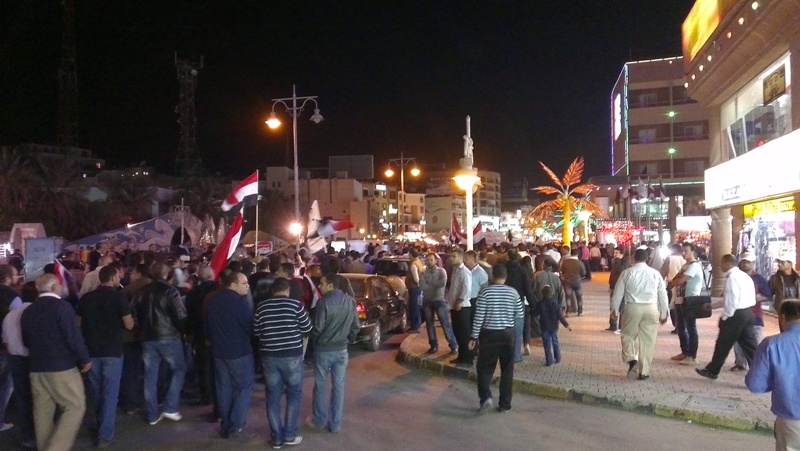
In what has not been seen since the Jan. 28th Revolution, large protests have been held around Hurghada, both pro and anti-Morsi.

While the pro-Morsi protesters took up camp in downtown Dahar of Hurghada, the anti-Morsi protesters rallied around Sheraton Street, one of the main tourist areas of Hurghada. They started in a small square in front of the Bella Vista Hotel, and spent about an hour hyping the crowd up. By this time the protest was only a few hundred strong.

After about an hour, the protesters moved down the Sheraton street. It was truly incredible to watch. To protect the protesters from the traffic and any unwanted individuals entering the flurry, the back end was sealed by a huge banner and the sides were initially sealed off by people carrying rope. The protest soon swelled however, and a human chain was created as an add-on to the rope. The protest stretched far down Sheraton as people moved down the street, diverting traffic.

Despite there being some frustrated drivers, most who passed through honked in support of the protesters walking through the street. While the protests here don't compare at all to those witnessed in Cairo, we have not seen protests like this since one or two days during the January Revolution. It's an indication of just how serious the situation at the moment really is.

Alongside chanting "The people demand the fall of the regime," protesters had a few colourful chants. From comparing Morsi to Mubarak, and calling them both liars, "Morsi is a failure" was also chanted. Find below photos from Hurghada's anti-Morsi rally today, along with some videos. Men and women, veiled and unveiled, and even children partook in Hurghada's rally tonight.

A young boy riles up the crowd


**All photos copyright Susan Richards-Benson. Please contact me for high-res photos**

Youtube Videos:


Thursday, May 10, 2012

Egyptians Eagerly Anticipate Presidential Debate

I naively hadn't realized just how monumental this moment is in the lives of so many Egyptians until I had to explain the concept of what a presidential debate actually is.

Tonight Amr Moussa and Abou el Fatouh will face off in the presidential debate and have the chance to argue their platforms. Anyone wanting to watch this debate live can do so at the following link, Al Masri Al Yawm's channel:


Monday, April 16, 2012

Is Child Kidnapping on the Rise?

In the past few days, I have heard of three separate incidences in Hurghada of a child being kidnapped. A parents worst nightmare, the apparent increase is prompting many residents to question what is going on. Parents are advising not to allow children out into the streets to play, to avoid certain areas, and to never leave your children out of your sight.

Last April, headlines in Egypt were dominated with the trend when the grandniece of the late Anwar al-Sadat, 12 year old Zeina Effat al-Sadat, was kidnapped. Zeina was released almost 24 hours later, following negotiations between the kidnappers and her family and a 5 million LE ransom sum paid. Her story points to the increasing trend in Egypt of kidnapping for profit. "As a sign of Egypt's deteriorating security conditions, child abductions have become an easy way for criminals to make money," security expert and former policeman Maher Zakhary told IRIN.

The family members of richer, more affluent Egyptians are being targetted with the kidnapper's sole agenda being the ransom payment. Kidnappings in and around the greater Cairo area, particularly from areas such as Heliopolis, would appear to fall into this category. But they stand out; the ransom request usually promptly follows the kidnapping.

I reported in this blog last year on the case of Soraya Dierich, who to this day remains "missing." Soraya's story is indicative of another common form of kidnapping in Egypt. The case of an Egyptian man marrying a foreign woman, bearing a child together, and once the relationship sours the man kidnaps the child and disappears. Soraya is the child of such an unfortunate situation, and was kidnapped by her father in May of 2011. Sadly the incidences of kidnappings like this are becoming so commonplace, the US Department of State has clear guidelines for parents facing these issues. Stressed in the document are Egyptian custodial laws, which will generally favor the mother if she is an Egyptian citizen, and / or Muslim. Otherwise custodial rights will often fall to the father, and in the eyes of the Egyptian legal system, he may claim the parental rights to his children. In cases like Soraya with a foreign mother, her alleged kidnapping is complicated by the fact that in the eyes of most Egyptians, the father has done nothing wrong.

But the recent spat of kidnappings in Hurghada cannot be as clearly defined as the two incidents above.

Omar, kidnapped in Hurghada
The first story surfaced on the 12th of April, with reports of 1 year old Omar being kidnapped from the popular Villages Road area. Omar's mother, an Egyptian woman, left him with a foreign woman outside the coffee shop Arabesque to take her daughter to the toilet. When she returned, Omar had disappeared without a trace. The last description of the foreign woman, as has been issued by the mother, was: "the woman that took omar has the birthmark on the right wrist. It has the shape of a coin and is dark brown. She is between 30 and 40 years old, around 170cm to 180cm tall, medium build, a little bit a long chin, dark brown hair till the shoulder. Her eyes are blue or green, she is not sure because of the red sunglasses. She was wearing a white bermuda and a pink blouse. Her daughter is around 2 years light brown hair till the shoulder. She was wearing a bleu jeans skirt and a red tshirt with yellow lines in front. The women was talking arabic with a foreign accent."


When I first read this story, my initial reaction was "how could a mother possibly leave her child with a stranger." The common reaction appears to be that women in Egypt previously had nothing to fear from leaving their children with strangers, as children are so coveted here they were generally always safe. Perhaps I'm just too cynical having grown up outside of this country to expect a stranger will safely watch my child.

It wasn't long after the story of Omar was circulated, that reports of another child's kidnapping surfaced. Snatched on the 11th of April, 7 year old Yousef Ahmad al-Sawi was taken in Hurghada. The poster below has been hung up in mosques and local supermarkets in the attempts to locate him.


Sadly when it comes to preventing or protecting children from these instances of kidnapping, strict parental vigilance is the best way forward. Hani Helal, the secretary-general of the Egyptian Coalition on Children's Rights, said "the government does not attach enough importance to the problems suffered by children. This leads to increasing violations against the children."

Helal further claimed that if the Egyptian government does not work to improve the security of children in Egypt, he will resort to the UN.

So why are these children being snatched if there isn't an obvious ransom or custodial battle being played out?  The answer it seems, is either human trafficking, sexual exploitation, trade in body organs, or criminal activity.

Such was the situation for Hayam Rabie, who's 1 year old daughter went missing after Rabie left her with neighbours while she ran errands. Upon her return, her daughter was gone without a trace. It was later uncovered that one of Rabie's neighbours had kidnapped the child. Evidence uncovered in her neighbours flat revealed blood bags, IVs, and other medical equipment, pointing to an ominous conclusion. Rabie's daughter remains missing.

Is this a new phenomenon as many media outlets are reporting? Is this really the new trend of security in Egypt in the post-revolution vacuum? While most stories are attributing this rise in kidnapping to the police's inability to do anything about it, the sadder truth may in fact be that this has been a long standing tradition, but up until recently the media has not felt the need to report on the circumstances. In previous years many of the children kidnapped were snatched from the remote and poorest areas in Egypt; their stories were just not considered newsworthy.

As Hafez Abu Saeda, secretary-general of the Egyptian Organisation for Human Rights, a Cairo- based NGO, told IPS in 2009, "In most cases, children are kidnapped for use in criminal gangs - gangs of beggars, thieves or drug dealers - or for prostitution and sexual exploitation," he said. "Of course, many cases are simply children running away from home due to domestic problems, or the result of a personal vendetta - not uncommon in the Egyptian countryside."

Fediya Abu Shohba, professor of criminal law at the Cairo-based National Centre for Social and Criminal Research, agrees with Abu Saeda, and in the same article states:


"The disappearance of children has proliferated over the last five years, but has become especially acute over the course of the last year [2009]," Abu Shohba told IPS. "And when a child disappears - and doesn't come back - it usually means they have been kidnapped.

"The prevalence of the phenomenon can be attributed to several, mainly social, factors," she says. "These include an increase in the number of vulnerable children living on the street, decreasing parental care due to economic pressures, the erosion of traditional religious values, and the promotion of violence and crime by the mass media."

So although it would appear that these kidnappings are not a new and developing trend, it does not lesson the gravity of the situation. Parents are being advised to keep constant watch on their children and to never leave them unattended. A hotline has been set up to receive reports of kidnapping which they claim have risen in the post-revolution times to 6 or 7 calls a day. [Despite researching this, I have been unable to find the number for this hotline.] Preventative measures are the only way to ensure the safety of your child; only you can help stop this rising trend of kidnappings.


Thursday, March 29, 2012

Female MB Representative Supports FGM

In a move that is raising a great many questions, Azza El Garf, a female representative in the Muslim Brotherhood's Freedom and Justice Party, has expressed her support for the practice known as Female Genital Mutilation.

In Egypt's post-revolution parliament, female representatives make up a meagre 1 percent of legislatures currently serving. Of this 1%, El Garf is a prominent figure. Her recent comments on FGM shed distinctive light on what the potential future for women in Egypt may be shaping up to be.

The Muslim Brotherhood's Freedom and Justice party made headway with voters during initial voting rounds by promoting their family friendly ideals and their staunch support of Islamic Shariah as the primary source of legislation. For months now, liberal thinkers and women have speculated on how the FJPs domination in the parliament could potentially reverse the small milestones achieve by women in Egypt. With this parliament dominated by men, the little hope remained in the 1 percent female representation to stand firm in the progress made in the past few years. El Garf's comments serve as an indication that even these women may not be the defenders of women's rights they were hoped to be.

Commenting on the current perception of women in parliament, El Garf says: "People here think women can be a doctor, go to university, be a teacher or an engineer ... But people still think 'women are no good at politics.' We want to change this view."

In what initially appears to be a clear statement that women are here to express their ability to play a crucial role in politics, El Garf goes on to comment on the individual rights that women in Egypt have won over the past few years.

One of these was a ban imposed in 2008 on female castration, or genital mutilation.

"It is a personal decision and each woman can decide based on her needs. If she needs it, she can go to a doctor," El Garf says. She further highlights that according to the Muslim Brotherhood, the procedure is considered a beautification plastic surgery.

The World Heath Organization defines FGM as:  "procedures that intentionally alter or cause injury to the female genital organs for non-medical reasons." It goes on to say that the procedure has no health benefits for girls or women.

The practice of FGM is in itself contentious. Many traditional societies believe that through FGM, the purity of a young girl can be preserved by removing the unclean portion of her genitals. Others believe that removing the clitoris prevents a woman from have sexual urges, thereby ensuring she will not be tempted to engage in illicit sexual behaviour. The list of negative repercussions it can cause to a woman are endless, and include but are not limited to: cysts, infections, infertility, and in some cases death. FGM is primarily carried out on younger girls, mostly before the age of 15.

Despite this, El Garf's opinion is that a girl should have the right to choose to mutilate her genitals or not. But the question here is, how many young girls aged 1-15 will fully understand the repercussions? To provide a girl with the right to make a choice will require educating her on the potential impact later on in life, does this then mean El Garf is suggesting launching earlier sex education for women to be able to make an informed decision on FGM?

More worrying are El Garf's statements on divorce. Many women in Egypt, particularly Muslim women, are forced to suffer long and troublesome marriages, oftentimes in an abusive situation. In what at the time was considered a land-mark move, in 2005 the Egyptian courts passed a law permitting a Muslim woman the right to file for a 'no-fault' divorce without first needing the permission of her husband or a male relative. El Garf believes these have allowed the legislation surrounding divorce to become too "lax," and supports the imposition of more stringent conditions for divorce. She does not clarify if this means that the husband's permission will first be required for any woman to file for a divorce, nor anything about women facing abusive husbands.

As the FJP continues to solidify its hold in the Egyptian political arena, comments such as those made by El Garf are becoming more frequent. Feminists in Egypt have much to worry about upon seeing a woman verbally trample on the minor rights they have long and hard fought for. Many of those who fought hard to bring 30 years of dictatorship to an end are now asking themselves, "is this the democracy we fought and died for?"

To read more on El Garf, click here.

Wednesday, March 14, 2012

Construction: Hard Manual Labor in Egypt

Anyone that has been to Hurghada knows as well as I know that the town is constantly expanding and growing. As more people move to the city, more buildings are put up to accommodate the swelling population. This often means that old villas are knocked down to make room for apartment buildings in their stead.

One of the reasons K and I chose where we live is due to the fact that the majority of the buildings surrounding us are already complete. I for one do not want to feel that I live in a construction zone. Next door to us stood the frame of an apartment building that has been standing for 25 years.

As tourism in Egypt begins to rise again, construction in Hurghada has gone back into full swing. However, a law passed last year by the government banned any further sale of land in the Hurghada area, meaning that if you planned to construct a new apartment building, you were required to do so on pre-purchased land. A typical sight throughout Egypt is the frame of a building, or a partially completed building with steel beams and wires protruding from the top. There are a few reasons behind this. First and most obviously, the owner of the building ran out of funding, and was forced to halt construction until more funds became available. Secondly, the apartment is often bought by a family who has given birth to a son, and left empty until such time that the son grows up and himself marries, at which point construction on the apartment will be completed and the son and new bride will move in. Thirdly, leaving the building to appear under construction is a tax write off and thus saves the owner a great deal of money.

The credit crunch in Egypt lately has left a lot of building owners struggling to cover the over-head costs of property ownership. A convenient trade has sprung up as a result of this, namely the trade in steel construction parts and concrete. Such is the case for the building next to us, and lead me to witness construction in Egypt as I never really had before.

The CAT was the only 'heavy machinery' used in the
entire process
Now, the "building" next to us was no more than a frame. This frame is held together by steel rods and concrete blocks which themselves constitute a huge over-head cost of any construction project. Gaining access to the steel beams requires knocking the frame down. This was lesson number one; watching the frame of an apartment being knocked down, and wondering why, until I learned that rather than let the frame sit stagnant the owner could make a profit off of it and sell off the construction parts.

The first piece of machinery to be brought in was a Caterpillar demolition tool. Resembling an enormous spike, hydraulic arms cause rapid pumping of the demolition arm, enabling it to easily break through rocks and cement to get at the steel underneath. Remarkable is that this was the only piece of heavy machinery used in the entire process. The Caterpillar was individually owned, and the owner informed us that he should have the building down in 2 days. [Lesson learned: When it comes to construction in Egypt, if they tell you 2 days, interpret that to mean 2 weeks. 2 weeks of non-stop noise starting at 8 am in the morning left us less than happy campers, but I digress].

The next step was the extraction of the steel beams from inside the concrete blocks. The CAT would break the concrete beams into bricks that were about 1 foot in diameter. Then the hard manual labour takes over.

You can see the steel rods protruding from the blocks
Egyptian construction workers use a mallet to repeatedly strike at the brick to remove the steel frame. Rotten steel is tossed away, and steel that can be re-used is set to the side for the next step in the process.

A little further away from the construction site are what appear to be wooden beams erected into the sand. These beams are in fact going to be used to straighten out the crooked steel beams in order for them to be used in the next construction site. Working with this wooden beam, a worker takes the steel rods and with a small hammer bangs the rod out straight. Using no more than a wooden beam and a hammer, gradually a pile of straightened steel rods grow on the side.

2 workers work to straighten out the 'tangle' of steel rods
next to them. On the ground you can
see the straightened ones.

Once the CAT has brought the building down, the workers begin to sift through the rubble to pull out the extra rods of steel that may have been missed. This alone took almost two days. Once the area was cleared, the CAT was brought back in, with a new tool attached, and began the process of loading up dump trucks with the rubble to be transported for processing.

Sifting through the rubble for stray steel rods.
 
Overall it was an exceptionally eye-opening experience in how the construction process works in Egypt. I should add however, I have to question how many of the 'new' buildings around the area are in fact constructed using old materials...and if these materials are ever put through safety tests to ensure that they are fit to use again. I probably shouldn't bother asking, as I know what the answer would be :p


Friday, March 9, 2012

Women in Egypt march for their rights

Yesterday marked International Women's Day. As women around the world contemplated how their roles in society have evolved over the past 100 years, women in Egypt were fighting to see the rights they long struggled for remain firmly in place.

The increasing number of Islamists in the Egyptian Parliament is giving many women in Egypt a reason to be worried. As many Salafists MPs have announced they would never back a female presidential candidate, and hold the potential of restricting women's role in society, Egyptian women fear that their margin of freedom in the country might be coming to an end.

Thursday saw women in Cairo take to the streets to demand their freedom and their rights. As March 16th marks Egyptian Women's day, the next week is sure to carry many headlines of women campaigning throughout the country.

Below is an article by MSNBC, commenting on the uphill battle that women in Egypt may face in the coming months as we all watch with bated breath to see just how much more power the Islamists will be afforded.


By Charlene Gubash

CAIRO, Egypt – International Women's Day took on special meaning for the more than 1,000 Egyptian women who braved harassment to march through downtown Cairo Wednesday.

The demonstration was sparked by the belief of many women that the recent political victories by socially conservative Islamists, who now control over 70 percent of the parliament, will eventually undermine the few hard-fought rights they have won.

“The situation is going backward,” complained flight attendant Nadia Salim. “The Salafists (conservative Islamists who believe in a strict interpretation of Sharia law and that women should have a limited role in society) and Muslim Brotherhood will bring us back 100 years.”

Trying to preserve existing rights

The women said they took to the streets not to gain more rights, but to preserve those they already enjoy.  "We have to hold onto what we have because of the Salafists and Islamists," warned university professor Iman Azzad.

Their main demand is that women should make up half of the committee that will draft Egypt's new constitution.  Women fear that the Islamist majority will take away their right to divorce and to win custody of their children

"Women are half of society," said Salim. "Why shouldn’t we form half of the constitutional committee?"

Activist Dina Abou El Soud said she had heard that the country’s judges had plans for women to make up only a 10 percent of the panel shaping Egypt's next constitution. She believes women's rights will be the first thing to be sacrificed in order to please the Islamist majority.

It’s a sea change from the ousted regime of President Hosni Mubarak, when women were guaranteed 64 parliamentary seats.  In the latest post-revolutionary elections, the quota was eliminated and women won only five seats.  "The other seats went to the Muslim Brotherhood and Salafists," said El Soud, co-founder of the Revolutionary Women's Coalition, which has 4,000 members on Facebook.

 "We are going backward, backward and backward," she added as she passed out fliers in English and Arabic. "It is time to make a women's revolution”

El Soud also said that Islamists are trying to discredit existing women's rights by suggesting they were imposed by the Mubarak regime, deriding them as "Suzanne Mubarak's Laws,” the name of the former first lady.

"It’s ridiculous. They are international women's rights that we have gained,” she said.

Ready for drastic measures

Considering what Egypt's roughly 40 million women stand to lose, Wednesday's turnout was miniscule. Mahy al Aref, a well-dressed pharmacy graduate, said the small crowd was probably due “a lack of educational awareness.”

She said she is worried about putting her German university degree to good use in an increasingly conservative society, a concern shared by her mother, Magda al Akkad, who runs an NGO. "I am worried because of the Islamist direction,” she said. “They have their ideas. I don't know where it will go, but I don't think they will be fair to women in general."

Al Akkad said she said she can foresee a day when Egypt would become unlivable for her and her daughter.  "If fanatics rule, I will leave this country,” she declared.

Monday, March 5, 2012

Cattle Dying in Egypt's Suez Canal


Live exportation of animals is a contentious issue around the world. Stories of animals trapped on ships being refused entry into ports around the world is unfortunately not a new issue. The last incident involving a live export gone wrong occurred in 2010, when an Australian cargo ship transporting live cattle and sheep heading for the Egyptian port of Ain Sokhna decided to simply dump the carcasses over the side of the boat. This incident is believed to have triggered the 2010 shark attacks off the coast of Sharm el-Sheikh, and caused un-calculated damage to the environment of the Red Sea.

The most recent incident involves the MV Gracia Del Mar. Although registered as a Panamanian ship, the Gracia Del Mar departed from Brazil with a cargo of over 4,000 live cattle. Recently converted to a livestock vessel, the MV Gracia Del Mar allegedly had issues with ventilation in the animal hold area, causing over half of the cattle on board to perish.


The sheer volume of cattle that perished on board caused Egyptian authorities to deny port access for the ship. Accordingly, the vessel has been docked in the Red Sea entrance to the Suez Canal. It has also been denied entrance into Djibouti and Sudan for the same reasons.

Australia has a Memorandum of Understanding (MoU) signed with Egypt permitting the importation of live exports from Australia. As such, they are heading up the charge to try to allow the remaining cattle on board entrance into Egypt.

Animals Australia director Lyn White was quoted saying to an online publication that "Animals Australia has been working overnight with international colleague groups to find refuge for the surviving 2,000 cattle after Egyptian authorities refused to allow the animals to be unloaded...This is nothing short of an animal welfare disaster. If remaining cattle are not offloaded more of these animals will suffer appalling deaths at sea. We are appealing to authorities in Egypt to offload the remaining cattle at al-Sohkna, as was originally intended." 


White pointed to an incident involving an Australian live export ship, the MV Cormo Express carrying a cargo of sheep, where the refusal of one country after another to allow the ship to dock resulted in the death of 5,000 sheep. 


You can help let your voice be heard in this ongoing catastrophe. Email the following text to info_malr@agr-egypt.gov.eg


Dear Minister
                   It has been reported that 2750 cattle have died on board the livestock vessel Gracia Del Mar. According to the report the animals are continuing to die on board this ship . The report states that the cattle have been refused port entry in Egypt, Djibouti and Sudan because of the amount of dead or dying cattle of board .

The Egyptian Authorities must take action now to allow this ship to land so that the animals can be given veterinary or , were necessary, humanely euthanized . Such action is essential to prevent even more suffering in what has become a major animal welfare disaster.


Monday, February 20, 2012

The Game of Egyptian Customs

In today's connected society, shipping overseas is normally no big deal. Shipping from the US to Europe, where a letter would once take months to arrive, can now have a package delivered from the source to your door in under one week. With express air shipments and rush deliveries, this wait time is often even cut in half. In most countries you would declare the contents of your package, pay the pre-determined customs and taxes fees and be on your merry way. Egypt however, is not most countries.

I have tried my hand at shipping through the mail here only to have my package go missing. It is for this reason that when asked by people "can we mail things to you," the answer is almost always "no." The chances are high that your package will be lost in the mail, and in the event that it does reach you, you're going to have to pay close to 50 % of the value of the contents in customs. This means that when working with a rescue as I do with the Continental Rescue and Rehab, the many people who are willing to send horse supplies overseas are time and again told "sorry the Egyptian shipping customs make it too expensive." The option is usually to wait for someone travelling from the country of origin, and for them to pay excess baggage fees to transport the items back.

A single traveller transporting goods ended up not being enough for a batch of items that were scheduled to be sent to the CR&R from Switzerland. One volunteer gathered an astonishing 200 kg of items donated to be used for rescue horses in Egypt [Although the majority of these items never made it to the CR&R]. Through many telephone calls and e-mails, it was agreed upon with Swiss Air that the cargo would be delivered for a fraction of the cost, as it was intended for non-profit purposes. Not only this, but the cargo was earmarked as 'gifts and donations,' and the point of contact in Switzerland expressly stated "With this receipt of shipping you should be able to pick up the cargo from Cairo Airport and walk out."

Oh if only life in Egypt were that easy.

Now, I personally did not go to pick up the cargo. The following events are reported by my source who went to collect the items from Switzerland himself. We shall call him G (Name withheld for privacy purposes).

Upon arrival to the airport in Cairo, G asked where he should go to collect cargo items. Initially he was taken inside the airport by doorman number 1. He walks G to big-wig number 1's office. In this office, G again requests to know where he should go to collect cargo items from Swiss Air.

Big-wig proceeds to blow a lot of smoke up Gs backside, and instructs doorman number 1 to show G to doorman number 2, who will take him through to the cargo hold area. Doorman number 1 of course holds out his hand expectantly, as he obviously deserves a tip for taking G to big-wig number 1. G complies, and discreetly hands Doorman number 1 a 5 LE note.

Doorman number 2 ended up sticking to G for a significant portion of his journey. He takes him through to an office where a Swiss Air clerk is sitting. G tells the clerk that he is looking to collect a cargo sent via Swiss Air, and proceeds to hand the clerk his receipt. (Bear in mind, at this time G is only holding one piece of paper). The clerk tells him that in order to collect his cargo, they need photocopies of his ID, and a variety of other copies. Doorman number 2 interjects here and says "yes, and the photocopies themselves are 5 LE a page." To this, G turns away from doorman number 2, and asks the clerk how much he should pay. She informs him "2 LE per page." And so the system of corruption begins.

Once G has spent about 2 hours being bumped from one person to the next, he is finally taken to the cargo hold. He describes it simply as "looking like an outdoors market in downtown Cairo." There were boxes everywhere. There were people everywhere. There was no coordination, nor any clear indication of which cargo corresponded to which airline or delivery system, or which was staying in Cairo and which was being collected.

Finally inside the actual cargo bay, G is taken to big-wig number 2's office. Here, he is again asked to present copious amounts of paper. Big-wig number 2 tells G, "here is where we are going to determine the price of your customs." There was no set method of calculation. There was no percentage of the shipping that would be earmarked as customs. No, there was nothing of the sort. What there was, was a pencil-pushing accountant with a calculator, who was an "expert on assessing value of goods sent." Now, remember earlier I had mentioned that our source in Switzerland specifically stated there would be nothing to pay in Egypt? Yeah, okay thought so.

With that in mind, G keeps stressing these are gifts, these are donations, these are to help the horses. Big-wig number 2 says "Okay if these are gifts and not for sale I demand that you open all the boxes and show me everything." From what I have been told, many of the items were in such great condition that they appeared new, despite being donations of used items. The pencil-pushing accountant wanders up, takes a look at all the items in the boxes, and says "these items hold an approximate value of no less than 30,000 LE," and fair customs in their eyes can often be 25 % - 50 % of the items anticipated value.

Despite G's continued prostrations, big-wig number 2 does not want to hear any of it, and tells him "either you are going to agree to pay the customs, or we will keep your items in hold." Ahhh, and here's the catch. To keep your items in hold, you are charged the "land fee," as they politely referred to it. I should add, even if you are there, ready and waiting to collect your cargo as it arrives, you will be expected to pay this land fee.

When G inquired how much this "land fee" was, he was told "Ya3ni it depends. For the first day 100 LE, for the second day 150 LE, sometimes it is 200 LE." End all and be all, they will charge you whatever they feel is a fair land fee. [no comment needed here].

After a good few hours debating back and forth with big-wig number 2, G has at least 4 figures thrown at him for what the pencil pushing accountant sees as "fair figures" for a customs charge. Most of these figures total more than the actual cost to originally ship the items. In order to collect the items, G has to sign a receipt that also marks the cost of the customs fees. The first few figures he was thrown were not written down, merely verbally presented to him. By the last figure, big-wig number 2 grabbed the receipt, wrote down the final figure, and told G "if you want your things you will be paying us this."

Now, G had arrived to the cargo bay anticipating having to pay 'baksheesh,' but not anticipating having to pay an extortionate amount in customs fees. The closest ATM was back at the airport's main terminal, too far to walk after spending all morning on his feet. Luckily enough for him, there were taxi's roaming around ready to take him the short journey to the airport terminal. Let me make a note here, anybody who has taken a taxi into the airport knows there is an entrance fee of 5 LE. This fee, however, is a one time fee, thus meaning once the taxi is inside it does not have to pay the fee again. G's taxi tells him with a straight face, that for a 500 meter journey he wants 15 LE. Why? "Because sir I have to pay to get into the airport." After much fandangaling, G finally manages to get to the ATM and withdraws cash.

Returning to the cargo bay to collect the items, G had to provide the people who had been helping him throughout the day money "for their tea." I found this the most creative way to ask for under the table tips, that you should somehow feel obliged to pay for these boy's tea. Only in Egypt.

Once the boxes came out of the cargo bay, the madness began. Pick up trucks zoomed up to the area, with one box after the next being whisked away. G and his partner literally had to stand over their boxes to ensure that they would not get picked up in the confusion and sent somewhere else in Egypt. While they were loading their items onto the van, of course there were more boys there waiting to help in exchange for the cost of their daily tea.

When G finally had his cargo loaded onto the transport truck to deliver the things to Hurghada, he breathed a sigh of relief thankful that he could finally leave the airport. Oh if only it were really going to be that easy.

While attempting to leave through the main terminal, there were no less than 5 boys lined up, hands out, waiting for their tea money. The final obstacle was the soldier that sat at the front entrance to the terminal. As G approached, the soldier asked him "where have you been, and what have you been doing?" G explains that he's been dealing with customs for the better half of the day and is finally ready to leave. "Where is your receipt sir that proves this?" The receipt was upstairs in the administration office alongside the many other stacks of paper that had been shoved into his hand throughout the course of the day. The soldier, when realising G was not in possession of the receipt, said "if this is the case you must bring everything you just brought through customs to me, in order for me to inspect it and make sure you are really telling the truth." This is a door soldier...this guy has nothing to do with customs, it's just one more tier in the pyramid of corruption that is Cairo Airport's customs. Final result being, a folded bank note discreetly shoved into the hand of the soldier and a plea to "please just let us leave and be finished with this place."

I suppose at least that day, everyone had their tea paid for.


Saturday, February 18, 2012

High winds rattle Egypt

Egypt is known as the land of the sun, and most days this holds very true. I never imagined I would be sitting down to write a blog about the unusual weather patterns in Hurghada, as we have sun pretty much 355 days of the year, but such is the case.

Stepping outside this morning I felt like I had stepped back to Colorado in the thick of winter. A sharp bite of frost was in the air, and despite the sun in the sky winds caused temperatures to plummet. Now what we consider cold I know is nothing compared to what Europe has been experiencing, but for us it is remarkable. The temperature at our house today peaked at 16 degrees, but add the wild chill and you're down to single digits. Not only is the wind cold, it's blowing gale force winds.

Now, anyone who has previously lived in Egypt can remark on one thing. The slightest bit of rain causes Egyptian drivers to freak out. Put one small puddle in the middle of the road, and previously erratic drivers become down right dangerous. (Not to mention most cars don't have functioning wind screen wipers...I once drove in a taxi in a downpour and the guy was hanging out his window as he could not see through his screen. :p). Wind is an entirely different factor. High winds in the past few days have already caused Suez ports to shut down.

Gale force winds require a different technique of driving. You cannot break concentration, and you must account for the wind force on the side and undercarriage of the car. A string of road accidents in just the past few hours indicate that drivers here missed this in driver's education.

3 British tourists and their guide were injured in a bus accident, reportedly caused by bad weather causing the bus to flip. Translation? The driver was taking the hairpin turns near St. Catherine's at an already breakneck speed, but throw in there gale force winds and you have a recipe for disaster.

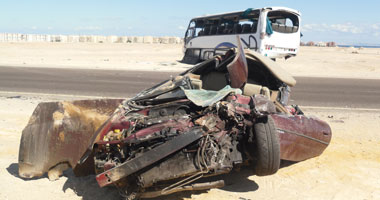
Another crash occurred this morning in Hurghada, where 2 were killed and 23 injured in another bus accident. The cause for this accident was not reported, but I would not be surprised to learn it is also as a result of high speeds in gale force winds.

Image courtesy of Youm7


These stories all come along with a story from the 9th of February, where 3 German tourists (2 adults and 1 child) were killed when their "submarine" sank off the coast of Hurghada. The reason for the accident? High winds and underwater tow caused the screen on the submarine to rupture, causing the consequent sinking.

I have to ask, why are these buses and boats being allowed to drive / sail in such poor weather conditions? Why is the bus driver not instructed to slow down on the journey due to the high winds? Why was a boat allowed to set sail with a strong under tow when those conditions are meant to be strictly regulated and monitored? Is it all about making that final dollar at the end of the day now? May the people who had to pay with their lives for shortcuts rest in peace.

If out driving at the moment in Egypt, take care. Remember to slow down with these speeds, remember your car can easily be flipped with strong gales. If you don't have to travel long open stretches at the moment, don't. Rain is forecast for the next two days in the Northern Sinai and Cairo. For all drivers, please take your safety at this time into the highest consideration. 

Wednesday, February 15, 2012

What do to in the Event of a Carjacking

This warning came from the UN Department of Safety and Security for residents in Egypt. Car jacking and attempted theft are on the rise at the moment. Below are some very important tips on what you can do to avoid a car jacking, or in the event that you fall victim, how you are most likely to come away from the situation unscathed.

Unfortunately there are a significant number of reports of armed carjackings in Egypt. These incidents are not confined to the desert highways but also occur on the main roads in Cairo. They are also not confined to night time hours – but now at any time during the day time. Primarily the hijackers are targeting four wheel drive vehicles or luxury sedans. Sometimes they are ransomed back to the owner, sometimes they are sold on for other purposes. In the vast majority of cases the occupants of the vehicle are unharmed. The carjackings are not usually targeted at any group or individual or organisation – they just want the car.

An incident of a carjacking this morning in Mohandessin affected one of us and occurred in daylight in a busy main street. It is important for you to understand how to respond in a carjacking incident so the following provides some guidance that may help prevent this from happening again.

Usual Methods of Carjacking

• A staged accident at the side of the road and attempts to flag you down to assist,
• A staged accident in traffic where a vehicle may bump you in order to get you to stop,
• Blocking your driveway as you wait for a gate to open,
• A vehicle with two or more occupants following you in traffic and attempting to get you to stop by using the car horn or flashing lights,
• Shooting at the tyres of your vehicle.

Preventive Actions

• Don’t stop at an accident if it looks at all suspicious. Keep driving and use your mobile phone to summon for help from emergency responders.
• If you must stop because you are the victim in a vehicle accident then do so in a public crowded area even if you have to drive a little further.
• Phone ahead to security guards (if you have them) or a family member to ensure your gate is open as you arrive.
• Try not to stop AT ALL for someone who tails you on the road and uses horns or lights to try to flag you down. It is possible that after a time they will give up their attempts once you have driven past their area of operation or into a more public and well lit location. This has worked as an effective strategy for one of our staff members.
• BUT, if you hear a gun shot or see weapons then STOP. This means they seriously want YOUR vehicle. It is a complete judgement call if you decide to take action to evade possible attackers but often this does not turn out well.
• Keep your windows and car doors locked at all times. This helps to prevent an incident if you are stopped in traffic for any reason.
• Use your side and rear view mirrors to check vehicles around you. Be aware of your surroundings and traffic patterns.
• When driving keep your distance from other vehicles so that you have room to escape or manouvre in traffic if you need to.
• Avoid unnecessary travel after dark
• Keep your emergency numbers up to date in your mobile phone and record them so they are quickly available. The number to dial in Egypt is 122 to report an emergency or call for help.

Actions in the Event you are being Carjacked

• Always assume there are weapons involved.
• If there is no escape – STOP.
• Breathe and keep calm.
• Keep your hands on the steering wheel in plain sight.
• No sudden movements – take your seat belt off only when the attackers know what you are doing.
• Do not look at the carjackers in their eyes – this could be taken as an act of aggression.
• Respond in a non-confrontational manner.
• It is always best not to resist and to give the attackers what they want.
• The main objective is to get away safely.

After being Carjacked

• Get to a safe place before reporting the incident.
• Report immediately to the police and your security focal point or DSS.
• Try to remember the details of the attackers – what they were wearing, how many of them, accent, vehicle they were driving – whatever facts you can remember will be useful.
• Talk the incident through with relatives or friends. This helps to alleviate the stress of the event.

Remember these incidents are seemingly random – there is no particular pattern and no specific road of particular vulnerability any more – except to say that the incidents have mostly occurred on major thoroughfares.

Please share this advisory with your family and take precautions for your safety.

Sunday, February 12, 2012

Spreading Xenophobia in Egypt

It's not a new excuse to hear recent unrest blamed on 'Invisible Hands,' which usually means the U.S. and Israel. But this has always remained part of political rhetoric, with few people actually believing that the state was completely innocent and the blood of the revolution is on the hands of the Western  nations.

I was shocked to see this picture today. Is this an indication that their continued plug of placing blame on the foreigners is paying off? Does this mean that more raids on NGOs will follow, or are people going to realise that this is a plan of sedition and to spread discord among the population? Only time will tell. 

Picture courtesy of Twitpic. 
The sign posted above reads: "No to the American/Israeli plan to divide Egypt." The propaganda wheels are in full swing. 

Friday, January 13, 2012

What do to if your dog / cat ingests poison

I apologise that it has taken me a few days to get to writing this post, but this is because I have been waiting for confirmation on the suspected poisonings in Hurghada. Although it seems that the mass poisoning in Maadi I previously blogged about may have been government sponsored, we are as of yet unable to find any proof indicating the same for Hurghada.

What we seem to have in Hurghada is a few possibilities. Individual residents lying poison out on the road, shop or restaurant owners trying to clear their immediate area of strays, or government vets lying the poison out. As the government vet who would be responsible for placing poison in and around the city is currently on vacation, it's safe to say he is not involved in any cases of poison around here.

This leaves 2 options, individual residents or business owners. Now bear in mind that strychnine is not something you can readily get your hands on. To purchase this poison it is often necessary to go through a dealer and can end up quite costly - making it an unlikely option for many. The next poison of choice is readily accessible and available, and just as deadly. I'm talking rat poison.

Remember that these poisons are thrown into the street on meat - meaning your dog can snatch up a piece very quickly without you even noticing. Fortunately there are signs to watch out for if you suspect your dog has ingested poison.


  1. Make sure that you have an emergency vet contact in your phone or somewhere handy. I have provided a list of vets in the Hurghada area, and would personally recommend Dr. Mohammed Taieby, who will always respond to an emergency case - and I cannot make the same statements about all the vets on the list. 
  2. Your dog or cat will begin to exhibit symptoms of poisoning quite rapidly. If you notice your pet is extremely agitated and excitable, more so than usual, keep a close eye on them.  
  3. Seizures are a common symptom of ingestion of poison, be it strychnine or rat poison (often one and the same). Doctor Dog describes the seizures as: "during which the dog throws the head back, can't breathe and turns blue. The slightest stimulation, such as tapping the dog or clapping the hands, starts a seizure. This characteristic response is used to make the diagnosis."
  4. Other symptoms include drooling, muscle spasms, loss of coordination, collapsing. 
  5. If you start noticing your pet seizing or spasming, contact your vet IMMEDIATELY. The faster the veterinary medical response, the higher chances your pet has of surviving. Strychnine, NOT rat poison will induce these spasms.
  6. Often you will be told to try to induce vomiting in animals that have been poisoned. This is CRUCIAL information. IF YOUR DOG IS ALREADY SPASMING, TRYING TO INDUCE VOMITING CAN EXACERBATE THE SITUATION AND CAUSE FURTHER SEIZURES. Wrap the animal in a warm blanket and transport to vet IMMEDIATELY. 
  7. If you have not yet noticed signs of seizures but still fear that your animal may have ingested poison, you can induce vomiting. To induce vomiting in dogs, there are two websites you can check out here and here. I do not want to post how to induce vomiting in cats, please consult your veterinarian to find out how. 
Remember time and speed are your only allies when it comes to potential poisoning of your pets. If you are very worried about walking your animals outside, muzzle them to avoid potential ingestion. It is not fair to lock the animals inside rather than walk them - why should they be tortured and have to pay for human cruelty. 

For vets in the Hurghada area, please find contact numbers below. (Thanks to Anca for preparing the list you see below!) I would like to add to this list for vets around the country, if you have more recommendations PLEASE add to the comment section below. Please also feel free to share your stories of your pets that have been poisoned. The more that we collect the information on the poison and the areas it is being laid, the stronger case people have to bring to the government and demand an immediate resolution to the problem. 


1. Smart Vet Clinic, Dr Mohamed El Taieby,
Mobile No. 0163828100 
24 Hour Emergencies. I will give directions to the Clinic as the road hasn't got a name
Located just off of Maderis (School) Street, across from the Supermarket Beit el-Maleka or the Seagull Retail Clothing shop.
Email: smartvetclinic@yahoo.com 


2. Blue Moon Animal Shelter
Doctor Veterinarian Girgis Kamal (Tel.: 0164693169).
Mubarak 1 Nr. 14, Apt.7
Tel.: 010 5490046
E-mail: bluemoongalerie@hotmail.com

3. Dr. Sameh Shata
Plot 95, Old Public Beach Panorama Hotel Road
Dahar, Hurghada
Tel: 065-3544009, 012-1664628 Fax: 065-3544009

4. Dr.Mohamed Atef
PawsandClaws Veterinary Clinc, next to Dreams Beach
Services offered: Vaccination, Flea and insect control, Spay and neuter, Small and large surgeries, Orthopedic surgery, X ray, Fetal dubler, Toxoplasma check, Laboratory exam, Health certificates, Worming program, Grooming
Tel: 0176077576
E-mail: pandcvetclinic@yahoo.com


Wednesday, January 4, 2012

The Shell of Sharm el-Sheikh

Christmas for me usually represents a time of leaving Egypt. This year, it was different. K and I headed to the Sinai Peninsula to meet my family who had travelled from overseas. It was a year of forging new traditions and re-creating the Christmas atmosphere in a very "un-Christmassy" place. For K and I our journey started in Sharm el-Sheikh, where we stayed before heading further into the Sinai towards Dahab.

This time of year in Egypt is considered one of the three peak, or "high" seasons. In resort towns like Sharm el-Sheikh and Hurghada, Christmas and New Years host an influx of tourists seeking respite from the cold and harsh winters at home. In previous years in Hurghada, New Years parties sell out a few weeks before the event with only a limited number of tickets remaining for last minute deals. Sharm is the same; big name DJs all booked to come in and play to what is hoped will be sell-out crowds and fully booked resorts and hotels.

K and I chose to stay in Delta Sharm, a hot-spot for Sharm residents and tourists alike. It offers the security of a compound alongside all the facilities you would expect of a hotel: pools, bars, restaurants, shops, and a little strip mall with rental car shops and real-estate offices.

One of the pools in Delta Sharm
But walking along these "mini mall" strip of shops was depressing. For every open office, there were two abandoned, empty, boarded up, or "for rent" next to it. Coffee shops had a few stragglers outside, others that boasted they were open 24 hours were closed. Remnants of what is evidently a party town working schedule, these offices just had no business to warrant keeping those hours.

Walking down the main strip in Sharm on Naama Bay was also an eye opening experience. K and I went to track down dinner and do a little shopping around 5 p.m. Coffee shop after coffee shop lay empty, with waiters outside trying to usher the small crowd of shoppers into their bars or restaurants. Also striking was that of the people milling around in the streets, most were Egyptians, not foreigners. By the time we were leaving Naama Bay the streets and restaurants had gotten a little more crowded, but nothing like the level of patrons one would normally expect in Sharm at this time of year.

Naama Bay in Sharm
Everywhere you go, people will tell you the same thing. "Business is suffering. Tourists are gone, we have no money anymore." This brings to mind the rhetoric in recent months of Islamist candidates who claim that Egypt's economy will do just fine surviving on Cultural Tourism (Which estimates point to making up less than 10 % of the total income from tourism). Al Masri Al-Yawm posted an article today in which quotes show that tourism in Egypt dropped almost 30 % in 2011 alone, in part due to ongoing unrest in the capital Cairo and the comments made about crack downs on the tourism industry.

When my family made the decision to come to Egypt, they were met with the common question of "why are you going there? Is it safe?" I've been hearing that question since I first moved to Egypt in 2006, and the answer is, YES, Egypt is safe. The Sinai is SAFE. There is an illusion being painted in the media that on every street corner you will find a protest, or someone flinging rocks, of a building on fire, or thugs running rampant. This is not the case, not at all. In fact the entire time that we were away, we left the news off and stayed offline - leaving us no indication of what was happening in the country. Were it not for national media, the unrest in Cairo and Alex would not even have made you question could you come to Egypt.

Don't get me wrong, I'm not naive enough to proclaim that Egypt is 100% at the moment, because it's not. There are certainly areas I would advise against foreigners travelling right now, particularly those that require travel over long stretches of mostly unmanned roads, such as roads down to Luxor, Aswan, and Sohag. But if you're coming to Egypt to check out the Red Sea sights and the Sinai Peninsula, you have very little to worry about. I was asked to emphasize this by family and friends who came to stay, if you have any doubts about your safety in Egypt, let me put your mind to ease.

Hurghada is more fortunate than many of the cities in the Sinai, as there continues to be a steady stream of foreigners coming here *knocks on wood* but in the Sinai things aren't so easy. I'll continue this saga in a new postings, but I will leave you with these words:

Please come and visit, the Egyptians are ready to welcome everyone with open arms! 

Saturday, December 31, 2011

Egypt to reassure diplomatic ties following raids on NGO offices

This past week saw yet another question mark raised in how exactly Egypt wishes to continue with their diplomatic relations with Western nations. The raid by security of 17 NGOs, under the auspices of alleged concern over foreign funding received, has been met with alarm and diplomatic outrage by not only the US, but the UK and Germany as well. Below the BBC provides a report on the increasingly strained ties between Egypt and the West, and how Egypt is in turn attempting to assuage their fears.


Egypt has reassured the US that it will stop raids on the offices of non-governmental organisations (NGOs), the US state department says.
Officials said property seized in the raids would be returned to the groups, which include two based in the US.
Defence Secretary Leon Panetta has spoken to Egypt's military ruler by phone to discuss the issue, they added.
Egypt raided the offices of 17 NGOs in Cairo on Thursday, after expressing concern over foreign funding.
The country's ruling military council has said repeatedly it will not tolerate foreign interference in the country's affairs.
But the US reacted sharply to the move, condemning it as an attack on democratic values and hinting that it could review the $1.3bn (£0.84bn) in annual US military aid to Cairo if such incidents continued.
'Normal operations'
On Friday, Mr Panetta and the US ambassador to Egypt, Anne Patterson, spoke to top Egyptian officials including military ruler Field Marshall Mohamed Tantawi, the US state department said.
"The ambassador has sought and received Egyptian leadership assurances that the raids will cease and property will be returned immediately," spokeswoman Victoria Nuland said in emailed comments.
"She has also made clear that we expect all international NGOs, including those that receive US government support, be able to return to normal operations as soon as possible in support of the democratic transition underway in Egypt."
David Kramer, the director of the US human rights watchdog Freedom House, told the BBC that while the reassurance was welcome, it was not enough to undo the damage.
Mr Kramer, whose office was among those raided, said some of his seized property had still not been returned.
Thursday's raids were part of a probe by Egypt into allegations of illegal funding from abroad.
Evidence suggested some groups were violating Egyptian laws, including by not having permits, prosecutors were quoted as saying on Thursday.
But analysts said they were part of a broader move by the ruling military council to silence dissent after months of criticism of its human rights record.
The Supreme Council of the Armed Forces (Scaf) has been running Egypt since a popular uprising ousted former President Hosni Mubarak in February.
But in recent months the military government has found itself the focus of protests, as activists questioned its commitment to democratic reform.

Monday, November 28, 2011

Voting in Egypt gets underway

What an exciting day for Egypt today. The start of what is hoped will be true democracy in the country. Even Google has gotten in on the Egyptian spirit.


Already there are reports of votes being 'bought' and individual lists and candidates handing out sugar, tomatoes, and meat to entice Egyptians to vote for their party, as well as reports indicating that again the dead are able to cast their votes. But I have not confirmed any of this, and it's not surprising to see rumours abound. I did however pass the polling station closest to my house earlier on today, and was happy to see people queuing up to cast their votes, with army and police personnel stationed around the entrance to help provide security. The next few months will be a telling time for the future of Egyptian politics, and I wish everyone today who is out there voting the best of luck. Yalla Masr!

For live updates on the progress of the elections, provided by al-Masri al-Yawm, click here

Wednesday, November 23, 2011

Ongoing unrest in Egypt

I have intentionally stayed quiet on this topic for a few days now for a few reasons. One being that I'm not in Cairo this time around, so I only have what I'm seeing on the media to go by and the last Revolution at least taught us that the media is only showing about 10 percent of what's really going on.

One thing I would like to highlight is that although through the media it looks as though the entire fabric of Egypt is collapsing again, this is not the case. In Hurghada we are very much isolated from what is going on, and were anyone to ask me "is it safe to come to the Red Sea at the moment," my answer would immediately be yes. We are already starting to see the repercussions of the unrest in Cairo, with the Egyptian pound weakening and the markets already closing early on Wednesday. Of course the primary objective at the moment is to restore peace and stability to the country, and my heart goes out to those in Tahrir fighting for their freedom. But I cannot let myself get caught up in the fervor and make it out that the entire country is on the verge of breaking down. As K said to me yesterday, were it not for the news and the internet we really wouldn't have any idea of what was going on in the rest of the country from here in Hurghada.

I said this yesterday, and I will repeat it again here. As we are all watching the scenes in Cairo and throughout the rest of Egypt unfold, I would like to take this time to remind everyone that aggression and hostility will not help anyone. The continuing tensions are undoubtedly causing cracks in the surface. We must remember to be patient when listening to others, when dealing with others in the streets. We must remember the fundamental cores of democracy that the people in Tahrir are fighting for. The right to freedom of expression, the right to live securely. If we can all remember these little facets of what the original revolution was meant to be about, together we can hope to keep the fabric of Egyptian society strong.


My thoughts are with my friends in Tahrir, and with those I hold dear in Cairo. Please let us at least remember some of the lessons we were taught in the last revolution: spreading discord and rumours will only come to bite us in the long run. Check before you're posting anything, and be patient with those around you. Remember that as expats, no matter how much we feel that Egypt is our home, this is an Egyptian fight. The best role that we can play at the moment is to stand back, show our support, help with supplies when necessary, and avoid falling into the trap of believing everything that we read.