Showing posts with label youth. Show all posts

Thursday, March 31, 2011

Repost: The Revolution's Honeymoon is Over


With the apparent momentum of the January 25th Revolution slowing down, April 6 youth again rally calls to march on Tahrir tomorrow, April 1st, to remind the army that their intial demands still stand. Many youth of the revolution feel that their demands have been brushed aside; corrupt members of the old regime remain key figure heads in the government. Some even claim that a "counter revolution" has been spawned within the government ranks itself in an attempt to undermine the goals achieved. 

Below is a feature analysis from al-Ahram online on the march tomorrow, what it is meant to entail, and how the youth have come to this point again.

The revolution's honeymoon is over
With the revolution losing its momentum and other forces gaining the upperhand, activists open up new avenues with which to push through their demands
Yasmine Fathi , Thursday 31 Mar 2011
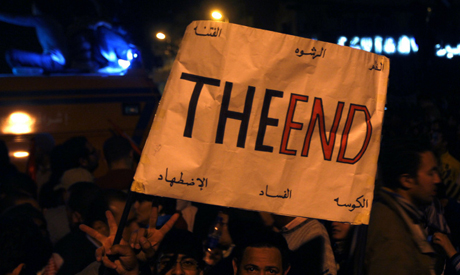


“Do not give up, Do not get bored, Do not stop,” screamed the title of a motivational video on the Facebook page of the April 6 Youth Movement.

The movement, which emerged as one of the main players in the Egyptian revolution, accompanied the video with an invitation to the “Save the Revolution Friday” million man march on 1 April. The purpose of the event, they say, is to press on with the rest of the revolution’s demands, rid Egypt of the “institution of corruption” with all its figures and symbols and to challenge the counter-revolution initiated by the old regime which, they say, is playing behind the scenes to end the Egyptian revolution.
“The Egyptian people will not accept the laundering of the old regime and presenting it back to them in a new form,” wrote the group in the invitation, explaining that they insist on the complete removal of the remnants of Mubarak’s regime from every institution in the country.

No one can deny that the Egyptian revolution inspired the world. To peacefully topple a dictator like Mubarak who ruled the country with an iron fist for 30 years in just 18 days was seen as a miraculous achievement, one that stunned the whole world.

And the Egyptians basked in the praise, reminding themselves that they did the impossible. “We were even faster than the Tunisians who needed a whole month to topple their regime,” they said as they nudged each other. But it seems that while the revolution was successful at first, it has begun to burn out.

Following the fall of Mubarak, the prosecutor-general announced that Egypt’s former untouchables including Ahmed Ezz, a close confidant of Gamal Mubarak who monopolized the steel industry for years and the detested Minister of Interior Habib El-Adly, would face trial. Assets of former ministers and corrupt businessmen were frozen, the Parliament and Upper House were dissolved as was the state security apparatus and many of its officers were put on trial.

But then the situation turned sour. Many of the revolutionary demands were not met, without any satisfactory explanations from either the Armed Forces or the “revolutionary government” of Prime Minister Essam Sharaf.

Mubarak has not been put on trial. The National Democratic Party (NDP) is still alive and kicking despite the revolutionaries insisting that it has to be dissolved. The local councils and governors appointed by the old regime have not been replaced; editors of all the national papers, associated and hired by the old regime, remain in their positions; members of the old regime still dominate most workers’ unions and public companies; the emergency law has not been lifted and most political detainees remain in captivity.

The shame list does not end there. Members of the old regime, including those the April 6 movement dub the “axis of evil” – Safwat El-Sherif, Zakaria Azmy and Fathi Sorour – have neither been arrested, nor investigated.

Reports and eye witness accounts have emerged that the army detained, tortured and even performed virginity tests on protesters seized in Tahrir Square on 9 March. Many of the protesters were then put on trial in military courts and handed prison sentences.

Two weeks after Tahrir was cleared by the army, the government approved an anti-strike law banning protests, strikes and sit-ins that “damage the economy” and slamming a one year sentence and fines of up to half a million pounds on protesters. This was followed by a new political parties law, which stipulated that any new political party must have at least 5000 members across ten governorates to be registered, which means that many political parties, still under construction will not be able to recruit enough members in time for the parliamentary elections in September. This, say analysts, means that the next parliament will be dominated by those who are ready, namely the NDP and Muslim Brotherhood, who not only have the numbers but also the presence in the streets and towns of Egypt.

The starkest reminder is Tahrir Square; the symbol of the revolution is now empty save for the normal traffic after being filled with millions of protesters. All this has made people ask, has the Egyptian revolution lost steam? Did it speed like a train only to now be stuck in the same stop, unable to move?
“I don’t understand,” fumes Ahmed Bahaa El-Din Shaaban, an activist and one of the founders of the Kefaya movement “During the Sadat and Mubarak eras, political parties needed only 1000 members and now in the revolution they need 5000? In the Mubarak era you could protest and now in the revolution there is an anti-protest law? Does this make sense? The honeymoon phase is over and obviously if we want to save the revolution, we have to work hard because something sinister is going on.”

A counter- revolution, says Aida Seif El-Dawla, a human rights campaigner and political activist, is what's going on. “All this is evidence that there is a very strong counter-revolution at work here,” she says. “The old regime wants the revolution to end here, because any more changes will harm them greatly. But the revolution has not ended, not at all.”

But, she adds, the revolution is under threat, which is why many activists have put together “Popular Committees to Protect the Revolution” across the nation. Each committee is comprised of the residents from a neighbourhood and works on raising political awareness of the revolution and its goals to galvanise grassroots support. There are currently 40 committees working throughout Egypt and, says Seif El-Dawla, they are organizing a general conference for 22 April to discuss how to maintain the momentum of change.

Ahmed Ezzat, a young lawyer who coordinates 25 of those committees, says that the committee has also begun releasing a newspaper called Revolutionary Egypt, with a print run of 50,000 copies per week.

“This publication helps us raise awareness of the fact that the revolution is far from over and explain to people how the counter-revolution functions and how they are misled by the state media every day,” says Ezzat.

But it’s not just awareness that they want, says Ezzat, but also the support of the people. The idea to create this committee came to him while he was still in Tahrir Square during the revolution.

“I met people from different suburbs, cities and workers unions and thought that we need to recruit these people so that when they go back home, they can spread the message of the revolution to their families, neighbours and friends,” explains Ezzat.

In fact, it is these people who will keep the revolution alive and kicking, he says.

“Some people say that the problem with this revolution is that it doesn’t have a leader,” says Ezzat. “But for me the problem is that it doesn’t have a body, it needs support and people, lots of people to keep the pressure on.”

But, says Ezzat, it’s hard enough when the state media is telling the people to back off.

“They keep telling people that we should be patient and give the Armed Forces time and they play the stability tune,” says Ezzat. “But no, if we give them a chance, they will use it to regroup and repress us again. Besides why do they need time to put Mubarak on trial, aren’t all the corruption files there? How about the emergency law, why do they need time to lift it?”

The writer and historian Saad Zahran says that one of the problems with the Egyptian revolution is that it is not “owned by anyone.” It was not triggered by a political party, a secret organization, or pushed forward towards a specific political ideology. It was, as most Egyptians will proudly tell you, a mass uprising that did not leave out any political factions.

“This was glorified and hailed by the media,” explains Zahran. “The best thing about our revolution is that it doesn’t belong to anyone, that’s what the media sang for days. But this is not a good thing. It means that nobody prepared for it and there is no unified vision; it means that everyone right now is confused, trying to think of ways to move the country forward, which leaves the arena empty for anyone to hijack the revolution and use it to benefit their own interests.”

Indeed, while Egyptians made a show of unity to the world during the revolution, now everyone is at loggerheads about what to do next. The 19 March referendum on constitutional amendments laid these differences out in the open.

The Muslim Brotherhood, which actively participated in the protests in January, campaigned heavily for a “Yes” vote during the referendum, while the rest of the political parties and groups were against the proposed amendments. The referendum also opened up sectarian divides; many Christians hoped for a “No” vote, in opposition to Salafists and supporters of the Brotherhood.

Political scientist Emad Gad says that the military council rejected a plan presented by the country’s intellectuals to slowly ease the country towards democracy by creating a presidential council made up of two military officials and a civilian, and appoint a constituent assembly to write a new constitution before holding parliamentary and presidential elections.

“But no they insisted on holding a referendum extremely fast which they held in an undemocratic environment,” he says. “They saw the use of religion to manipulate the public to vote yes, they witnessed the Salafists terrorizing anyone who wanted to say ‘no’ and they did nothing about it.”
All this, adds Gad, coincided with a public relations campaign, aimed at scaring the public into following the council’s plans without objecting. The release of the Islamic Jihad member Aboud El-Zomour, who was convicted for the assassination of President Anwar El-Sadat, from prison and his subsequent appearances on television, the video of Sheikh Hussein Yaqoub, a famous Salafist cleric, who described the ballot boxes as “ghazwa” (a term used during the era of Prophet Mohamed to describe a battle) and calling anyone who voted “No” a kafir (infidel), were all in sync with the plans of the military council, says Gad.

“Why did they let El-Zomour say on national TV that he wants to cut people’s hands and legs off, why did the video of Yaqoub go viral on the internet?” asks Gad.

Another suspicious issue is the sudden appearances of Salafists and reports of them attacking Christians which began spreading shortly after the revolution, a big blow to the protesters who claimed that national unity was one of the main values of January 25. Last week, it was reported that Ayman Mitri, a Coptic school teacher in Qena,had his ears cut off by Salafists who accused him of running a prostitution ring. On Monday, a text message was sent to women across the country, warning them that the next day, “Salafists will hold protests in streets and squares and have said that they will kidnap any woman who is not wearing a veil,” and went on to warn women to stay home.

“This is all so suspicious. The military council has opened the door for all the Salafists and other extremists to scare the people. To make them feel that they need their protection from those crazies and to agree to the transitional plan they have.”

Shaaban is clear on what Egyptians and their revolution are now up against. “The military council and the Brotherhood are kidnapping the revolution, stealing it from under the noses of Egyptian,” says the activist. “The council was given the duty of fulfilling the demands of the revolution after Mubarak left, but there is a conflict of interest here because they were part of the Mubarak regime.”

Though worrying, according to analysts, there is no need to fret. The supporters of the revolution may have lost some battles, but the war is far from over.

Amr El-Shoubaki, a senior analyst at the Al-Ahram Center for Political and Strategic Studies, says that the battle has simply changed its form and moved from Tahrir Square to other arenas.

“People are now forming new political parties, independent syndicates, and preparing for the parliamentary and presidential elections,” says El-Shoubaki. “I believe that the next battle will be in the social and political arena rather than on the streets.”

Egyptian workers, forbidden from creating independent unions since 1952, are now organizing unions to speak in their name to demand their rights. But, says Kamal Abbas, the general co-ordinator for the Centre for Trade Union and Workers Services (CTUWS), the workers themselves are facing their own counter-revolution.

After Mubarak stepped down, workers across Egypt held strike after strike, often curtailing the production of their factories and companies.

“But when we investigated the matter, we found that they are often striking because their company is provoking them so that they can strike,” explains Abbas. “For example, you can have an electricity company who refuses to give its workers their benefits, and then tell them to go and protest in front of the ministry of electricity, why?”

The proliferation of independent unions, even among previously unsyndicated professions such as barbers and salesmen, proves to Abbas that things are changing.

“No revolution continues in the same momentum; it usually ebbs and flows,” he says. “But in my opinion it is important for workers and Egyptians in general to organize themselves, so that they can have the tools to fight the next war. And that doesn't mean that the revolution is over but that it has morphed into something different, but with the same goals.”

Last Friday, activists and political groups called for a million man march in Cairo to protest the anti-strike law, but only a few thousand turned up in front of the Radio and TV headquarters in Maspero. As several army officers monitored the protests, one protester began chanting the popular slogan during the revolution of "the people and the army are one hand." This time, however, he was booed and people screamed "not anymore." Now on Friday, it will become clear if the Egyptian revolution is still on or not. Activists are calling for millions to join in and if they do, it will be the first official face-off between the people and the army.

Monday, March 21, 2011

Repost: Controversial outcome to Saturday's Elections

Controversial Outcome to Saturday’s Elections

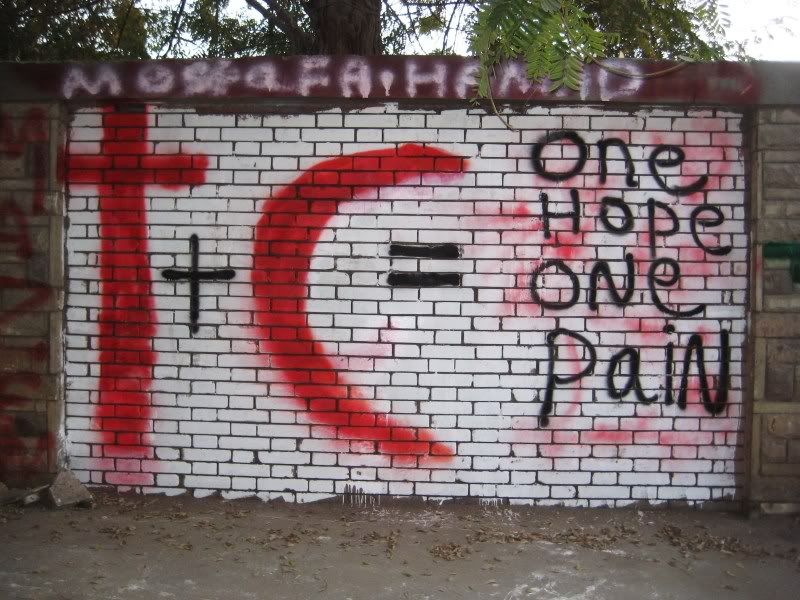
One of the latest murals cropping up throughout Egypt showing support for a secular Egypt, Christians and Muslims: One Hope, One Pain
Saturday was the first “democratically-held” elections that Egypt has seen in a long time, if ever. Egyptians, at least 16 years of age with identification cards, went to local high schools to vote on constitutional referendums which included a quick presidential election to be held within six months.

Many voters said “no” to this proposal as it does not give enough time for opposition parties to organize their campaigns. However, Referendum Chairman Mohamed Attiya said that Egyptians voted more than three to one in favor of the amendments with 41% of eligible voters turning out.

I suppose the three-to-one ration includes a majority of people whom I do not know since everyone I spoke to voted no. My own poll: three-to-zero in favor of postponing presidential elections. In fact, I only heard of a friend of a friend that actually said yes. And now everyone is in a frenzy.

This video is one of many that went viral inspiring computer-savvy Egyptians to vote no while giving background as to why, and I think that there should be stock in the use of multi-media since that was proven to be the main backbone of the revolution.

And yet, the outcome came to a resounding "yes" followed by concerns of the Muslim Brotherhood.

“Egypt's best organized political forces, the Muslim Brotherhood and members of the former ruling party, campaigned for passage,” according to NPR. So ladies and gentlemen, it’s time to get your panties in a wad and get geared for another al-Qaeda/Hamas faction…

No. Not really.

For the 1000th time, why is so much stock being placed in the Muslim Brotherhood? The Muslim Brotherhood constitutes a very small percentage of Egypt. They had nothing to do with the revolution, only took part after it gained speed. The younger Egyptians called on the revolution and the younger Egyptians will NEVER support the Muslim Brotherhood.

NPR continued: “The Brotherhood, which has strongly campaigned for the adoption of the changes, advocates the installment of an Islamic government in Egypt. The ambivalence of its position on what role women and minority Christians play under their hoped-for Islamic government — like whether they could run for president or be judges — worry large segments of society.”

Oh for the love of God, STOP THE PRESS ON THE MUSLIM BROTHERHOOD ALREADY!!! CAN’T YOU SEE IT ONLY SERVES AS A RECRUITMENT TOOL (as I blog about this – pot, kettle, black).

If the election outcome was rigged, it isn’t to back the Muslim Brotherhood. It is only to put the military at a greater advantage to install yet another military ruler. Don’t believe me, look at the history in Egypt and throughout Africa.

I was getting my hair done a few weeks ago and my hairdresser, Ahmed, began discussing the most viable presidential options as he saw it. He discussed the Muslim Brotherhood and said, “We will never let them control our country.” Ahmed is not a young Egyptian, but rather a mid-40 year-old from a poor area outside of Maadi.

Were the elections “free and fair”? I’m sure that isn’t the case, but it is an uneducated fool that would think such progress could be made overnight. However, it is hoped that with each new election, it will get better.

Who are most Egyptians gunning for? Ahmed said, “I don’t know who will be our president. I can’t say. I just hope that he leads with a good heart.”

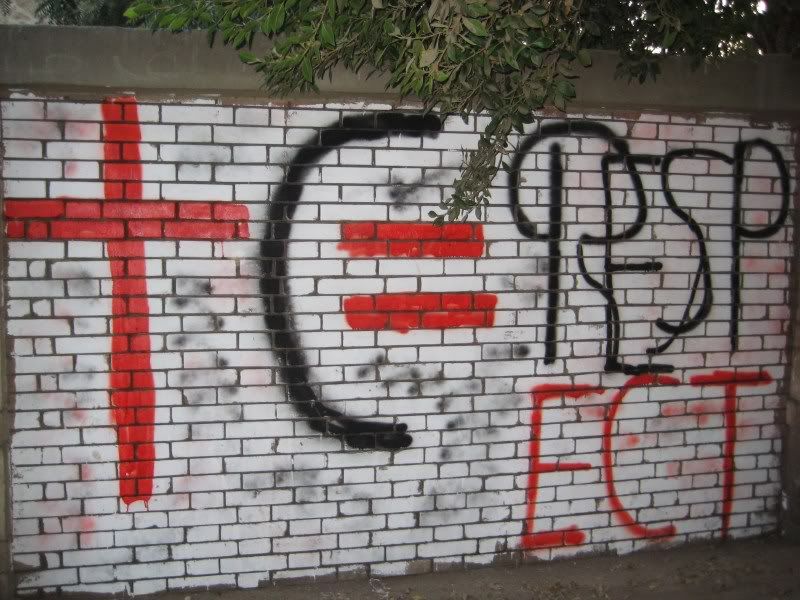
Another message painted on a school wall with the Christian symbol (cross) and Muslim symbol (moon)

Source.

Friday, March 18, 2011

A Voice of the Revolutionary Youth

This is a re-post from a friend of mine, Amr Bassiouny, who has been passionately involved in the Egyptian Revolution from beginning to present. He presents an interesting viewpoint on the voting, scheduled to take place tomorrow.

Tomorrow is a big day for anyone involved in the Revolution. Voting "NO" on the amendments will enable the formation of an entirely new Constitution, unprecedented in this country's recent history. Voting "yes" will allow ammendments to the present Constitution; it's a very hot debate indeed.

Here's a pic from what I've started seeing here in Hurghada, just one of many cars I saw with posters and flyers proclaiming "La2a" or "No" in Arabic.


And without further adieu, here is the posting from Amr Bassiony.

Will the real counter-revolution please stand up?

I have recently avoided offering my opinion in writing on the matrix of political and conspiracy theories that have been flooding the airwaves, Internet and offline conversations since January 25 — partly due to frustration but also because I found it rather difficult to form of a clear picture what was going on. But right now, a certain sense of clarity has hit me and some pieces of the puzzle are coming together. So I’d like to share with you what I regard as a plausible scenario.

Bear with me, it may be a little complicated and confusing at first, though I’m hoping my point will become clearer as your read your way to the end of this post.

The Plan

The National Democratic Party (NDP) has always kept the sheep in line using fear.  There were only two options for us: either we have a “secular” government that will create stability and safety for us all, or we will have to accept the Muslim Brotherhood (or the “Brother Muslimhood” as our former number one intelligence man Suleiman liked to call them) and live under an Islamic government.

Now that the president is ousted, and people have woken up to more options, more freedom and a desire to create their fate, someone (and his entourage) are not happy. If I were the head of the NDP, and I wanted to prove all those “bastards from Jan25” that broke my back that they were wrong and I was right, what would I do? I’d stick to my word and fulfill the prophesy that I had once predicted.

Prophecy #1: Instability & Insecurity

On January 28, what was the first thing that this government did? Rewind back a few weeks. Remember when club-wielding vigilantes set up cordons on streets, and teary-eyed house wives called in to State TVs wailing about thugs and people breaking into their homes. Remember that horror movie? That was our government fulfilling their promise, and they did; they created widespread chaos, insecurity and instability.
And mind you, this was not a burst of instability, it’s part of a long-term plan that is meant to sustain a level insecurity that can remain for months if not years, and the following events point to that:
  • Before the Military Council came in power (i.e. events left to happen by the NDP)
    • Large number of prisoners released.
    • Looting, widespread crime and terrorizing neighbourhoods.
    • Stolen police and military uniforms and weapons.
    • Destroyed economy (financial/economic security).
    • Chaos within the ranks of the Interior Ministry.
  • After the Military Council came in power (i.e. events that happened as the Military Council watched, possibly with their blessings)
    • Shenanigan of State Security Investigations (Amn El Dawla) immediately after the resignation of Ex-Prime Minister Ahmed Shafik.
    • Sectarian violence (in the presence of the military).
    • The torching of Atfeeh Church by thugs causing the Christians to come out on the streets in protest.
    • Christians attacked by “thugs” immediately after chanting “Allah Akbar!” (warming us up for the Bogey Monster — the Islamists?)
    • Women’s march attacked by thugs.
    • Thugs and military holding a joint operation to attack and arrest protesters in Tahrir and evacuate the square.
    • Military attacking Coptic Christian protesters in Maspiro when their numbers dwindled.
To conclude that point, the NDP said that without them there would be instability and now there is instability (because of them). The military only continued to fulfil this prophesy by working with thugs to instigate the sectarian violence and eliminate legitimate demonstrations.

Prophesy #2: The Bogey Monster/ “El Bo3Bo3”

The second thing we were reminded of, in a manner of speaking, through recent event was the so-called political strength and “organizational might” of the Muslim Brotherhood (MB), they were the Bogey Monster, or “El Bo3bo3” if you prefer it in Arabic.  The second part of the prophecy had to be fulfilled; the Islamists would take over just because they were so powerful as the NDP has always warned … or are they?

This is a much more complicated and much less obvious unfolding of events happening at the moment, so let’s collect those dots then connect the dots together.

The dots:
  • Top NDP officials are not targeted. Those who were handed down travel bans, asset freeze, or were put under investigation are almost only businessmen ministers, which by comparison to some big wigs, were probably the least corrupt (if at all) of all those who were involved in government. The most powerful and corrupt (Safwat El Sherif, Fathy Sorour, Mofid Shihab, Zakareya Azmy & the Mubaraks) were excluded.
  • The US officially says that it does not mind having the MB in the political scene (note that the US heavily funds our military).
  • The MB becomes a legal entity and is allowed to run for major elections.
  • One MB member was on the constitutional amendments committee from day 1.
  • The NDP states that it will not disband, and will run in the upcoming elections.
  • Aboud El Zomor is released from prison (one of the main figures in the assassination of our late president, Anwar El Sadat)
  • Note that the following entities/persons are pushing to vote “NO” to the constitutional amendments & want a new constitution:
    • Amr Mousa
    • Ayman Nour
    • Mohamed El Baradei
    • Judge Hisham El Bastawisy
    • Constitutional law professor Dr. Tharwat Badawy
    • The Judges Club
    • The Revolution Youth Coalition
    • El Wafd Party
    • El Ghad Party
    • Your mother
    • Your father
    • Jesus
    • … and Bhudda
  • The following entities are pushing to vote “YES” on the amendments:
    • The NDP
    • The MB
    • The Salafi Movement
  • The MB officially saying they will not run for presidency, but plan on taking 30-40% of the seats in Parliament.
  • If the constitutional changes are passed, then the elected parliament is entrusted in making the new constitution, and the president has no choice but to enforce it.
Add all the givens regarding instability section plus the actions of the military, that only aid the NDP in going forward with their plan.

Connecting the dots

There is a strong connection or shared interest between the military, the NDP and the MB, who seem to be on one side, while the whole moderate and non-religious political spectrum seems to be on the other.  The NDP and MB have the same common goal of voting “Yes” in the referendum (they’re both strong, have deep pockets and can mobilize supporters), and the military is either working with them or pushing them in that direction (in either case, there is “tawato2”).

On the other hand, we must face the fact that the military is helping in creating an environment where the MB have an upper hand through pushing for early parliamentary elections and refusing a presidential council.
From a political perspective, the MB is looking to control the political landscape through the parliament, not through the presidency.  This is almost a disguise so they can appear to be a lesser threat that is not after taking over the country.  But the fact is that it is in the best interest of the MB to have one of its own as the speaker of parliament, as that position will be equally if not more powerful than the upcoming president (in the more probable case of a parliamentary model of government). If the MB hold a relative majority in parliament (as they openly plan to do), that means that they will be entrusted with making a new constitution, giving them unprecedented control.

Also, there is seems to be a sort of acceptance towards the MB, from the US to the Military and NDP (in that order). Perhaps a deal was cut?

The NDP’s ability to control the parliament in the upcoming elections is questionable, although considering their confidence and refusal to disband, they most probably have a plan to stay in the game one way or another.  I don’t want to speculate too much on this point though as it is not yet clear to me how that may happen.

On the other side of the spectrum, the opposition parties and figures are too busy trying to be president because it’s fancy, while forgetting that the next government may very well be parliamentary in nature and thus the power will lie with the entity that can control the parliament, not the president’s office. This is a major political blunder that they seem to be oblivious to at this point.

The Military: What gives?

The question remains: what does the military have to gain from this? I can argue that it’s clear and obvious. Field Marshall Mohammed Tantawy has been Mubarak’s man for decades, and there’s no reason why he should not continue to be so.  If anything, he is the only reason why Mubarak can lead a quiet life in the red sea resort of Sharm El Sheikh now while we all swim in the turmoil that he has thrust us into.

The fact of the situation is that the Military is clearly not working in the favor of this revolution, and they are not listening to us so intently and responding to our demands as some have claimed. They have shown that they will torture innocent protesters (including artists) inside the Egyptian Museum, and that can’t be good, let alone those that they falsely label arrested protesters as “thugs,” and are currently facing the threat of execution alongside murderers and highway robbers.

So, if the Military isn’t working with us, does that mean they’re actively working against us? Are they perhaps working with either the MB or the NDP?  Which one it is? I personally don’t have the answer … I doubt anyone does. There remains as a big question mark.

Conclusion/Speculation

Following the previous train of thought, it is rather plausible that the MB are being pushed into controlling our next government, possibly in conjunction with the NDP — with the backing of the highest ranking political officer in the military, if our fears and doubts are true.

From there, the NDP (or whoever is representing their interests at that point) can come out and tell us “we told you so” about the MB taking over, and “we are your only saviour.”  We will then be expected to bow down to their command once again in order to rid ourselves from the Islamic government that we revolted and fell into. Iran, anyone?

When that happens (and the people will be fed up by then) the thugs will come back out to the ballots and the rigging will happen all over again in favor of the NDP. But this time, the people will accept it, in fact they will probably welcome it, because they have seen what the country might turn into after Mubarak and his entourage were removed, putting us straight back into the hands of the one political gang that we revolted to rid ourselves of.

Now, this is what a true counter-revolution looks like in a country like Egypt is corrupt down to the bone. We the people are on our own against all odds, against all forces working against us. Against a counter-revolution that is powerful and that is strong, manipulative and with many faces. Though the one thing that they do not understand yet, is that they cannot stand against the will of a nation.

The only way to foil this plot is to vote “NO” to the constitutional amendments.  Even if the argument is not clear to you or you cannot explain the intricate details of the amendments, you can put it in this simple argument:

Dear Sir,

Here are the people who are for the amendments: the NDP, the MBs, and Salafis … and here are those who are against it: Everybody who’s for freedom and who has the country’s interests in mind.  Which side do you want to be on here?

Thank you and have a good day.


Follow Amr on his Twitter @AmrBassiouny

Saturday, July 17, 2010

Egypt's Pharonic Rule

President Hosni Mubarak, or as many have deemed to call him, Egypt's modern Pharaoh, is reportedly very ill, leading many Egyptian commentators and critic to foresee great changes to the Egyptian political stratosphere. Will Hosni Mubarak's son, Gamal, assume the Egyptian crown, or will the conservative Muslim Brotherhood live through their increasing popularity on the streets and gain control over the government in Egypt.

Many Egyptians have a great deal to say on the matter, but equally just as many are content to sit back and say nothing, having become accustomed to the inability to speak out about politics in their country. I ran across an extremely interesting article in The Economist that discusses precisely that, the changing regime in Egypt, and the changing face of modern day Cairo. I felt it pertinent to share it here for all, and have added my comments in bold.

The long wait

After three decades of economic progress but political paralysis, change is in the air, says Max Rodenbeck


TRAVELLING into Cairo, Egypt’s monster-sized but curiously intimate capital, it is hard to tell if these are the best of times or the worst. Visitors who have long known the city are in two minds. Egyptian expatriates returning home are liable to cringe at the worse-than-ever traffic, the ever-louder noise, the fervid religiosity, and what they often bemoan as a new aggressiveness that spoils their nostalgia for a sweeter, cheerier Egypt. But tourists who came here, say, 20 years ago, tend to delight in the sleeker look of the place, the surprisingly efficient and still friendly service, the far better quality and variety of goods in the markets, and the fact that some taxis now actually have functioning meters. side note: Although many taxi's now have meters, most still don't use them, or for those that do, many will double the cost and overcharge people

Both impressions are right. The new World Bank-funded, Turkish-built terminal at Cairo International airport is as blandly functional as Cincinnati’s or Stockholm’s. Gone are the sweaty officials and greasy baggage handlers of yore, the taxi touts and shoving crowds. A businessman arriving here may be whisked in an Egyptian-built car to the cigar bar at one of Cairo’s dozens of swish hotels—perhaps one at City Stars, a commercial complex on the scale and in the style of Las Vegas. Or perhaps to another fancy hotel in one of the burgeoning gated exurbs in the desert, surrounded by the lavishly watered greenery of a designer golf course. There, the talk will be of beach houses and yachts on the Red Sea, of hot stocks on the Cairo exchange, and of Egypt’s delightfully low-cost labour. which would then encompass less than a third of Egyptian society. Egypt's social strata is one where the idiom "the rich get richer and the poor get poorer" couldn't be more true. Rich upper class Egyptians have more money than they know what to do with, while for many in the lower class, finding enough cash to feed a family for a week (let alone a month) is a far greater concern .

A less lucky traveller, however, might instead see these things as most Egyptians do: in the giant backlit billboards that clutter Cairo’s roadsides and rooftops, vividly flaunting the unattainable. The consumer paradise they display, with perfect hair, light-skinned children and men in pinstripe suits, stands in stark contrast to the harried, shuffling crowds below. Such sights will probably be accompanied by an earful of complaint from the driver stuck in a jam: about corrupt traffic cops and the absurd impossibility of feeding and schooling the kids on $150 a month, but above all about politics, the staple of all Middle Eastern conversationalists.

Political talk in Egypt has always been acidly cynical, but now a new bitterness has crept in (aided in no part by the increasing access to Internet that more Egyptian youth now have). This has not been prompted by any change from above, since little has really changed in Egyptian politics since President Hosni Mubarak came to office 29 years ago. The sour mood is informed instead by the contrast between rising aspirations and enduring hardships; by a growing sense of alienation from the state; and by the unease of anticipation as the end of an era inevitably looms ever closer.

It is not surprising that Egyptians should feel rather like driftwood on the Nile, accelerating towards one of the great river’s cataracts. Their current pharaoh is 82 years old, visibly ailing, and has no anointed successor. Most of his people have known no other leader. The vast majority have grown so inured to having no say in the course of events that the reflex is to float patiently rather than try to paddle. Parliamentary elections are scheduled for November this year and presidential ones for September next. As usual, few citizens are likely to take part. They will watch from the sidelines and accept the preordained results with grim humour.


Losing patience

Nevertheless, the expectation of a seismic shift is almost tangible in the air, and not just because of Mr Mubarak’s health. Egyptians may be renowned for being politically passive, but the rising generation is very different from previous ones. It is better educated, highly urbanised, far more exposed to the outside world and much less patient. Increasingly, the whole structure of Egypt’s state, with its cumbersome constitution designed to disguise one-man rule, its creaky centralised administration, its venal, brutal and unaccountable security forces and its failure to deliver such social goods as decent schools, health care or civic rights, looks out of kilter with what its people want.

For some time Egyptian commentators have been noting resemblances between now and the years before Egypt’s previous seismic shift. That happened in 1952, when a group of army officers rolled their tanks up to King Farouk’s palaces and tossed him out. The coup was wildly popular at the time. It had followed a period of drift and growing tension, marked by strikes, assassinations, riots and intrigues between Communists, Muslim Brothers and the king. Egypt was thriving economically, but the spoils flowed mostly to a cosmopolitan elite that was out of tune with the street. It had a functioning democracy, but ever-squabbling politicians seemed unable to get things done. To general chagrin they could not shake off the lingering influence of Britain, whose soldiers refused to budge from the Suez Canal where they had been encamped since 1882.

The officers’ coup replaced this genteel but dysfunctional constitutional monarchy with one-party rule, fronted by a strongman and backed by secret police, with the tanks idling nearby. Republican Egypt became a model for other Arab dictatorships and forced wrenching changes at home. Its promises of free health and education, land reform and jobs in state factories and offices did lift millions out of misery to mere poverty. The ideology of pan-Arabism trumpeted by the coup leader, Gamal Abdel Nasser, gave Egyptians a place of pride in the world, even if his boldness brought ruinous wars in Yemen and against Israel.

Six decades and four presidents on, the revolutionary regime has metamorphosed into one that encourages private business and allows for some pluralism. Yet it looks to many Egyptians like a waning dynasty—the 45th in the long line of houses that have ruled the world’s most enduring nation since 3000BC. Its promises are largely in tatters. Schools and hospitals are indeed free to enter, but they are grim, bare, crowded places where getting learning or treatment requires cash that many still do not have. The lower middle class of army officers and bureaucrats who rose in the revolution have joined the gentry they were supposed to have ousted, adopted their haughty ways and now share Egypt’s spoils with them. The poor still queue for government-subsidised bread and must scrimp and save to buy a pair of shoes.

The government’s plan to perpetuate itself in office, via the traditional electoral rigmarole, is likely to go ahead. Predictions of change in Egypt have almost always proved wrong; generally it bumbles along much as usual. This time may just be different. The country now faces three main possibilities. It could go the way of Russia and be ruled by a new strongman from within the system. It might, just possibly, go the way of Iran, and see that system swept away in anger. Or it could go the way of Turkey, and evolve into something less brittle and happier for all concerned.