Thursday, March 29, 2012

Female MB Representative Supports FGM

In a move that is raising a great many questions, Azza El Garf, a female representative in the Muslim Brotherhood's Freedom and Justice Party, has expressed her support for the practice known as Female Genital Mutilation.

In Egypt's post-revolution parliament, female representatives make up a meagre 1 percent of legislatures currently serving. Of this 1%, El Garf is a prominent figure. Her recent comments on FGM shed distinctive light on what the potential future for women in Egypt may be shaping up to be.

The Muslim Brotherhood's Freedom and Justice party made headway with voters during initial voting rounds by promoting their family friendly ideals and their staunch support of Islamic Shariah as the primary source of legislation. For months now, liberal thinkers and women have speculated on how the FJPs domination in the parliament could potentially reverse the small milestones achieve by women in Egypt. With this parliament dominated by men, the little hope remained in the 1 percent female representation to stand firm in the progress made in the past few years. El Garf's comments serve as an indication that even these women may not be the defenders of women's rights they were hoped to be.

Commenting on the current perception of women in parliament, El Garf says: "People here think women can be a doctor, go to university, be a teacher or an engineer ... But people still think 'women are no good at politics.' We want to change this view."

In what initially appears to be a clear statement that women are here to express their ability to play a crucial role in politics, El Garf goes on to comment on the individual rights that women in Egypt have won over the past few years.

One of these was a ban imposed in 2008 on female castration, or genital mutilation.

"It is a personal decision and each woman can decide based on her needs. If she needs it, she can go to a doctor," El Garf says. She further highlights that according to the Muslim Brotherhood, the procedure is considered a beautification plastic surgery.

The World Heath Organization defines FGM as:  "procedures that intentionally alter or cause injury to the female genital organs for non-medical reasons." It goes on to say that the procedure has no health benefits for girls or women.

The practice of FGM is in itself contentious. Many traditional societies believe that through FGM, the purity of a young girl can be preserved by removing the unclean portion of her genitals. Others believe that removing the clitoris prevents a woman from have sexual urges, thereby ensuring she will not be tempted to engage in illicit sexual behaviour. The list of negative repercussions it can cause to a woman are endless, and include but are not limited to: cysts, infections, infertility, and in some cases death. FGM is primarily carried out on younger girls, mostly before the age of 15.

Despite this, El Garf's opinion is that a girl should have the right to choose to mutilate her genitals or not. But the question here is, how many young girls aged 1-15 will fully understand the repercussions? To provide a girl with the right to make a choice will require educating her on the potential impact later on in life, does this then mean El Garf is suggesting launching earlier sex education for women to be able to make an informed decision on FGM?

More worrying are El Garf's statements on divorce. Many women in Egypt, particularly Muslim women, are forced to suffer long and troublesome marriages, oftentimes in an abusive situation. In what at the time was considered a land-mark move, in 2005 the Egyptian courts passed a law permitting a Muslim woman the right to file for a 'no-fault' divorce without first needing the permission of her husband or a male relative. El Garf believes these have allowed the legislation surrounding divorce to become too "lax," and supports the imposition of more stringent conditions for divorce. She does not clarify if this means that the husband's permission will first be required for any woman to file for a divorce, nor anything about women facing abusive husbands.

As the FJP continues to solidify its hold in the Egyptian political arena, comments such as those made by El Garf are becoming more frequent. Feminists in Egypt have much to worry about upon seeing a woman verbally trample on the minor rights they have long and hard fought for. Many of those who fought hard to bring 30 years of dictatorship to an end are now asking themselves, "is this the democracy we fought and died for?"

To read more on El Garf, click here.

Wednesday, March 28, 2012

Bailey's Chocolate Cream Frosting

I love Bailey's, and like most women, I love chocolate. So is there anything better than a combination of the both that can be used as a frosting for cupcakes? Mmm, I think not. I actually whipped this creation up myself the other day while searching for a suitable frosting for Vanilla Cupcakes. Can I tell you a secret? I've been eating the frosting without the cupcakes :p It's that good.


So here's what you'll need: 


  • 250 grams of cream cheese, softened to room temp. 
  • 150 grams of chocolate
  • 1 1/2 cups icing sugar
  • 1/2 tbsp of butter
  • 1 tbsp Bailey's


Directions: 


Melt your chocolate with the butter. The trick to melting chocolate so that you get the rich and smooth texture is to avoid placing it directly on the heat. Best way to do this, is to place your chocolate in a pot, and place that pot on top of a pot of boiling water. It will provide consistent heat for the chocolate to melt. Adding just a 1/2 tbsp of butter gives you a smooth rich chocolate sauce that will easily pour.

Take your softened cream cheese and gradually add the icing sugar. Stir until smooth and most of the lumps are gone.

Add your chocolate sauce to the cream cheese and icing sugar mix. Stir well.

Finally, add your tbsp of Bailey's and stir through thoroughly.

Use to frost cakes, or as a delicious topping to cupcakes!

Bon appetit :)


Saturday, March 24, 2012

Egyptians Need Not Apply

In the past few days I have seen a few different postings on various Hurghada sites commenting on the need to be attractive for a few different things. One was a job description, in which the company put at the top of their requirements, must speak Polish and be good looking. With such a subjective requirement as being part of the job, I have to wonder how many people read the description and move on for fear that they might not meet the 'good looking' requirement. I had to ask the original poster, and his response was simply "being good looking is a requirement in all facets of life isn't it?"

Perhaps this is what is so wrong with society these days. In Egypt, women of a Western persuasion will deal with harassment on a daily basis ranging from cat calls to the more violating, yet thankfully infrequent, groping or flashing experiences. As Islamists continue to gain more control in the political arena throughout the country, it is not surprising to hear rhetoric being thrown around of imposed veiling, morality police, and the like. So this is all well and good on paper, but then when you see things like "good looking" as part of a job description, it completely polarizes the majority of potential employees. It may as well say "veiled and over-weight women need not apply." It takes advantage of the image people have of Western women in Hurghada (that is, we are all easy and overly-friendly), and uses to the advantage of the company the sexually driven desires most Egyptian men have when speaking with a foreign woman. Talk about a double standard.

With this in mind, I ran into this flyer posted on facebook:


Yes, that does say "Face and dress control." Again, a completely subjective method of permitting entrance. Does this translate to "if you're ugly don't even bother?" Even more questionable is with the stringent couples and dress code policies that are portrayed by the night clubs in Hurghada, why entering these establishments does not live up to the expectations. Any single woman can expect to be accosted by the men in there hoping for their one foreign fling, as we all bear the scarlet letter of harlot being from the West.

Is it not about time that these ostracizing stereotypes be addressed in Egypt? Perhaps the worry of an imposed hijab is not all that women in Egypt should be mindful of. Perhaps a bigger question we should be asking, is if Egyptian women find themselves with an imposed hijab written into the legislation, how much further is this going to push Western women living in Egypt onto the outskirts and cause harassment to skyrocket?

In a town like Hurghada which makes the majority of its income from tourism, this concern should be at the forefront of many business owners’ minds. Further alienating the foreign population, specifically the foreign female population, may actually end up back-firing on them and seeing a reduction in business rather than a surge in good-looking entrants.  If conservative ideals and subsequently conservative dress continues to spread throughout Egypt, Hurghada may find itself facing a long and up-hill battle to un-do the years of polarization foreign women have been subjected to. After all, if all the foreign women leave, the over-sexed men may have no choice but to turn to hijabis for their next "good-looking" endeavour.


Wednesday, March 21, 2012

A Moonlit Marina

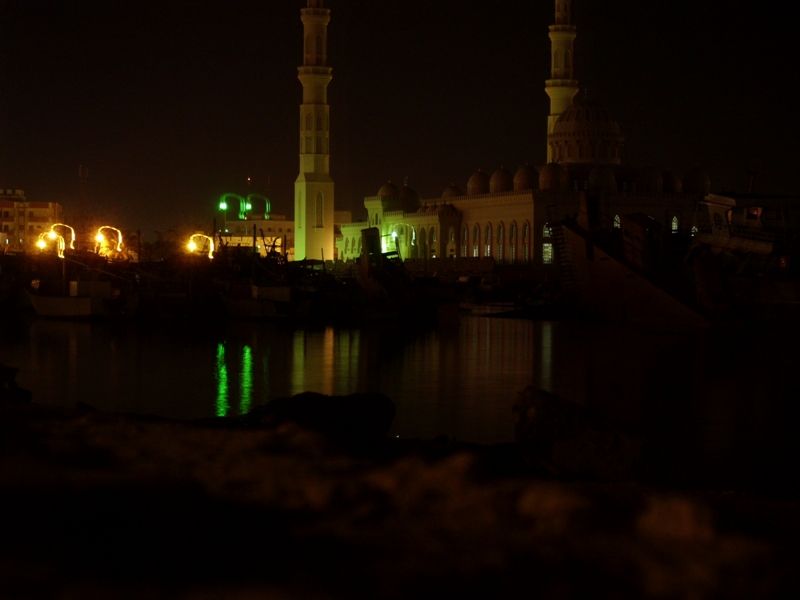
I was out last week during the full moon with K and his family taking a stroll along the end of the Hurghada New Marina. I decided to play around with my camera a little bit, and ended up with these shots which I wanted to share with you.

Full moon over the Red Sea


Mosque at night!

Fishing Trawlers docked for the night

Hurghada at night

Red Sea Dream


[All photos copyright Susan Richards-Benson. Photos may not be re-produced without express permission] 

Saturday, March 17, 2012

Where to Go - Lips 4 U

I'm sure this is a grievance that many women, particularly expat women, have living in Hurghada. It is nigh on impossible to find decent make up without paying through the nose for it. Sure, the pharmacies dotted on virtually every street corner throughout the city offer cheap knock-offs and 5 LE mascara, but for those looking for make-up that will actually last past the first application, these are out of the question.

When you do find shops that sell brand make-up, such as Max Factor, L'Oreal, or Estee Lauder, the prices are astronomical. I understand mark-ups for importation prices, but I am not willing to pay close to $40 for what would normally cost $15 dollars outside of Egypt.

With this in mind, I was pleasantly surprised to find Lips 4 U. Located on the street parallel to Sheraton Road, between Central Street and Metro Market, Lips 4 U offers a wide range of make-up and beauty products both imported and local to Egypt. Not only this, but their prices are extremely fair!

I managed to find a bargain deal on a new Max Factor mascara, marked at 70 LE. Considering I have seen this same mascara for sale priced at 150 LE, you can't go wrong.

Lips 4 U is owned and operated by Taru, who has recently moved to Hurghada from Sweden. Taru speaks excellent English and is more than willing to let you browse and look around. I loved this, as so often in stores here you feel that the sales associates have to act like your shadow, making the entire shopping experience far more stressful than it needs to be. For me personally, when I want to browse I like to be left alone :p

Taru also offers appointments for manicures (Gel nails), and hopes to eventually branch out with Lips 4 U. I wish you all the best!

For more information, contact Taru on 0106-617-2608. 

Where to Go - Golden Pet

Golden Pet is among the few pet shops in Hurghada worth recommending. Located just behind the Metro on Sheraton Street, Golden Pet offers a wide variety of pet accessories, food, and toys.

Image courtesy of Golden Pet

What sets this shop aside from the multitude of other pet stores around Hurghada is their strict policy against selling pets. Many Hurghada residents will abide by a boycott of any shops that sell animals due to the fact that these often come from breeders who neither care about the welfare of their animal, nor where it eventually ends up. Golden Pet offers birds for sale, kept in spacious cages, and that is it.

Some of the items they offer include dog leads and harness, cat accessories, dog and cat beds, and a wide array of food. They offer imported pet food from Italy, the Egyptian brand Canido (which I would never recommend), and the popular Pro Pac and Sport Mix blend that many owners feed here. Alongside this they offer bird seed and wet and dry cat food.

Staffed by friendly individuals always willing to help, Golden Pet truly offer pet owners in Hurghada a wide range to choose from. Another great aspect is for those looking to travel with their dogs outside of Egypt, Golden Pet can custom order dog crates of any size for you, and ask only for a 10 day period for delivery.

Their hours of operation are Monday through Friday, 11:00 - 22:00, Saturday from 18:00 - 23:00, and Sunday's from 11:00 - 22:00 .

For more information or to find out if Golden Pet has what you're looking for, contact them at goldenpet.store@gmail.com OR by phone on 011-4885-3833. You can also check out their facebook page here.


Wednesday, March 14, 2012

Construction: Hard Manual Labor in Egypt

Anyone that has been to Hurghada knows as well as I know that the town is constantly expanding and growing. As more people move to the city, more buildings are put up to accommodate the swelling population. This often means that old villas are knocked down to make room for apartment buildings in their stead.

One of the reasons K and I chose where we live is due to the fact that the majority of the buildings surrounding us are already complete. I for one do not want to feel that I live in a construction zone. Next door to us stood the frame of an apartment building that has been standing for 25 years.

As tourism in Egypt begins to rise again, construction in Hurghada has gone back into full swing. However, a law passed last year by the government banned any further sale of land in the Hurghada area, meaning that if you planned to construct a new apartment building, you were required to do so on pre-purchased land. A typical sight throughout Egypt is the frame of a building, or a partially completed building with steel beams and wires protruding from the top. There are a few reasons behind this. First and most obviously, the owner of the building ran out of funding, and was forced to halt construction until more funds became available. Secondly, the apartment is often bought by a family who has given birth to a son, and left empty until such time that the son grows up and himself marries, at which point construction on the apartment will be completed and the son and new bride will move in. Thirdly, leaving the building to appear under construction is a tax write off and thus saves the owner a great deal of money.

The credit crunch in Egypt lately has left a lot of building owners struggling to cover the over-head costs of property ownership. A convenient trade has sprung up as a result of this, namely the trade in steel construction parts and concrete. Such is the case for the building next to us, and lead me to witness construction in Egypt as I never really had before.

The CAT was the only 'heavy machinery' used in the
entire process
Now, the "building" next to us was no more than a frame. This frame is held together by steel rods and concrete blocks which themselves constitute a huge over-head cost of any construction project. Gaining access to the steel beams requires knocking the frame down. This was lesson number one; watching the frame of an apartment being knocked down, and wondering why, until I learned that rather than let the frame sit stagnant the owner could make a profit off of it and sell off the construction parts.

The first piece of machinery to be brought in was a Caterpillar demolition tool. Resembling an enormous spike, hydraulic arms cause rapid pumping of the demolition arm, enabling it to easily break through rocks and cement to get at the steel underneath. Remarkable is that this was the only piece of heavy machinery used in the entire process. The Caterpillar was individually owned, and the owner informed us that he should have the building down in 2 days. [Lesson learned: When it comes to construction in Egypt, if they tell you 2 days, interpret that to mean 2 weeks. 2 weeks of non-stop noise starting at 8 am in the morning left us less than happy campers, but I digress].

The next step was the extraction of the steel beams from inside the concrete blocks. The CAT would break the concrete beams into bricks that were about 1 foot in diameter. Then the hard manual labour takes over.

You can see the steel rods protruding from the blocks
Egyptian construction workers use a mallet to repeatedly strike at the brick to remove the steel frame. Rotten steel is tossed away, and steel that can be re-used is set to the side for the next step in the process.

A little further away from the construction site are what appear to be wooden beams erected into the sand. These beams are in fact going to be used to straighten out the crooked steel beams in order for them to be used in the next construction site. Working with this wooden beam, a worker takes the steel rods and with a small hammer bangs the rod out straight. Using no more than a wooden beam and a hammer, gradually a pile of straightened steel rods grow on the side.

2 workers work to straighten out the 'tangle' of steel rods
next to them. On the ground you can
see the straightened ones.

Once the CAT has brought the building down, the workers begin to sift through the rubble to pull out the extra rods of steel that may have been missed. This alone took almost two days. Once the area was cleared, the CAT was brought back in, with a new tool attached, and began the process of loading up dump trucks with the rubble to be transported for processing.

Sifting through the rubble for stray steel rods.
 
Overall it was an exceptionally eye-opening experience in how the construction process works in Egypt. I should add however, I have to question how many of the 'new' buildings around the area are in fact constructed using old materials...and if these materials are ever put through safety tests to ensure that they are fit to use again. I probably shouldn't bother asking, as I know what the answer would be :p