Wednesday, March 21, 2012

A Moonlit Marina

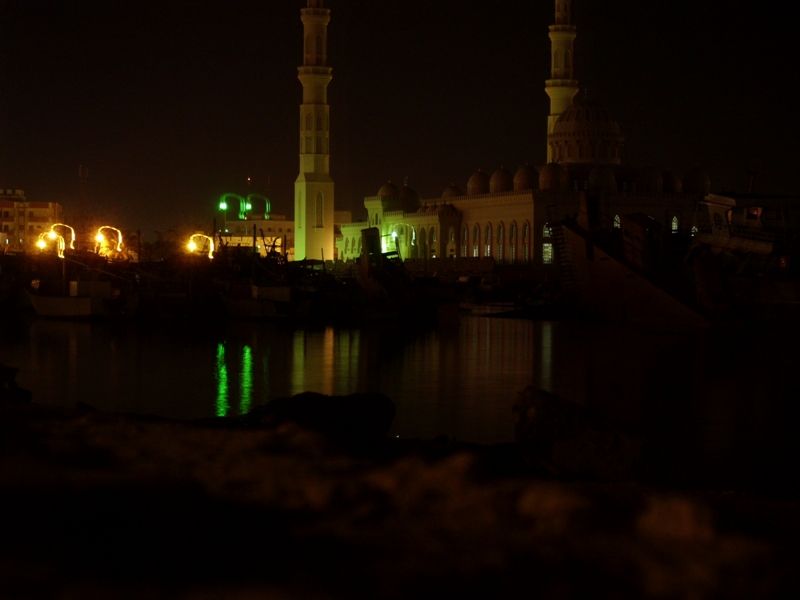
I was out last week during the full moon with K and his family taking a stroll along the end of the Hurghada New Marina. I decided to play around with my camera a little bit, and ended up with these shots which I wanted to share with you.

Full moon over the Red Sea


Mosque at night!

Fishing Trawlers docked for the night

Hurghada at night

Red Sea Dream


[All photos copyright Susan Richards-Benson. Photos may not be re-produced without express permission] 

Saturday, March 17, 2012

Where to Go - Lips 4 U

I'm sure this is a grievance that many women, particularly expat women, have living in Hurghada. It is nigh on impossible to find decent make up without paying through the nose for it. Sure, the pharmacies dotted on virtually every street corner throughout the city offer cheap knock-offs and 5 LE mascara, but for those looking for make-up that will actually last past the first application, these are out of the question.

When you do find shops that sell brand make-up, such as Max Factor, L'Oreal, or Estee Lauder, the prices are astronomical. I understand mark-ups for importation prices, but I am not willing to pay close to $40 for what would normally cost $15 dollars outside of Egypt.

With this in mind, I was pleasantly surprised to find Lips 4 U. Located on the street parallel to Sheraton Road, between Central Street and Metro Market, Lips 4 U offers a wide range of make-up and beauty products both imported and local to Egypt. Not only this, but their prices are extremely fair!

I managed to find a bargain deal on a new Max Factor mascara, marked at 70 LE. Considering I have seen this same mascara for sale priced at 150 LE, you can't go wrong.

Lips 4 U is owned and operated by Taru, who has recently moved to Hurghada from Sweden. Taru speaks excellent English and is more than willing to let you browse and look around. I loved this, as so often in stores here you feel that the sales associates have to act like your shadow, making the entire shopping experience far more stressful than it needs to be. For me personally, when I want to browse I like to be left alone :p

Taru also offers appointments for manicures (Gel nails), and hopes to eventually branch out with Lips 4 U. I wish you all the best!

For more information, contact Taru on 0106-617-2608. 

Where to Go - Golden Pet

Golden Pet is among the few pet shops in Hurghada worth recommending. Located just behind the Metro on Sheraton Street, Golden Pet offers a wide variety of pet accessories, food, and toys.

Image courtesy of Golden Pet

What sets this shop aside from the multitude of other pet stores around Hurghada is their strict policy against selling pets. Many Hurghada residents will abide by a boycott of any shops that sell animals due to the fact that these often come from breeders who neither care about the welfare of their animal, nor where it eventually ends up. Golden Pet offers birds for sale, kept in spacious cages, and that is it.

Some of the items they offer include dog leads and harness, cat accessories, dog and cat beds, and a wide array of food. They offer imported pet food from Italy, the Egyptian brand Canido (which I would never recommend), and the popular Pro Pac and Sport Mix blend that many owners feed here. Alongside this they offer bird seed and wet and dry cat food.

Staffed by friendly individuals always willing to help, Golden Pet truly offer pet owners in Hurghada a wide range to choose from. Another great aspect is for those looking to travel with their dogs outside of Egypt, Golden Pet can custom order dog crates of any size for you, and ask only for a 10 day period for delivery.

Their hours of operation are Monday through Friday, 11:00 - 22:00, Saturday from 18:00 - 23:00, and Sunday's from 11:00 - 22:00 .

For more information or to find out if Golden Pet has what you're looking for, contact them at goldenpet.store@gmail.com OR by phone on 011-4885-3833. You can also check out their facebook page here.


Wednesday, March 14, 2012

Construction: Hard Manual Labor in Egypt

Anyone that has been to Hurghada knows as well as I know that the town is constantly expanding and growing. As more people move to the city, more buildings are put up to accommodate the swelling population. This often means that old villas are knocked down to make room for apartment buildings in their stead.

One of the reasons K and I chose where we live is due to the fact that the majority of the buildings surrounding us are already complete. I for one do not want to feel that I live in a construction zone. Next door to us stood the frame of an apartment building that has been standing for 25 years.

As tourism in Egypt begins to rise again, construction in Hurghada has gone back into full swing. However, a law passed last year by the government banned any further sale of land in the Hurghada area, meaning that if you planned to construct a new apartment building, you were required to do so on pre-purchased land. A typical sight throughout Egypt is the frame of a building, or a partially completed building with steel beams and wires protruding from the top. There are a few reasons behind this. First and most obviously, the owner of the building ran out of funding, and was forced to halt construction until more funds became available. Secondly, the apartment is often bought by a family who has given birth to a son, and left empty until such time that the son grows up and himself marries, at which point construction on the apartment will be completed and the son and new bride will move in. Thirdly, leaving the building to appear under construction is a tax write off and thus saves the owner a great deal of money.

The credit crunch in Egypt lately has left a lot of building owners struggling to cover the over-head costs of property ownership. A convenient trade has sprung up as a result of this, namely the trade in steel construction parts and concrete. Such is the case for the building next to us, and lead me to witness construction in Egypt as I never really had before.

The CAT was the only 'heavy machinery' used in the
entire process
Now, the "building" next to us was no more than a frame. This frame is held together by steel rods and concrete blocks which themselves constitute a huge over-head cost of any construction project. Gaining access to the steel beams requires knocking the frame down. This was lesson number one; watching the frame of an apartment being knocked down, and wondering why, until I learned that rather than let the frame sit stagnant the owner could make a profit off of it and sell off the construction parts.

The first piece of machinery to be brought in was a Caterpillar demolition tool. Resembling an enormous spike, hydraulic arms cause rapid pumping of the demolition arm, enabling it to easily break through rocks and cement to get at the steel underneath. Remarkable is that this was the only piece of heavy machinery used in the entire process. The Caterpillar was individually owned, and the owner informed us that he should have the building down in 2 days. [Lesson learned: When it comes to construction in Egypt, if they tell you 2 days, interpret that to mean 2 weeks. 2 weeks of non-stop noise starting at 8 am in the morning left us less than happy campers, but I digress].

The next step was the extraction of the steel beams from inside the concrete blocks. The CAT would break the concrete beams into bricks that were about 1 foot in diameter. Then the hard manual labour takes over.

You can see the steel rods protruding from the blocks
Egyptian construction workers use a mallet to repeatedly strike at the brick to remove the steel frame. Rotten steel is tossed away, and steel that can be re-used is set to the side for the next step in the process.

A little further away from the construction site are what appear to be wooden beams erected into the sand. These beams are in fact going to be used to straighten out the crooked steel beams in order for them to be used in the next construction site. Working with this wooden beam, a worker takes the steel rods and with a small hammer bangs the rod out straight. Using no more than a wooden beam and a hammer, gradually a pile of straightened steel rods grow on the side.

2 workers work to straighten out the 'tangle' of steel rods
next to them. On the ground you can
see the straightened ones.

Once the CAT has brought the building down, the workers begin to sift through the rubble to pull out the extra rods of steel that may have been missed. This alone took almost two days. Once the area was cleared, the CAT was brought back in, with a new tool attached, and began the process of loading up dump trucks with the rubble to be transported for processing.

Sifting through the rubble for stray steel rods.
 
Overall it was an exceptionally eye-opening experience in how the construction process works in Egypt. I should add however, I have to question how many of the 'new' buildings around the area are in fact constructed using old materials...and if these materials are ever put through safety tests to ensure that they are fit to use again. I probably shouldn't bother asking, as I know what the answer would be :p


Friday, March 9, 2012

Women in Egypt march for their rights

Yesterday marked International Women's Day. As women around the world contemplated how their roles in society have evolved over the past 100 years, women in Egypt were fighting to see the rights they long struggled for remain firmly in place.

The increasing number of Islamists in the Egyptian Parliament is giving many women in Egypt a reason to be worried. As many Salafists MPs have announced they would never back a female presidential candidate, and hold the potential of restricting women's role in society, Egyptian women fear that their margin of freedom in the country might be coming to an end.

Thursday saw women in Cairo take to the streets to demand their freedom and their rights. As March 16th marks Egyptian Women's day, the next week is sure to carry many headlines of women campaigning throughout the country.

Below is an article by MSNBC, commenting on the uphill battle that women in Egypt may face in the coming months as we all watch with bated breath to see just how much more power the Islamists will be afforded.


By Charlene Gubash

CAIRO, Egypt – International Women's Day took on special meaning for the more than 1,000 Egyptian women who braved harassment to march through downtown Cairo Wednesday.

The demonstration was sparked by the belief of many women that the recent political victories by socially conservative Islamists, who now control over 70 percent of the parliament, will eventually undermine the few hard-fought rights they have won.

“The situation is going backward,” complained flight attendant Nadia Salim. “The Salafists (conservative Islamists who believe in a strict interpretation of Sharia law and that women should have a limited role in society) and Muslim Brotherhood will bring us back 100 years.”

Trying to preserve existing rights

The women said they took to the streets not to gain more rights, but to preserve those they already enjoy.  "We have to hold onto what we have because of the Salafists and Islamists," warned university professor Iman Azzad.

Their main demand is that women should make up half of the committee that will draft Egypt's new constitution.  Women fear that the Islamist majority will take away their right to divorce and to win custody of their children

"Women are half of society," said Salim. "Why shouldn’t we form half of the constitutional committee?"

Activist Dina Abou El Soud said she had heard that the country’s judges had plans for women to make up only a 10 percent of the panel shaping Egypt's next constitution. She believes women's rights will be the first thing to be sacrificed in order to please the Islamist majority.

It’s a sea change from the ousted regime of President Hosni Mubarak, when women were guaranteed 64 parliamentary seats.  In the latest post-revolutionary elections, the quota was eliminated and women won only five seats.  "The other seats went to the Muslim Brotherhood and Salafists," said El Soud, co-founder of the Revolutionary Women's Coalition, which has 4,000 members on Facebook.

 "We are going backward, backward and backward," she added as she passed out fliers in English and Arabic. "It is time to make a women's revolution”

El Soud also said that Islamists are trying to discredit existing women's rights by suggesting they were imposed by the Mubarak regime, deriding them as "Suzanne Mubarak's Laws,” the name of the former first lady.

"It’s ridiculous. They are international women's rights that we have gained,” she said.

Ready for drastic measures

Considering what Egypt's roughly 40 million women stand to lose, Wednesday's turnout was miniscule. Mahy al Aref, a well-dressed pharmacy graduate, said the small crowd was probably due “a lack of educational awareness.”

She said she is worried about putting her German university degree to good use in an increasingly conservative society, a concern shared by her mother, Magda al Akkad, who runs an NGO. "I am worried because of the Islamist direction,” she said. “They have their ideas. I don't know where it will go, but I don't think they will be fair to women in general."

Al Akkad said she said she can foresee a day when Egypt would become unlivable for her and her daughter.  "If fanatics rule, I will leave this country,” she declared.

Monday, March 5, 2012

Cattle Dying in Egypt's Suez Canal


Live exportation of animals is a contentious issue around the world. Stories of animals trapped on ships being refused entry into ports around the world is unfortunately not a new issue. The last incident involving a live export gone wrong occurred in 2010, when an Australian cargo ship transporting live cattle and sheep heading for the Egyptian port of Ain Sokhna decided to simply dump the carcasses over the side of the boat. This incident is believed to have triggered the 2010 shark attacks off the coast of Sharm el-Sheikh, and caused un-calculated damage to the environment of the Red Sea.

The most recent incident involves the MV Gracia Del Mar. Although registered as a Panamanian ship, the Gracia Del Mar departed from Brazil with a cargo of over 4,000 live cattle. Recently converted to a livestock vessel, the MV Gracia Del Mar allegedly had issues with ventilation in the animal hold area, causing over half of the cattle on board to perish.


The sheer volume of cattle that perished on board caused Egyptian authorities to deny port access for the ship. Accordingly, the vessel has been docked in the Red Sea entrance to the Suez Canal. It has also been denied entrance into Djibouti and Sudan for the same reasons.

Australia has a Memorandum of Understanding (MoU) signed with Egypt permitting the importation of live exports from Australia. As such, they are heading up the charge to try to allow the remaining cattle on board entrance into Egypt.

Animals Australia director Lyn White was quoted saying to an online publication that "Animals Australia has been working overnight with international colleague groups to find refuge for the surviving 2,000 cattle after Egyptian authorities refused to allow the animals to be unloaded...This is nothing short of an animal welfare disaster. If remaining cattle are not offloaded more of these animals will suffer appalling deaths at sea. We are appealing to authorities in Egypt to offload the remaining cattle at al-Sohkna, as was originally intended." 


White pointed to an incident involving an Australian live export ship, the MV Cormo Express carrying a cargo of sheep, where the refusal of one country after another to allow the ship to dock resulted in the death of 5,000 sheep. 


You can help let your voice be heard in this ongoing catastrophe. Email the following text to info_malr@agr-egypt.gov.eg


Dear Minister
                   It has been reported that 2750 cattle have died on board the livestock vessel Gracia Del Mar. According to the report the animals are continuing to die on board this ship . The report states that the cattle have been refused port entry in Egypt, Djibouti and Sudan because of the amount of dead or dying cattle of board .

The Egyptian Authorities must take action now to allow this ship to land so that the animals can be given veterinary or , were necessary, humanely euthanized . Such action is essential to prevent even more suffering in what has become a major animal welfare disaster.


Tuesday, February 28, 2012

Where to Go - Ban Sabai

Recently, I have read more and more about beauty spas and massage parlours being shut down throughout Egypt and the Middle East. Often seen as 'inappropriate,' the perception of most massage parlours is one of quiet tips and off-menu services. This is not always the case however.

Ban Sabai is a wonderful little massage parlour located just across the road from Old Vic. Run by two ladies who moved to Egypt from Thailand, Ban Sabai boasts a wide array of traditional Thai massages, with all ingredients that are used directly imported from Thailand. 

I decided to splurge the other day and went for an Aromatherapy Thai massage. It was absolutely divine. Pisan, the massage therapist, was the epitome of professional. I would highly recommend anyone looking for a massage to check out Ban Sabai. 

Among massages they offer are: 

Thai massage, 60 min. for 200 LE. 

Thai salt scrub massage, 75 min. for 250 LE. 

Pain relief massage, 50 min. for 200 LE. 

Not to mention the traditional aromatherapy massages and foot reflexology! For more information or to book an appointment call: 0127 8392 336.