Tuesday, July 2, 2013

Repost: General Abdel Fattah el-Sisi: top brass ready to defend the people

From the Guardian, Ian Black provides a little insight into the man leading the "military coup" in Egypt, Abdel el-Sisi.

General Abdel Fattah el-Sisi, architect of the military intervention inEgypt's worsening political crisis, was little known outside the army when he was appointed Mohamed Morsi's defence minister last August — part of the Islamist leader's deft consolidation of power.
Sisi, a career soldier, was head of military intelligence and the youngest member of the 19-strong Supreme Council of the Armed Forces. But despite coming from the heart of the security establishment he had a reputation for being sympathetic to the Muslim Brotherhood — the reason, many Egyptians assumed, Morsi chose him for the job. Sisi is said to be a religious man, and his wife, unusually, wears the full niqab (face veil.)
Mohamed Beltagy, a senior Brotherhood figure, has described receiving a "brotherly" warning from the intelligence chief about an impending attack by regime thugs on demonstrators in Tahrir Square in what became known as the "battle of the camel" — one of the brutally defining moments of the revolution that overthrew Hosni Mubarak, in February 2011.
But Sisi also attracted criticism for appearing to defend the behaviour of the armed forces in detaining and beating women protestors who were subjected to strip searches and "virginity tests" and threatened with prostitution charges.
Sisi, born in 1954, was a relative youngster in a military dominated by elderly officers with extensive privileges and a traditional view of their place in Egyptian political life. Field Marshal Hussein Tantawi, who he replaced, was in his late 70s. Sisi, promoted two ranks, reportedly shook like a leaf when Morsi told him to "behave like a man" and take the job, while Tantawi waited in the next room.
Eyebrows were raised when Sisi decided to allow Islamists to enter the Egyptian military's officer training academy — when it had always insisted before that cadets were unimpeachably apolitical. Opposition suppprters point out that as army intelligence chief, Sisi was privy to classified information about the Muslim Brotherhood and more radical Islamist groups, as well as links with Hamas.
Just days before Sisi was appointed, jihadis in Sinai attacked Egyptian border guards, killing 16 and humiliating the armed forces — underlining the dangerous gaps in security in the messy post-Mubarak transition.
Sisi, an infantry officer, was trained at the UK Joint Command and Staff College and did a masters degree at the US army's War College in Pennsylvania.
He is said to have "experienced firsthand the aggravation of officers who watched huge amounts of money squandered on projects that lined the pockets of the high command but left the soldiers unable to fight effectively."
He is also described as enjoying close relations with the US military as well as Saudi Arabia, where he served as a military attache. Inside the army, some critics reportedly believe he has been too soft on the Brotherhood.
Last December, the new Egyptian consititution [sic] gave the military greater autonomy than it had ever enjoyed before but relations with the Brotherhood worsened as public disenchantment with Morsi grew and the army polished its own PR. Sisi warned of intervention a week before the 30 Juneprotests. Now he is at the centre of a high stakes struggle for the future of Egypt.

Morsi's Short Term Memory

A brilliantly insightful post from The Economist as everyone is waiting with bated breath to see whether Mr Morsi will respond to the Egyptian Army's 48 hour deadline.


Source
WHAT would you do if millions of citizens poured into streets demanding that you go? On television during his election campaign last year, Muhammad Morsi answered without hesitation. First, he said, people would not demonstrate against him because as president he would faithfully represent their will.  “But if they do,” he added firmly, “I would be the first to resign.”
But Egypt’s first freely-elected president has not resigned, yet, despite nationwide protests on June 30th that were far bigger than those that brought down his predecessor, Hosni Mubarak, two and a half years ago. Not only did the vast crowds bring every major city in Egypt to a standstill, amid an impromptu general strike. In scores of villages and provincial towns, protesters invaded government offices and shut them down by force, as police looked on approvingly. They also invaded, torched and looted the Cairo headquarters of the Muslim Brotherhood, the secretive fraternity that nurtured Mr Morsi and carried him to power. Five of his own ministers resigned, too, the latest in a long string of defections in the 12 months since Mr Morsi took office. 
As if still more prompting were needed, on July 1st, Egypt’s army issued an ultimatum. If the country’s bickering civilian politicians do not find ways to meet people’s demands within 48 hours, it said, the army will issue its own political road map for them to follow. Given the extreme polarisation of Egypt’s politics, and the accelerating evaporation of the Brotherhood’s constituency, there does not seem to be much incentive for Mr Morsi’s opponents to compromise.
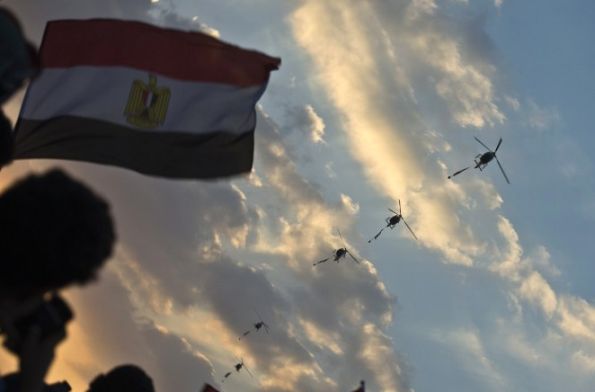
For hundreds of thousands of Egyptians who came out for a second day of cheerful protests, there was no doubt what the army’s diktat meant: Mr Morsi is finished. Lending further credence to this supposition, a squadron of army helicopters, each trailing a giant Egyptian flag, circled Cairo’s Tahrir Square in a triumphant show of force that was met with roars of approval. The military also paid an unannounced visit to the Nile-side headquarters of Egypt’s state broadcasting system. The officials Mr Morsi had appointed to run Egyptian TV and radio quietly exited. 
Despite the army's insistence that its ultimatum does not amount to a coup, some have already declared its intervention a “soft coup”, not unlike its move, in 2011, to usher Mr Mubarak out of power. The military lingered too long then, during the tumultuous transition before Mr Morsi’s term, earning opprobrium for human rights abuses and general ham-fistedness. But a precipitous slide in Egypt’s economy under civilian rule, accompanied by lawlessness and corruption, has aided in shortening memories. With Mr Morsi’s administration having signally failed to tackle the country’s myriad and deep problems, opposition to it has snowballed over recent weeks into an avalanche.
Opinion polls from before the recent protests gave Mr Morsi an approval rating of around 30%. This has certainly now shrivelled as even fellow Islamists have abandoned a clearly sinking ship. Still, the Muslim Brotherhood has hundreds of thousands of active members, and millions of sympathisers. Containing their unhappiness will be a pressing challenge.
Egypt’s military has not revealed what its “road map” might look like. Most analysts expect that, having absorbed lessons from its last intervention, the army may this time both act more forcefully and set a quicker pace. The expectation is that its goal will be a return to civilian rule, under a revised and more inclusive constitution than the one that Mr Morsi hastily forced through last year. But despite the sudden eruption of public enthusiasm for the army, worries do linger. Could it be that now, armed with massive public backing and having dispensed with the Brotherhood, the only civilian party strong enough to challenge them, Egypt’s soldiers may be tempted to stay in power?
(Picture credit: AFP)

Monday, July 1, 2013

Hurghada Protests 30th June

To follow up on yesterday's photos, find below some videos from the protests in Hurghada.


All rights reserved
K
01Aspects©

Sunday, June 30, 2013

Protests in Egypt

Just a few snapshots from the protests today, in Cairo and in Hurghada.

Image courtesy of N. Mobariz. Maadi, Cairo 30.06.2013

Image courtesy of N. Mobariz

Image courtesy of K. Mobariz. Hurghada 30.06.2013

Image courtesy of O.Sayed. Hurghada 30.06.2013

Pressure on Independent Media Outlets Mount

Unfortunately there have been more than a few reports circulating in the past few days of attempts to shut down a media outlets in Egypt, most prominently being OnTV which is notorious for providing live updates on protests around the country. One such media outlet that has fallen victim to the increased pressure is the Arab West Report, my former employer, whose website was hacked last week leaving their website inaccessible. To this day, an error message pops up when trying to access the site.

This is a great shame as AWR always tried their hardest to provide unbiased news reporting, and would often post investigative reports detailing the "hidden" side of stories related to Muslim-Christian sectarian tensions. The hacking of AWR's website is just one further indication of the worrying stifling of independent reporting in Egypt.


Tensions increasing;
our websites have been hacked

 
Protesters at Tahrir Square chanting anti-President Mohamed Mursi slogans, June 28, 2013.
(Photo by Asmaa Waguih/REUTERS, trough nydailynews.com) 

AWR Cairo, June 29, 2013
 

Our websites have been hacked
 
On Thursday, June 27, our websites were hacked and can no longer be accessed by our IT staff. It seems like our dedicated server in Roubaix/France was hacked completely and the system and the data can no longer be accessed.
 
This also applies to our other websites cawu.org (http://cawu.org/), cidtegypt.com(http://cidtegypt.com/) and others, as they are running on the same system.
 
This means we will have to completely rebuild our website and copy all our data from our backup. This can take up to three days. 
 
Our IT-staff are working on this night and day.
 
We very much regret the inconvenience this has caused and hope to serve you again as soon as possible. 
  
Cornelis Hulsman,
Editor-in-chief Arab-West Report
 
Dieter-Müller-Ehrhard,
IT-Manager

Tips For Finding Pet-Friendly Accommodation in Egypt

On a lighter note for those in Egypt looking to find accommodation with pets, it can be an exceptionally difficult situation. The article below, submitted by Jenny Hart, provides a little insight for those of us in Egypt seeking pet-friendly accommodation. 

Finding Rental Accommodation Is a Struggle for Pet Owners
In Egypt we own around 178,000 pets, but perhaps one of the reasons why we don’t keep more cats and dogs is the difficulties faced by tenants in search of rental accommodation that welcomes animals. While it’s possible to see the situation from a landlord’s point of view, as potentially an untrained dog or cat could be destructive when in their property, it is frustrating for those of us who are responsible owners. Our pet would be unlikely to cause any more damage than a child might and rarely do landlords turn families away who have young children. So what are pet owners meant to do who are in the position that they need to rent their home?
Image source
Options for pet owners
While some renting property try to conceal their cats, dogs or other small animals, this is a risky step to take, as if found to be in breach of your contract the landlord is within their right to ask you to leave their property and with a bad reference the task of finding new accommodation becomes harder still. If it looks like you are going to struggle to find a landlord to take on both you and your pet, you may need to consider whether you could ask a willing member of family or a friend who owns their own home to keep them until you can find a more animal friendly rental. However, this option or the alternative of finding yourself without any accommodation is not appealing. Perhaps the key to securing a rental where you can openly keep your pet is to demonstrate to your landlord that your pet will be no trouble.
Demonstrating responsibility
While a landlord may have questions of their own they wish to ask to determine whether you and your cat or dog will be suitable tenants, in other cases you can cover the areas that will put their mind at ease. Highlighting that your pet is house trained, receives daily exercise, is not left for extended periods home alone and that you have taken all the steps to keep your companion in good health demonstrates your pet is less likely to be a risk to their property. Offering for your prospective landlord to meet your dog or cat is another good way to influence their decision in your favour, as seeing that your animal is indeed well behaved should help to convince them of your suitability.
Charges and expectations
When you find a landlord willing to accept you as a tenant with pets, it’s almost inevitable that you will pay more than if you were not renting with a dog or cat. This may mean that your refundable deposit is greater to cover potential repairs that may be needed or that you are required to pay a charge to offset professional cleaning costs when you vacate the property. In other instances, each month your rental payment could be higher, though some pet owners feel that this additional cost is worth it if they have found a pet friendly landlord. Especially if you are paying a premium for your accommodation, don’t be afraid to ask your landlord about reasonable issues that they should be prepared to deal with when renting to pet owners. For example, if the property has outside space with a fence that is in disrepair, they should be willing to fix this to prevent the escape of your dog. Equally, inside the property if they haven’t provided chair covers or a vacuum capable of dealing with pet hair, they should address this too to allow you to keep the property clean.
Benefits to landlords
Landlords would be wise to remember that by excluding pet owners they are missing out on the opportunity to rent to a greater audience, so they possibly may have periods where their property stands empty if they don’t cast their net wide enough for prospective tenants. Not only this, but landlords forget that when people find accommodation that welcomes their pets they will tend to stay for a longer period of time, so the cost and trouble of finding new tenants is reduced. Therefore it is not just tenants set to gain from the wider availability of pet friendly rentals, landlords are also in a better position, which may sway more of them to consider accepting pet owners.

Follow Egypt Protests Live

 For anyone wanting to keep a close eye on things as they unfold in Egypt today (and likely over the next few days) Cairoscene is providing live updates to keep an eye on the demonstrations around the country. From what I've been told, things in Hurghada are still quiet, but there are protests planned to start there around 5 pm. Will keep this updated, but in the meantime please check out Cairoscene's live updates here.